Categories more
- Adventures (62)
- Arts / Collectables (14)
- Automotive (77)
- Aviation (65)
- Bath, Body, & Health (123)
- Children (6)
- Cigars / Spirits (71)
- Cuisine (66)
- Design/Architecture (22)
- Electronics (63)
- Entertainment (36)
- Event Planning (115)
- Fashion (45)
- Finance (10)
- Gifts / Misc (6)
- Home Decor (118)
- Jewelry (41)
- Pets (3)
- Philanthropy (1)
- Real Estate (16)
- Services (44)
- Sports / Golf (14)
- Vacation / Travel (85)
- Watches / Pens (33)
- Wines / Vines (34)
- Yachting / Boating (67)



2026-06-18 Which Electric Breast Pump Features Matter for Your Routine


Published
09/15/2026Which Electric Breast Pump Features Matter for Your Routine
The best electric breast pump for your situation depends on how you actually pump, not on which spec sheet is longest. A mom who needs silence in a conference room has different priorities than one who pumps five times a day at home, and neither of them needs what someone pumping once a week as a backup actually needs.
Four pumping routines each point to a different feature priority. Underneath all of them, three specs matter regardless of how often you pump. Starting with your own routine makes the decision a lot more specific.
This article is for general informational purposes only and is not medical advice. For personalized guidance, please consult a healthcare professional or a certified lactation consultant (IBCLC).
Your Pumping Routine Shapes What You Actually Need
When you're away from your baby or exclusively pumping, the CDC advises pumping as often as your baby would typically drink breast milk. [Source: CDC, "Pumping Breast Milk," Feb 2026] For newborns in the early weeks, that's generally 8 to 12 times per 24 hours. [Source: CDC, "How Much and How Often to Breastfeed," Apr 2026] That rhythm shifts as your baby grows, but the underlying principle stays the same: consistency in milk removal is what signals your body to keep producing.
Frequency is only half the picture. The other half is context: where you pump, how much time you have, and what would actually stop you from doing it. Whether noise matters depends almost entirely on where you pump. In a private home setting it's rarely a concern, but in a shared workspace it tends to be the first thing that makes a pump unusable. Features only matter to the extent they solve your real problem.
Here's a quick way to locate your routine before the detail:
|
Pumping Routine |
Typical Daily Sessions |
First Priority Feature |
|
Commuting / Office |
2–3 |
Wearable form + quiet operation |
|
Nighttime pumping |
1–2 |
Fast warmup + low-light alignment |
|
Occasional use |
As needed |
Easy cleaning + flange comfort |
|
Exclusive / high-frequency |
5+ |
Bilateral efficiency + heat and vibration |
Feature Priorities for Four Pumping Routines
Commuting and Office Moms
If you're back at work and fitting pump sessions around your calendar, the in-bra wearable form isn't optional. A pump that requires external tubing, an outlet, or 20 minutes of complete stillness will lose against your meeting schedule within two weeks.
The first priority is an in-bra form with a secure seal. A double-sealed flange means you can move between rooms, bend to pick something up, or shift position without worrying about leaks. Second priority is noise. The American Speech-Language-Hearing Association identifies 40 dB as roughly equivalent to a quiet room. A pump operating at or under 46 dB is generally inaudible in a standard office environment. [Source: American Speech-Language-Hearing Association (ASHA)] Below that threshold, you're not creating an obvious moment when the pump kicks on.
Third is app control. Being able to adjust suction level from your phone without touching the device means you're not visibly managing hardware during a call. For charging, a case that covers a full workday without needing a wall outlet is the practical difference between a pump that works and one that sits in a bag.
Feature priority: in-bra form, quiet operation, app control, all-day battery.
Nighttime Pumping
Night pumping has a specific problem set: you need to do it without waking anyone up, without turning on lights, and without a setup complicated enough that you skip the session because you're too exhausted to figure it out at 3 AM.
Noise is still priority one, for the same reason it matters in an office. At night, the bar is even lower. A partner or baby sleeping nearby means any avoidable sound matters.
Second priority is alignment in low light. A built-in nipple light that shows you the tunnel position without a bedside lamp is one of the most practical design choices for nighttime use. At 3 AM, every step that disappears from the process increases the odds you actually finish the session. A 360° transparent tunnel serves the same purpose: you can see what's happening without adjusting the lighting for everyone else in the room.
Third is fast warmup. Heat around the breast supports milk let-down and flow. When warmup takes 15 seconds instead of several minutes, you're not sitting half-awake waiting. As beta user @Lili Macias described after testing the eufy S2 Pro: "Having a full egg with a light is definitely aesthetic and motivating for those late-night pumps!!" [Source: @Lili Macias, eufy Pump Beta User, eufy.com/eufy-breast-pump-s2-pro, "Moms Like You, Pumping Their Way"]
Secondary consideration: parts count. Fewer parts to rinse before bed is a small thing that compounds every night.
Feature priority: quiet operation, low-light alignment, fast warmup, parts count.
Occasional Pumping
If you're building a small freezer stash or only pumping when you need to be away from your baby, the features that make each session easier to start and finish matter most.
Flange comfort is first. A 2024 pilot study published in the Journal of Human Lactation found that participants using standard fit flanges "had significantly less milk output (mean difference = −15.0 g, 95% CI [−25.0, −5.0]) and less comfort" compared to those fitted with individually sized smaller flanges. [Source: Anders LA, Mesite Frem J, McCoy TP. J Hum Lact. 2025 Feb;41(1):54-64. Epub 2024 Nov 30. PMID 39614713] For occasional pumpers who haven't dialed in their fit, the default flange shipped with most pumps is often too large. A liquid silicone flange with a wide-angle design (like the dual-sealed build on the eufy S2 Pro) reduces the contact pressure that makes infrequent sessions feel uncomfortable.
The second priority is parts count. Five parts per side versus eight or more doesn't feel significant on paper. But if you're washing components at 11 PM after two uses this week, the time cost adds up fast. Fewer parts to keep track of also means lower risk of a missing piece making the pump unusable at an inconvenient moment.
Price is a secondary consideration. If you're not pumping daily, advanced vibration massage or a 7-day charging case are real features you may not need to pay for.
Feature priority: flange comfort, parts count, price.
Exclusive and High-Frequency Pumping
Five or more sessions per day is a different workload entirely. Every feature that affects session time and output compounds. A pump that saves five minutes per session adds up to roughly 150 minutes across a week. Output gains compound in the same direction: a 10% improvement across 35 sessions changes how much you can store by the end of the month.
Bilateral efficiency is the starting point: pumping both sides simultaneously with suction you can rely on across multiple sessions a day. Everything else in this section builds on that.
The second priority is where high-frequency pumping separates from the others: targeted vibration and heat for letdown support and duct health. Long-term exclusive pumping increases the risk of engorgement and clogged ducts, especially when pump schedules are compressed by work or travel. Most pumps list vibration as a feature, but whether the mechanism delivers targeted pressure against the tissue or just ambient motor buzz makes a practical difference. The targeted version addresses engorgement and duct clearance more directly. Paired with 360° ring-style warmth that primes letdown before suction begins, the combination can change how each session feels and how much is expressed per session.
Beta user @Erin documented this in her first session with the eufy S2 Pro: "Got 2 oz more than my normal afternoon pump. Ultra comfortable. Easy. Overall wonderful, comfortable first pump." [Source: @Erin, eufy Pump Beta User, eufy.com/eufy-breast-pump-s2-pro, "Moms Like You, Pumping Their Way"]
Third priority is app-based session tracking. If your 6 AM session consistently produces 30% more than your 2 PM session, that's actionable information. If you don't have a record, you're guessing at your own schedule.
Practical note on charging: a case that covers 7 days at 3 sessions daily reduces the number of things you have to manage in a week. Running heat and vibration shortens that window, so it's worth matching the spec to your actual usage pattern.
Feature priority: bilateral efficiency, vibration and heat support, app tracking, charging coverage.
Three Electric Breast Pump Features Every Mom Needs Regardless of Routine
Across all four routines, these three basics apply before anything else.
Flange fit. An ill-fitting flange doesn't just cause discomfort. It causes less milk output, as the Journal of Human Lactation study confirms. [Source: Anders LA, Mesite Frem J, McCoy TP. J Hum Lact. 2025 Feb;41(1):54-64. PMID 39614713] The nipple should move freely in the tunnel without rubbing the walls. If it doesn't, the pump's other features are working against a fit problem that no setting can fix. If you're unsure about sizing, an IBCLC can do an in-person or remote fitting session. "Nipple size can evolve throughout pregnancy and the postpartum period," notes The Lactation Network, "so it's a good idea to consult with your IBCLC to determine the best flange size depending on when you begin to pump." [Source: The Lactation Network, lactationnetwork.com, "Breast pump flange fit: How to find the right size"]
Noise level. 46 dB is the current working threshold for a pump that won't be audible in a typical indoor setting. Any pump worth comparing should list this number on its spec page. If it doesn't, treat that as a reason to dig further.
Parts count. This is unglamorous but predictive of whether a pump stays in use. Five parts per side is achievable with well-designed wearables. If cleaning regularly involves eight or more small components, the time cost accumulates in a way that makes skipping a session feel rational.
What the eufy S2 Pro Covers and Who It Fits Best
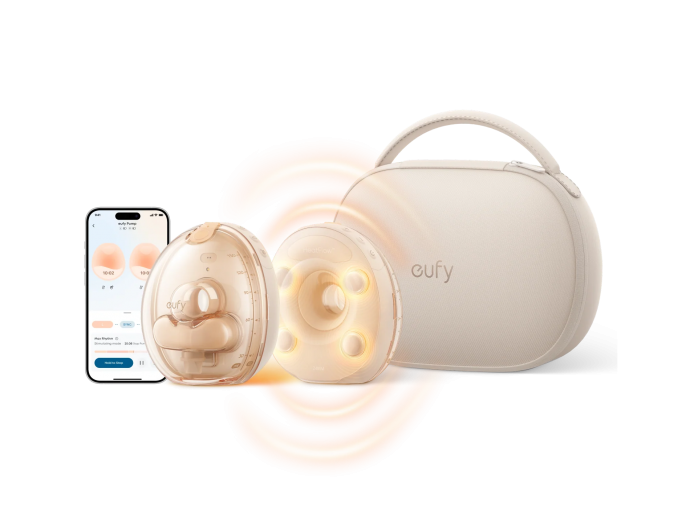
Moms who pump on a tight schedule, fitting sessions between meetings or before pickup, tend to get the most from the S2 Pro. It works across all four routines described above, but its feature set pays off most when sessions are frequent and consistency matters.
|
Pumping Routine |
S2 Pro's Relevant Capability |
|
Commuting / Office |
< 46 dB, in-bra wearable, app control from phone, double-sealed flange prevents leaks during movement |
|
Nighttime |
Built-in Nipple Light for alignment without overhead lights, HeatFlow™ 2.0 reaches temperature in ~15 seconds |
|
Occasional use |
5 parts per side, double-sealed liquid silicone flange, basic modes require no app setup |
|
Exclusive / high-frequency |
VibraPump™ (1.5× deeper impact, 12 mm head), 360° HeatFlow™ 2.0, session tracking via app, 7-day charging case |
Jessica Anderson, IBCLC and CLC, reviewed the S2 Pro and noted: "The eufy S2 Pro is one of the few new wearable pumps that actually makes me feel like the category is moving forward instead of just moving sideways in slightly prettier packaging." [Source: Jessica Anderson, IBCLC, CLC, Genuine Lactation, Apr 9, 2026]
In laboratory testing where both VibraPump™ and HeatFlow™ 2.0 were used together, sessions ran approximately 30% shorter and output was approximately 35% higher compared to pumping without those features active. How much of that carries over to real use depends on your baseline output, how consistently you run heat and vibration, and your session frequency. Actual performance may vary.
Most insurance plans still cover breast pumps. Contact your insurance provider to learn more about your benefits and what's covered under your plan.
If the extended VibraPump™ vibration depth and the world's first wireless charging case aren't priorities for your routine, the eufy Wearable Breast Pump S2 ($369.99) offers the same < 46 dB noise standard, HeatFlow™ 2.0, and 5-part cleaning design at a lower price point.
For the full S2 Pro feature set, see the eufy Wearable Breast Pump S2 Pro.
Conclusion
When comparing pumps, the more useful question is which features you'll actually notice at 2 PM on a Tuesday or at 3 AM after four hours of sleep. A longer spec list doesn't answer that.
For commuting and office moms, that answer is in-bra form and quiet operation. Nighttime pumpers tend to care most about fast warmup and hands-free alignment. Occasional pumpers need a comfortable flange and a quick cleanup routine. High-frequency moms are working with a different set of constraints entirely: bilateral efficiency, consistent heat and vibration support, and session data they can actually use.
Across all four routines, three things stay constant: flange fit, noise level, and parts count. Getting those right before anything else gives the rest of your feature decisions a solid basis.
If budget is tight, prioritize a properly sized silicone flange, a pump at or under 46 dB, and six or fewer parts per side. Advanced features are worth having once the fundamentals are in place. A pump with perfect vibration and a poor flange fit will sit in a drawer.
Still comparing options? Browse the full lineup at the eufy breast pump collection.
Comments
