Categories more
- Adventures (17)
- Arts / Collectables (14)
- Automotive (36)
- Aviation (11)
- Bath, Body, & Health (76)
- Children (6)
- Cigars / Spirits (34)
- Cuisine (16)
- Design/Architecture (22)
- Electronics (13)
- Entertainment (4)
- Event Planning (5)
- Fashion (45)
- Finance (10)
- Gifts / Misc (6)
- Home Decor (45)
- Jewelry (41)
- Pets (3)
- Philanthropy (1)
- Real Estate (16)
- Services (23)
- Sports / Golf (14)
- Vacation / Travel (59)
- Watches / Pens (14)
- Wines / Vines (24)
- Yachting / Boating (17)



7 Hotel Christmas Lighting Ideas for LA Properties

Published
09/28/2026A hotel lobby at check-in is the first real impression a guest forms of an entire stay. During the holidays, that impression sticks, or it doesn't. There's no real in-between. A generic wreath and one sad tree in the corner won't cut it, no matter how many string lights get wrapped around it as an afterthought. Good hotel christmas lighting ideas get guests reaching for their phones before they've even hit the front desk. Miss that window and no amount of extra lights fixes it later.
So what separates the properties guests actually remember? Here's who gets remembered: properties that treat holiday lighting as part of the guest experience, not a box corporate checks off sometime in November. The seven ideas below cover the arrival, the lobby, the exterior, and the small details that separate a property guests remember from one that blends into every other hotel nearby.
Look, budget matters here, and it should. Nobody's asking a boutique property to outspend the resort down the street. Three sharp, well-placed moments beat forty half-finished ones, every single time. Cover every surface instead, and the whole thing reads cluttered in every guest's photo. More isn't the goal.
Why This Matters More For Hotels Than Homes
A homeowner's holiday lighting gets seen by the neighbors and maybe a few visitors over the season. A hotel's display gets seen, photographed, and shared by every single guest who walks through that lobby for six weeks straight, plus everyone who follows the property's social accounts afterward. That's a very different audience. Does a home need the same investment? No. A property with three hundred rooms and a restaurant does.
1. Hotel Christmas Lighting Starts at the Covered Entrance, Not the Lobby
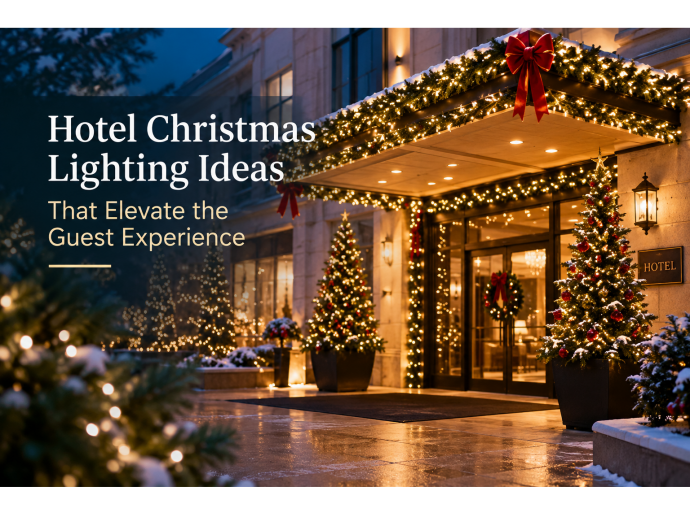
The arrival sequence starts before a guest ever reaches the front desk. A covered entrance wrapped in warm white string lights, with real or high-quality faux garland running along the columns, sets an expectation that carries all the way through check-in, whether the front desk team realizes it or not. Valets and bellhops working under that lighting become part of the impression too. Nobody planned for that, usually, but it happens anyway.
Skip the inflatable decorations and the oversized characters. They read as budget, not boutique, and they date a property the moment trends shift, usually within a season or two. A clean, architectural approach, lights that follow the building's actual lines instead of fighting them, reads as intentional design instead. Properties with a covered drop-off area get an advantage most homes never see: a dry, weatherproof structure that can carry a heavier, more permanent-feeling installation without anyone worrying about a storm undoing a week of work overnight.
2. Layer the Lobby Instead of Relying on One Tree
One large tree in the lobby corner is the default. It's also the least memorable option on this entire list, mostly because every hotel lobby in the country has roughly the same one. Layering does more work. Start with a tree as the anchor. Add garland along the concierge desk. Hang pendant-style lighting over the seating areas. Already running a signature scent program? Fold that in too.
The goal here isn't one photo op guests walk past on the way to the elevator. It's a lobby that feels different depending on where you're standing. Three or four lighting zones instead of one, and guests linger longer at check-in. That matters the second a line forms during peak arrival.
And honestly, it gives staff something to actually talk about. A front desk agent pointing someone toward the tree, or the garland, or that one seating nook, creates a small moment of conversation. A single, static display never does that on its own.
3. Light the Facade Without Turning It Into a Spectacle
Should a lit-up facade look like a completely different building for six weeks? No. A hotel facade lit for the holidays should still look like the same building, just elevated. Roofline outlining in warm white does that on its own. Add uplighting on whatever's already there, columns, arches, stonework, and it beats a wall of color-changing bulbs almost every single time.
The exception is a resort or entertainment-focused property where a bigger, brighter display is part of the brand. For most business and boutique hotels, restraint photographs better than volume. Cvent's own guide to hotel lobby design backs this up: guests form impressions fast. A cluttered display just works against the polish most properties are chasing in the first place.
4. Give the Courtyard or Pool Deck a Reason to Draw Guests Outside
Most courtyards and pool decks just go quiet once winter hits. That's wasted square footage. Guests already paid for it, whether they use it or not. String lights go up overhead, a firepit or a couple of heat lamps keep people out there longer, and a few well-placed lit trees do the rest. Suddenly there's a reason to grab a drink outside instead of retreating straight to the room.
This works especially well for properties with a bar or restaurant adjacent to outdoor space. A courtyard that looks worth sitting in drives incremental revenue that a lit lobby alone doesn't, since guests who linger over a drink outside are guests who spend more before heading up to their room.
Worth knowing: pool decks bring their own problem. Most fixtures aren't rated for the chemical exposure or moisture a pool area generates. Fixtures rated for wet locations, not just outdoor use generally, hold up through a full season without the corrosion that shows up on standard strands by January.
5. The Best Hotel Christmas Lighting Defaults to Warm White
Warm white wins, almost every time. It's the safest and most flattering choice across nearly every hotel's existing color palette and architecture. It photographs well in low light, it doesn't clash with brand colors, and it ages better across a six-week installation than cooler or multicolor strands tend to.
Color still has a place. A single accent, a red or green wash on one architectural feature, or color-changing lights confined to one tree, gives the display a focal point without turning the whole property into a strobe. Thing is, most properties that overuse color end up with a display that looks busy in photos rather than elegant.
6. Build a Designated Photo Moment on Purpose
Guests are going to take photos somewhere on the property. That much is happening regardless of what any hotel plans for. The properties that plan for it just get better photos out of the deal, shared more often, tagged with the hotel's actual name instead of left generic.
A lit archway, an oversized ornament installation, or a well-composed corner with a tree and a bench gives guests an obvious, flattering spot to stop. Here's the thing: an unplanned photo moment usually means guests photograph whatever looks best, which might be a competitor's property across the street instead of yours.
A small sign or subtle branding near the spot, nothing pushy, just enough that a tagged photo credits the right property, turns a nice display into marketing that costs nothing extra to run. Some properties go further and name the installation, giving guests a reason to search the hotel's name specifically when they post.
7. Plan Installation Around the 90-Day Temporary Lighting Window
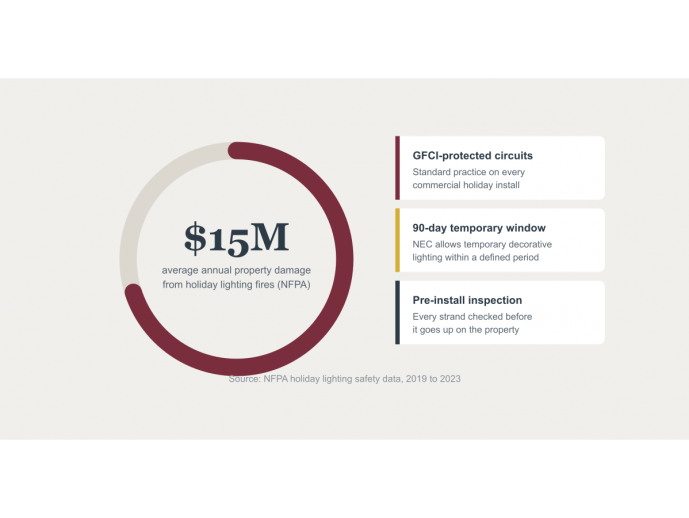
This part isn't optional, even though it's easy to skip past. Commercial holiday lighting isn't the same regulatory category as a permanent fixture, and that distinction matters a lot for a property already managing fire code and insurance requirements year round. The National Electrical Code allows temporary decorative lighting to stay up without the same permitting as a permanent installation, but only inside a defined window, and inspection requirements can still apply depending on the local authority.
According to NFPA's holiday lighting safety guidance, GFCI-protected circuits and pre-installation inspection of every strand are standard practice. Decorative lighting is involved in a meaningful share of holiday-season property fires. For a commercial property with guests on site, that's not a detail to skip.
Because that's really where a hotel's requirements diverge from a homeowner's. A single-family property has one insurance policy and one point of contact. A hotel usually has a facilities manager, a general manager, and a corporate risk or insurance office that all want documentation the installation met code, before a guest ever asks about it.
What This Looks Like Put Together
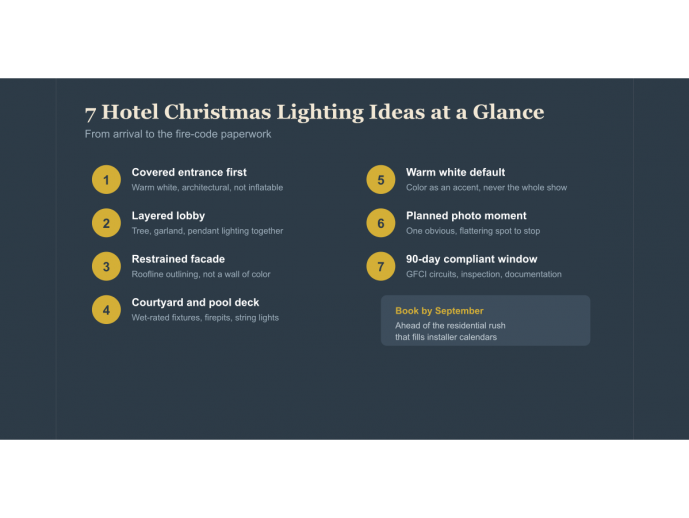
None of these seven ideas work in isolation as well as they work together. A well-lit covered entrance leads into a layered lobby, which opens onto a restrained facade and a courtyard worth sitting in, all of it lit in warm white with one intentional color accent. Add a photo moment guests actually use, installed and removed inside the window that keeps the property compliant, and the whole sequence works as one experience instead of seven separate decisions.
Getting the Installation Right
So commercial hotel christmas lighting ideas only work if the installation behind them is handled by a crew that understands electrical load across a large property, not a residential team scaling up. For hotels and hospitality properties planning a holiday display, the commercial christmas lighting installation team handles design, install, and the removal timeline as one coordinated service rather than three separate vendors.
Retail properties are already thinking through similar decisions this season. The christmas lighting ideas for retail storefronts breakdown covers a parallel set of choices for street-facing commercial properties, useful context if a hotel property also has ground-floor retail or restaurant frontage.
Book by September or early October. Commercial properties that wait until the residential rush fills installer calendars end up choosing from whoever has availability left, not the crew that actually understands hotel christmas lighting ideas built around guest experience, brand consistency, and fire code compliance.
Comments
