Categories more
- Adventures (208)
- Arts / Collectibles (374)
- Automotive (389)
- Aviation (300)
- Bath, Body & Health (739)
- Children (118)
- Cigars / Spirits (278)
- Cuisine (723)
- Design / Architecture (1118)
- Electronics (230)
- Entertainment (162)
- Event Planning (295)
- Fashion (552)
- Finance (198)
- Gifts / Misc (141)
- Home Decor (575)
- Jewelry (409)
- Pets (92)
- Philanthropy (124)
- Real Estate (393)
- Services (223)
- Sports / Golf (213)
- Vacation / Travel (1052)
- Watches / Pens (232)
- Wines / Vines (862)
- Yachting / Boating (9083)



Beyond the Logo: Five Details That Make a Men’s Belt Feel Premium

Published
10/19/2026A premium men’s belt should feel comfortable, fasten securely and look well finished up close. The difference lies in its materials, hardware and construction.
Look at how the strap flexes, how the buckle is finished and how neatly the belt fits your trousers. These five details offer a practical way to compare men’s belts, including vegan options, beyond the logo or material label.
1. Material that feels supple and substantial
A well-chosen strap has enough body to hold its shape without feeling rigid around the waist. Thickness alone is a poor guide: a bulky belt can feel clumsy, while a slimmer construction may sit beautifully with tailored trousers. Pay attention to how the material flexes near the buckle and whether the surface follows that movement smoothly.
Microfiber-based vegan leather is one option worth understanding. It combines a three-dimensional network of fine, nonwoven fibres with polyurethane, rather than relying solely on a surface coating over a conventional textile backing. The quality of both the base and the coating influences how the finished strap behaves.
A 2018 study in the Journal of Engineered Fibers and Fabrics found higher tensile, tear and peeling strength in an experimental split-microfiber material than in the knitted synthetic leather and animal leather samples tested. These findings apply to those samples, not Doshi belts or microfiber belts generally.
Doshi’s men’s vegan belts use microfiber-based vegan leather, bringing this type of construction into styles for both tailored trousers and everyday casual wear.
2. Hardware with the right weight and finish
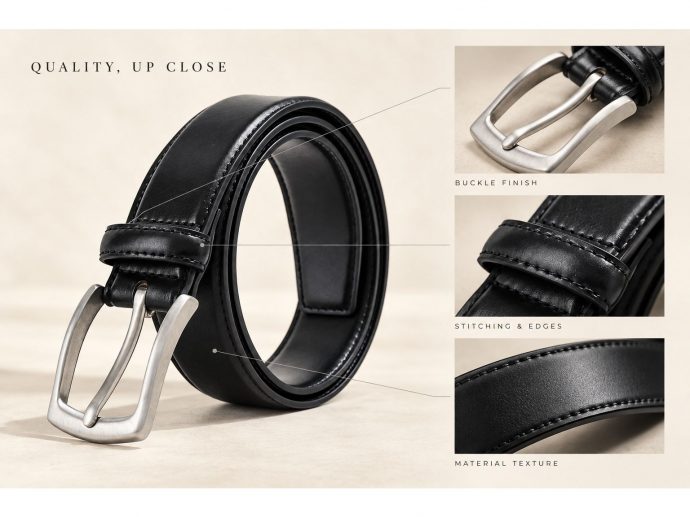
A buckle can change the character of the same outfit. A compact, polished shape feels at home with refined tailoring; a broader, brushed fitting works naturally with denim and heavier fabrics. The most successful choice looks proportionate to the strap and feels comfortable when seated.
Buckle material deserves as much attention as its appearance. Zinc alloy is commonly used for belt hardware because it can be cast into intricate shapes and given a range of plated finishes. The quality of that plating influences how well the surface withstands everyday wear.
Stainless steel offers a compelling premium alternative. Its corrosion resistance comes from a protective film that forms naturally on the metal, as explained by World Stainless. It can still pick up scratches, and any decorative coating has its own wear characteristics, so check the finish as well as the base metal.
Doshi pairs its microfiber-based vegan leather straps with stainless steel buckles across several dress and casual styles, showing how both strap construction and hardware contribute to a belt’s overall quality.
Look closely at the underside, too. Smooth edges, a securely attached prong and fittings that sit neatly against the strap are details worth checking, whatever the metal.
3. Finishing that holds up to close inspection
Turn the belt over. Its reverse side and edges often reveal as much as the front. Where stitching is used, look for an even line and consistent spacing, particularly around the buckle attachment. Edge finishing should appear smooth and continuous, without obvious lifting, rough patches or exposed adhesive.
Cleanly cut holes and a neatly finished tip contribute to the overall impression. A keeper should hold the loose end without forcing it into an awkward angle. These are small details, but they affect an object that is handled, threaded and fastened repeatedly. Decorative stitching is optional; careful assembly is the more useful consideration.
4. Fit that makes the belt disappear into the outfit
For a traditional belt with holes, fastening near the centre hole usually leaves useful adjustment in both directions. The tail should pass neatly through the keeper and trouser loop without becoming a distracting length of strap. Ratchet and other adjustable systems work differently, so judge each by how securely and comfortably it fastens.
Follow the maker’s measuring instructions rather than assuming that trouser size translates directly into belt size. Check width against the loops on the trousers you actually wear. A beautifully finished belt loses much of its appeal if it presses into the waist, catches on a loop or needs constant readjustment.
5. Versatility through texture and proportion
An everyday belt earns its place by working with the wardrobe around it. A restrained buckle and a smooth or subtly grained surface can move easily between chinos and tailored trousers. A more pronounced texture or substantial fitting can give casual clothing a stronger finishing point.
Colour should relate to the shoes and the outfit’s level of formality, without requiring every accessory to match exactly. Consider the finish of a watch or bag fitting as well. The aim is coherence: enough connection between the elements that the belt looks deliberately chosen.
A better measure of luxury
The appeal of a premium belt becomes clearer through wear. Its material feels comfortable, its fastening works easily and its proportions make sense with familiar clothes. Whether made from animal leather or a carefully engineered alternative, it should reward attention beyond the first glance. The strongest statement is often how little needs correcting once it is on.