


In March 2026, the intellectual property analytics firm PatentVest published a sector review counting roughly forty amylin-focused development programs running across the pharmaceutical industry, supported by more than USD 19 billion in deal value committed over the preceding eighteen months. One transaction accounted for USD 10 billion on its own, when Pfizer acquired a Phase 1 amylin analog bundled with a Phase 2 GLP-1 asset. Sums of that size rarely attach to a single receptor family. They mark the point at which a corner of peptide chemistry that spent two decades as a specialist curiosity turned into one of the most heavily worked areas in molecular science.
The consequences run well past corporate balance sheets. Capital concentration of that kind changes what laboratory scientists study, which comparators they need on the bench, and which molecules end up as the fixed reference points of an entire literature. Cagrilintide sits close to the center of that reorganization. It is a compound studied strictly as a research material, in vitro and in preclinical systems, and everything below describes laboratory investigation rather than any application in people.
The Market That Pulled Peptide Chemistry Into the Mainstream
Analysts disagree about the size of the peptide field, but not about its direction. Global Market Insights valued the global peptide therapeutics market at USD 49.7 billion in 2025, up from USD 46.4 billion in 2024, and projects it to reach USD 100 billion by 2034 at a compound annual growth rate of 8.1 percent. Precedence Research draws a more conservative curve from a slightly higher base, putting the 2025 market at USD 52.59 billion and forecasting USD 87.21 billion by 2035 at a CAGR of 5.19 percent. The gap between those two forecasts is a definitional argument about what counts as a peptide therapeutic, not a disagreement about whether the category is expanding.
The more revealing number sits one layer down, in the tooling. Emergen Research puts the global peptide synthesis market at USD 668.5 million in 2025, rising to USD 1,339.83 million by 2035 at a CAGR of 7.2 percent. Within that market, reagents represent the largest revenue share, and solid-phase peptide synthesis is the dominant technology segment. Reagents are consumed on every synthesis cycle, which makes their share a reasonably honest proxy for how much peptide work is actually being done rather than how much is being forecast. Both segments have been expanding in step with the wider field.
That is the backdrop against which interest in a specific amylin analog becomes legible. When a receptor family attracts forty parallel programs, the demand for well-characterized reference material rises alongside the demand for novel candidates. Academic groups, contract laboratories, and early discovery teams all need the same defined comparator to make their data mean anything next to anyone else's.
What Cagrilintide Actually Is
A Redesigned Amylin Backbone
Amylin, also called islet amyloid polypeptide, is a 37-amino-acid peptide hormone produced by pancreatic beta cells and co-secreted with insulin. As a laboratory tool the native hormone is close to unusable. It clears from circulation quickly, and it aggregates: the peptide has a strong beta-sheet propensity and readily forms amyloid fibrils, which destroys reproducibility in any assay that depends on a stable, monomeric ligand. Pramlintide, the first synthetic analog to reach the clinic, addressed the aggregation problem in part but retained a short duration of action.
Cagrilintide, developed by Novo Nordisk and carried through its development history under the codes AM833 and NN9838, is the engineered answer to both limitations. It has a molecular formula of C194H312N54O59S2 and a molecular weight of roughly 4409 g/mol. Structurally it keeps the 37-residue amylin scaffold, including the Cys2-Cys7 disulfide bond and C-terminal amidation, while carrying a set of deliberate substitutions arrived at through structure-activity relationship modeling.
The Chemistry of Half-Life Engineering
Three design choices define the molecule. The first is lipidation: a C20 eicosanedioic fatty diacid attached at the N-terminus through a gamma-glutamic acid linker. That chain supports reversible albumin binding, a well-documented strategy for slowing clearance, and it is the single largest contributor to the reported elimination half-life of roughly 159 to 195 hours. The second is a set of proline substitutions at positions 25, 28, and 29, which lower beta-sheet propensity and suppress fibril formation, the failure mode that made native amylin so difficult to work with. The third is a pair of substitutions, N14E and V17R, that form an intramolecular salt bridge stabilizing the central helix.
Each of those modifications is produced through solid-phase peptide synthesis, the workflow underpinning most modern peptide manufacturing and the reason the reagent segment tracks research volume so closely. The engineering is also what makes the molecule useful as a study compound. A ligand that resists aggregation and holds its conformation is one that behaves the same way in week four of an experiment as it did in week one.
Receptor Pharmacology and the Structural Biology Behind It
How Amylin Receptors Are Built
Amylin receptors are unusual among G protein-coupled receptors because they do not exist as standalone gene products. Each is assembled from the calcitonin receptor, CTR, paired with one of three receptor activity-modifying proteins. Pairing with RAMP1, RAMP2, or RAMP3 yields three pharmacologically distinct phenotypes designated AMY1R, AMY2R, and AMY3R. The same core receptor, differently chaperoned, produces different ligand preferences.
Cagrilintide is classified as a dual amylin and calcitonin receptor agonist, or DACRA, meaning it engages both the RAMP-associated amylin receptor complexes and the unpartnered calcitonin receptor. Characterizing that promiscuity, and quantifying how binding differs across the four targets, is one of the standing objectives of receptor pharmacology work in this area.
What Cryo-EM Revealed
The structural picture sharpened considerably in 2025. Entry 9BP3 in the Protein Data Bank records the human amylin 1 receptor in complex with Gs and cagrilintide, solved by electron microscopy at 2.20 Angstrom resolution. The deposited assembly includes RAMP1, the calcitonin receptor, the Gs heterotrimer subunits GNAS, GNB1, and GNG2, and a llama-derived nanobody 35 construct used to stabilize the complex for imaging. The coordinates were deposited in May 2024 and released in April 2025, with the accompanying analysis published by Cao and colleagues in Nature Communications.
Companion structures across the amylin receptor subtypes and the calcitonin receptor have since described what researchers term a bypass binding mode, a pose distinct from that adopted by earlier compounds in the same pharmacological class. Alongside the structures, signaling work using cAMP readouts and dissociation kinetics has established that cagrilintide leaves its receptor far faster than salmon calcitonin does, on a timescale of minutes rather than tens of minutes, which produces a measurably different downstream signaling profile.
Preclinical Receptor Mapping
In preclinical systems, receptor engagement has been localized to specific hindbrain structures. Studies using cFos activation mapping have identified the area postrema, the nucleus of the solitary tract, and the lateral parabrachial nucleus as sites where amylin receptor signaling is detectable, and RAMP1 and RAMP3 knockout models have been used to establish which receptor subtypes are responsible for the observed signaling. This is descriptive receptor anatomy: it maps where a receptor lives and which subunit combination carries a given signal. It is not a statement about outcomes in people, and the research framing around cagrilintide is careful to hold that line. Clinical development programs in this sector are a matter of public record, but the laboratory literature and the clinical literature are separate bodies of work with separate claims.
How This Works in Practice
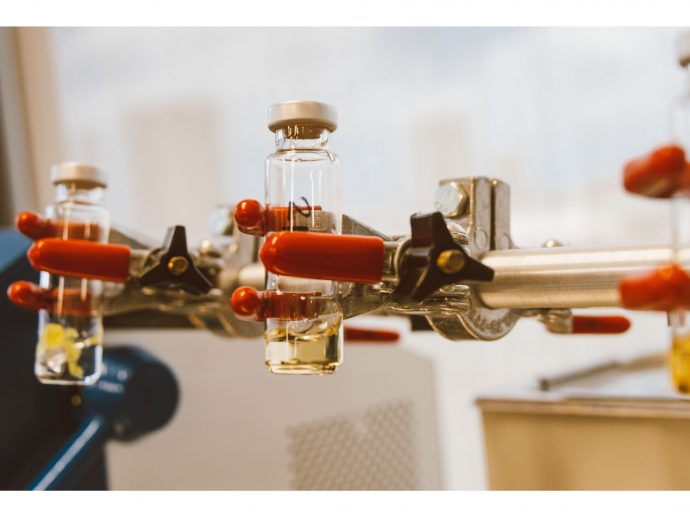
Laboratory reality is less glamorous than cryo-EM. Cagrilintide is supplied to research settings as a lyophilized powder, a form chosen because freeze-dried peptide survives shipping and storage far better than material in solution. It is reconstituted only when a protocol calls for it. Peptides in this class are sensitive to repeated freeze-thaw cycles and to prolonged time at ambient temperature, so cold-chain handling and disciplined aliquoting are standard practice rather than optional rigor.
Sourcing is where research-use-only framing stops being a legal formality and becomes an operational constraint. Laboratories obtain the compound as reference material from suppliers that specialize in research peptides rather than clinical product. Bluum, a US-based supplier that ships domestically, is one example of a source operating within that framework, listing the peptide as a lyophilized powder in sterile research vials with the molecular formula and 4409 g/mol molecular weight stated on the product record. The company states that every batch is accompanied by a third-party-verified Certificate of Analysis covering identity verification and purity analysis by HPLC, with lot numbers and testing dates recorded, and it labels the material research use only, not intended for human consumption, clinical use, or veterinary applications. Its published storage guidance runs to 2 to 8 degrees C for short-term handling and -20 to -80 degrees C for long-term storage, protected from light and moisture.
Those details matter more than they appear to. Purity analysis by HPLC and molecular weight confirmation are what let a laboratory establish that a given lot matches the expected profile before it enters a study, and receptor pharmacology is unusually unforgiving of impurities. A binding assay cannot distinguish between a genuine shift in affinity and a lot containing degraded or aggregated material. Lot-level documentation, traceability, and correct storage on receipt are, in practical terms, part of the experimental method.
Where the Field Goes Next
The evidence base around amylin-pathway compounds is now large enough to be modeled rather than merely reviewed. A synthetic target trial emulation published in Metabolism Open in 2025 assembled seven randomized controlled trials totaling 5,786 participants, drawing on literature published up to 30 September 2025, and applied Bayesian network meta-analysis to the reconstructed data. The existence of a dataset of that size, and of methods built specifically to interrogate it, indicates a field that has moved past the exploratory phase into systematic comparison.
That comparison is getting more crowded. Petrelintide, eloralintide, and amycretin have all entered development as amylin-pathway candidates with differing receptor selectivity profiles, which raises the analytical stakes for laboratory work. When several compounds engage overlapping receptor sets through different binding modes, distinguishing them requires reference material of known provenance and consistent quality. A comparator that varies lot to lot is not a comparator.
Friction points are becoming visible too. Nomenclature is one: a single compound carrying multiple development codes across different literatures creates real ambiguity in database searches and citation trails. Analytical standardization is another. Purity thresholds, characterization methods, and documentation practices vary considerably across the research supply chain, which complicates cross-laboratory comparison in exactly the area where comparison matters most. Neither problem is technically difficult. Both are unresolved because the field expanded faster than its conventions did.
Conclusion
What makes the amylin story interesting is not the capital flowing into it but the structural biology it has funded. Within roughly two years, a receptor system built from an unlikely pairing of a calcitonin receptor and an accessory protein has gone from partially characterized to resolved at near-atomic scale across multiple subtypes, complete with binding modes, kinetic profiles, and subunit-level attribution of signaling. That is a substantial advance in the fundamental understanding of a class B GPCR family, and it happened because a well-behaved, aggregation-resistant ligand existed to make the experiments possible.
The open questions remain genuinely open. How the three amylin receptor subtypes divide labor, why receptor residence time varies so sharply between structurally related ligands, and what the bypass binding mode implies for selectivity engineering are all live problems in receptor pharmacology. They are the kind of questions that get answered slowly, in vitro, with carefully characterized material and reproducible methods. The engineering that made this peptide stable enough to study is, in the end, what made the science available at all.
Research use only. The compound discussed in this article is intended solely for laboratory research and in-vitro investigation. It is not a drug, food, or cosmetic, and it is not intended for human consumption, clinical use, diagnostic use, or veterinary application. Nothing in this article should be interpreted as medical advice or as a description of any outcome available to an individual. References to clinical development programs are included as a matter of public record only.
