Categories more
- Adventures (17)
- Arts / Collectables (14)
- Automotive (36)
- Aviation (11)
- Bath, Body, & Health (76)
- Children (6)
- Cigars / Spirits (71)
- Cuisine (54)
- Design/Architecture (22)
- Electronics (13)
- Entertainment (4)
- Event Planning (12)
- Fashion (45)
- Finance (10)
- Gifts / Misc (6)
- Home Decor (45)
- Jewelry (41)
- Pets (3)
- Philanthropy (1)
- Real Estate (16)
- Services (23)
- Sports / Golf (14)
- Vacation / Travel (59)
- Watches / Pens (14)
- Wines / Vines (33)
- Yachting / Boating (17)


Custom Logo T-Shirt Supplier: How to Choose the Right One

Published
08/31/2026Choosing a reliable custom logo t-shirt supplier involves more than comparing prices. The supplier must be able to reproduce accurate logo placement, clean edges, consistent brand colors, and a finish that performs well after repeated washing.
Before ordering custom logo t-shirts, buyers should confirm the garment fabric and GSM, decoration method, artwork requirements, Pantone references, sample approval process, MOQ, and production timeline. These details determine whether the final batch remains consistent across sizes, colors, and future reorders.
Quick Answer: What Makes a Good Custom Logo T-Shirt Supplier?
A reliable custom logo t-shirt supplier should offer suitable decoration methods, clear MOQs, physical sampling, accurate color matching, and documented logo placement. Buyers should also confirm whether approved artwork and production specifications are retained for future reorders.
Why Supplier Choice Matters More Than It Seems
A logo is often the most recognizable part of a brand, which means any inconsistency in how it prints becomes immediately visible. A slightly off color, a blurry edge, or uneven placement across a batch of shirts reflects on the brand itself, not just the printing process.
This is exactly why working with the right Custom logo t‑shirt supplier matters more than it might seem at first glance. Two suppliers can quote nearly identical prices while delivering very different results, and the difference usually comes down to equipment quality, operator experience, and how carefully they handle color matching.
For businesses ordering Custom logo t‑shirts repeatedly, whether for staff uniforms, event merchandise, or a retail line, supplier consistency becomes even more important. A design that looks sharp on the first order needs to look identical on the tenth.
Key Benefits of Working With the Right Supplier
Consistent print quality across orders. A dependable supplier keeps logo placement, color, and clarity uniform from batch to batch.
Access to multiple printing methods. Good suppliers offer screen printing, embroidery, and direct-to-garment options, matching technique to logo complexity.
Faster reordering. Once a supplier has your logo file and specs on record, repeat orders typically move through production faster than the initial setup.
Fewer costly mistakes. Suppliers experienced with logo work tend to catch placement or color issues before production, not after.
Buying Guide: What to Look For
Not every supplier delivers the same reliability. Here's what actually separates a dependable partner from a frustrating one.
|
Factor |
Why It Matters |
|
Printing method range |
A supplier offering screen printing, embroidery, and DTG can match method to your logo's complexity |
|
Color matching process |
Ask how the supplier handles Pantone matching if your brand colors are specific |
|
Sample availability |
A willingness to send a pre-production sample signals confidence in consistency |
|
Minimum order quantity |
Confirm MOQs align with your actual volume needs |
|
Turnaround time |
Understand production timelines separately from shipping timelines |
|
File retention policy |
Ask whether logo files and specs are saved for faster reordering later |
|
Communication responsiveness |
Slow responses early on often predict friction once production begins |
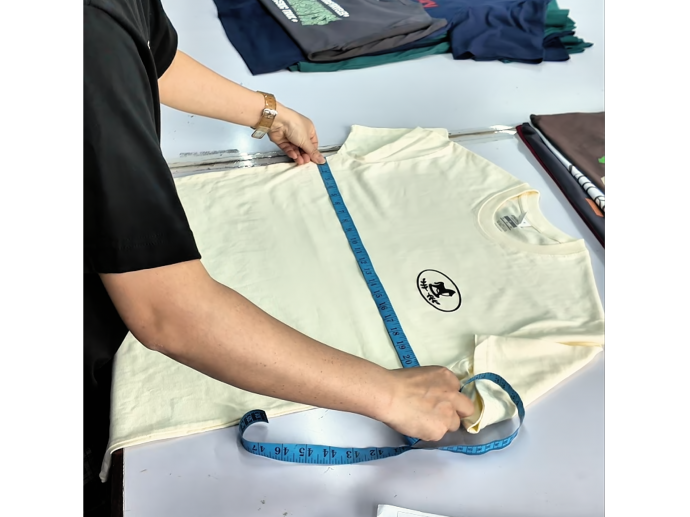
Before requesting a quotation, prepare a vector logo file, garment color, total quantity, size breakdown, logo dimensions and placement, Pantone references, label and packaging requirements, and delivery destination. Complete specifications make quotations easier to compare and reduce revisions during sampling.
If your logo has fine detail or multiple colors, ask the supplier directly which printing method they'd recommend rather than assuming one method fits every design.
Common Mistakes to Avoid
Skipping the sample stage. Approving full production without a physical sample is one of the most common and costly mistakes when working with a new supplier.
Judging suppliers on price alone. A lower quote sometimes reflects lower-quality equipment or less experienced operators, which shows up in the finished product.
Not asking about color matching. Suppliers without a clear Pantone matching process can produce noticeably different colors across separate orders.
Assuming all suppliers handle every printing method equally well. Some specialize in screen printing but handle embroidery or DTG less consistently, or vice versa.
Expert Tips
Send a vector file of your logo rather than a low-resolution image whenever possible. This gives the supplier the cleanest source for accurate scaling and color reproduction.
Ask for a physical sample rather than a digital mockup before approving a full run. Screen colors rarely match printed results exactly.
If you plan to reorder the same design regularly, confirm the supplier retains your file and specs. This alone can shave significant time off future orders.
Featured Category: Custom Printed T-Shirts
For buyers comparing supplier options directly, Unit Hundred's custom printed t-shirt category covers a range of printing methods and fabric weights suited to logo-based orders. The lineup reflects the kind of consistency buyers look for when evaluating a Custom logo t‑shirt supplier for repeat business, whether for uniforms, promotional items, or retail products.
Reviewing this category is a reasonable starting point for buyers trying to match printing method and fabric quality to their logo design and budget.
Why Choose Unit Hundred
Unit Hundred has been involved in apparel manufacturing since 2001, with production support covering cutting, sewing, screen printing, embroidery, packaging, and quality control. Coordinating garment production and decoration within one workflow helps maintain logo placement, color consistency, and workmanship across bulk orders.
Ready-made garments with printing or embroidery can generally start from 50 pieces, while fully customized styles typically start from 100 pieces per style. Standard samples usually take 3–7 working days, and bulk production generally takes 7–20 working days after sample approval.
FAQs
What should I look for in a custom logo t-shirt supplier?
Look for a range of printing method options, transparent minimum order quantities, clear color-matching processes, and a willingness to provide samples before bulk production.
How do I know if a supplier's printing quality is reliable?
Requesting a physical sample before a full production run is the most reliable way to judge print quality, placement accuracy, and color matching.
Does printing method affect supplier choice?
Yes. Some suppliers specialize in screen printing while others focus on embroidery or direct-to-garment printing, so match your logo's complexity to their strength.
What's a typical minimum order quantity for custom logo t-shirts?
Ready-made garments with printing or embroidery can generally start from 50 pieces. Fully customized styles typically start from 100 pieces per style.
Should I request a sample before every reorder?
Not necessarily, but it's worth requesting one for the first order and periodically afterward, especially if there's a gap of several months between orders.
Do suppliers retain logo files for future orders?
Many do, which speeds up reordering and helps maintain consistent placement and color across print runs. It's worth confirming this directly.
Can one supplier handle both small test orders and large bulk runs?
Many suppliers accommodate both, though pricing per unit is typically higher for smaller test orders compared to standard wholesale minimums.
How long do sampling and bulk production usually take?
Standard samples usually take 3–7 working days. Bulk production generally takes 7–20 working days after sample approval. Shipping time is calculated separately.
What file format should I provide for my logo?
Vector files such as AI, EPS, or PDF are preferred. A high-resolution PNG may also be suitable for certain printing methods.
Can custom logo t-shirts include private labels and custom packaging?
Yes. Orders can include neck labels, care labels, size labels, hangtags, branded polybags, barcode stickers, and custom cartons.
Conclusion
Choosing the right custom logo t-shirt supplier means verifying logo reproduction, color matching, sample quality, and repeat-order control before bulk production. Clear approved specifications help keep custom logo t-shirts consistent across the first order and future reorders.
Comments
