Categories more
- Adventures (62)
- Arts / Collectables (14)
- Automotive (77)
- Aviation (65)
- Bath, Body, & Health (123)
- Children (6)
- Cigars / Spirits (71)
- Cuisine (66)
- Design/Architecture (22)
- Electronics (63)
- Entertainment (36)
- Event Planning (115)
- Fashion (45)
- Finance (10)
- Gifts / Misc (6)
- Home Decor (118)
- Jewelry (41)
- Pets (3)
- Philanthropy (1)
- Real Estate (16)
- Services (44)
- Sports / Golf (14)
- Vacation / Travel (85)
- Watches / Pens (33)
- Wines / Vines (34)
- Yachting / Boating (67)


From City Living to Lakeside Retreats: Finding the Perfect Rental Accommodation


Published
08/26/2026Smart Strategies for Finding the Perfect Rental Accommodation
Navigating the rental market requires a strategic approach, especially in competitive areas. By leveraging modern tools and adopting best practices, we can significantly streamline the search process and increase our chances of securing an ideal home.
Streamlining Your Search: Tips for Finding the Perfect Rental Accommodation
In today's rental market, efficiency is paramount. We've observed that a significant majority of renters, approximately 82%, utilize three or more listing platforms during their search. This multi-platform approach is a cornerstone of an effective strategy. Beyond simply browsing, actively engaging with these platforms can yield better results.
One of the most effective ways to stay ahead is by setting up saved search alerts. These notifications ensure you're among the first to know when a property matching your criteria becomes available, allowing you to act quickly. When a desirable listing appears, prompt communication with the landlord or agent is crucial. Statistics show that landlords who actively promote their listings are 75% more likely to sign a lease, and including tour options on a listing can more than double a landlord's chances of receiving an application. This highlights the importance of being responsive and prepared to schedule a viewing.
Many platforms now offer integrated tools that make the application process faster. For instance, some allow renters to complete applications 1.75 times faster by applying directly from a listing. This speed can be a significant advantage in markets where properties are snapped up quickly. When considering various property types, from cozy studios to spacious family homes, remember to utilize dynamic search filters to narrow down options. Whether you're looking for modern one- to three-bedroom rentals in a bustling urban center or a quiet suburban house, precise filtering saves valuable time.
The goal is to move from initial search to securing a lease as efficiently as possible. Some platforms boast impressive timelines, with users finding a home in an average of 29 days, and receiving first contact from a landlord within just 6 days of publishing a tenant profile. This demonstrates the power of comprehensive and proactive engagement.
Property Inspections and Scam Verification
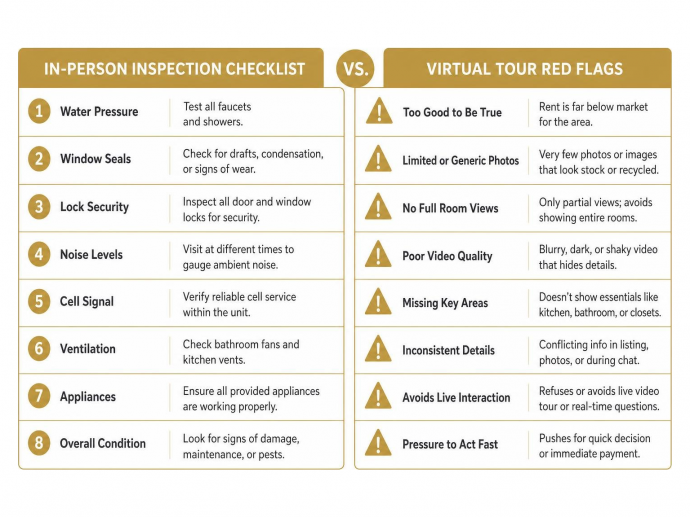
Once you’ve identified potential properties, a thorough inspection is non-negotiable. This step is critical for identifying potential issues and ensuring the property meets your expectations. During a physical walkthrough, we recommend a detailed checklist:
- Water Pressure: Test all faucets and showers. Low pressure can be a persistent nuisance.
- Window Seals: Check for drafts, condensation, or signs of wear that could indicate poor insulation and higher utility bills.
- Lock Security: Inspect all door and window locks for functionality and security.
- Noise Levels: Visit at different times of day if possible to gauge ambient noise from neighbors, traffic, or nearby businesses.
- Cell Signal: Verify reliable cell service within the unit, as this can vary even within the same building.
- Ventilation: Check bathroom fans and kitchen vents for proper operation.
- Appliances: Ensure all provided appliances are in good working order.
Beyond the physical inspection, verifying the legitimacy of a listing and avoiding rental scams is paramount. Unfortunately, fraudulent listings are a persistent problem. Here’s how we can protect ourselves:
- Cross-Reference Listings: Compare the listing across multiple reputable platforms. Inconsistencies in price, photos, or descriptions can be red flags.
- Direct Owner Contact: Always try to communicate directly with the landlord or property manager. Be wary of individuals who insist on communicating only via email or text and avoid phone calls.
- In-Person Viewings: Never commit to a rental or send money without first viewing the property in person or having a trusted representative do so. Scammers often use attractive photos of properties they don't own.
- Beware of Pressure Tactics: Be suspicious of landlords who pressure you to make quick decisions or send money without a signed lease agreement.
- Unusual Payment Methods: Avoid requests for payment via wire transfer, gift cards, or cryptocurrency, as these are often untraceable.
- Research the Landlord/Agent: A quick online search of the landlord's name, property management company, or even the property address can reveal valuable information or red flags.
Calculating True Move-In Costs and Recurring Monthly Expenses
One of the most common pitfalls in rental searching is focusing solely on the advertised rent. To truly find the "perfect" accommodation, we must understand and calculate both the total move-in costs and the complete recurring monthly expenses. This comprehensive financial perspective is crucial for setting a realistic budget and avoiding unpleasant surprises.
Understanding Monthly Housing Costs
The advertised rent is just one component of your true monthly housing cost. To get an accurate picture, we recommend calculating the total recurring monthly cost using this formula:
Total Recurring Monthly Cost = Advertised Rent + Required Monthly Building/Service Fees + Estimated Utility Expenses + Parking/Transit Costs + Pet Rent (if applicable)
Let's break down these elements:
- Advertised Rent: The base monthly payment for the unit.
- Required Monthly Building/Service Fees: Many modern buildings include mandatory fees for amenities (gym, pool), trash, pest control, or administrative services. These can add a significant amount to your bill.
- Estimated Utility Expenses: Research typical costs for electricity, gas, water, internet, and sometimes even trash or sewer. Don't guess; ask the landlord for average utility bills from previous tenants if possible, or research local utility provider estimates.
- Parking/Transit Costs: If parking isn't included or you rely on public transport, factor in monthly parking fees or transit passes.
- Pet Rent: Many pet-friendly properties charge an additional monthly fee per pet.
A good rule of thumb for budgeting is that your gross monthly income should be at least three times the total monthly rent (including mandatory fees). This benchmark helps ensure affordability and is often a requirement for landlords.
For those looking to significantly reduce their monthly outlay, particularly in urban areas, co-living can be an excellent option. Renters can save between 45% and 55% on rent by opting for a shared two-bedroom apartment compared to renting a one-bedroom alone in top US cities. This strategy allows access to desirable locations or larger spaces that might otherwise be out of budget.
Budgeting for Move-In Outlays and Special Accommodations
Beyond recurring monthly costs, the upfront cash required to move into a new rental can be substantial. We advise calculating your total move-in cash using this formula:
Total Move-In Cash = First Month's Rent + Security Deposit + Application/Admin Fees + Broker Fees (if applicable) + Pet Deposits/Fees + Moving Expenses
- First Month's Rent: This is typically due at lease signing.
- Security Deposit: Often equivalent to one or two months' rent, this is held by the landlord to cover potential damages. Some regions have caps on how much can be charged.
- Application/Admin Fees: Non-refundable fees charged for processing your application and administrative setup.
- Broker Fees: In some markets, you might pay a fee to a real estate broker who helped you find the property.
- Pet Deposits/Fees: Separate from pet rent, many landlords require a one-time, often non-refundable, pet fee or a refundable pet deposit. If you're searching for specific accommodations like pet-friendly vacation rentals for a temporary stay, be sure to clarify their pet fee structure as well.
- Moving Expenses: Factor in costs for professional movers, truck rentals, packing supplies, and any utility connection fees.
Understanding these two distinct financial totals—recurring monthly costs and upfront move-in cash—provides a clear and comprehensive picture of the financial commitment involved. This allows for informed decision-making and helps prevent any unexpected financial strain during the transition.
AI Tools, Tenant Screening, and Legal Protections
The rental journey extends beyond finding a property; it involves meticulous application preparation, understanding how landlords screen tenants, and being aware of your legal rights. Modern technology, particularly AI, is also transforming how we approach these steps.
Application Preparation: Finding the Perfect Rental Accommodation Without Friction
A well-prepared rental application can significantly improve your chances in a competitive market. Landlords are looking for reliable, responsible tenants, and a complete, organized application demonstrates your readiness. We recommend gathering the following information and documents well in advance:
- Master Address Document: Create a single document listing all your past addresses, dates of occupancy, and landlord contact information. This saves time when filling out multiple applications.
- Income Verification: Have recent pay stubs (typically 2-3 months), bank statements, or an offer letter ready to prove your income. Self-employed individuals may need tax returns.
- Credit Report Review: Obtain a copy of your credit report months before you start searching. Review it for any inaccuracies and dispute them. Knowing your score allows you to address potential concerns upfront with landlords.
- SSN Data Protection: While landlords will need your Social Security Number for background and credit checks, be cautious about providing it prematurely. When submitting documents, consider blocking out sensitive personal data like your full SSN on initial copies, providing it only when a formal application is required.
- Landlord References: Have contact information for previous landlords ready. It's also a unique insight to consider asking prospective landlords for references from their current or past tenants to verify their responsiveness and reliability.
Being upfront and honest about any past credit issues or negative rental history can build trust with prospective landlords. It's better to explain a situation proactively than have it discovered during a background check.
Leveraging AI Technologies and Landlord Screening Best Practices
The rental search process can be time-consuming, with estimates suggesting up to 40 hours of manual work. AI-powered tools are emerging to streamline this. Instead of rigid filters, these tools allow you to describe your ideal rental in plain English, using natural language processing to match you with suitable listings. Some AI agents can even handle landlord communication, schedule tours, and provide detailed fee breakdowns, turning "40 hours of manual hell" into "one chat."
For landlords, effective tenant screening is crucial for protecting their investment. As renters, understanding this process can help us present ourselves as ideal candidates. Key landlord best practices include:
- Pre-Screening Questions: Before a formal application, landlords often ask questions about move date, reason for moving, income, household size, pets, and eviction history. These help filter out unqualified applicants early.
- Objective Criteria: Landlords should maintain uniform and objective qualification criteria for all applicants to comply with Fair Housing Laws. This means evaluating all applicants based on the same standards.
- Income Verification: A common industry standard is that a tenant’s gross monthly income should be at least three times the monthly rent. Landlords verify this through pay stubs, employment letters, or tax returns.
- Background and Credit Checks: These are standard procedures to assess financial responsibility and criminal history.
- Landlord References: Contacting previous landlords provides insight into a tenant's rental history, including payment habits and property care.
- Adverse Action Notice: If an applicant is denied based on information from a credit or background check, landlords are legally required to provide an adverse action notice, explaining the reason for denial and the source of the information.
AI can also assist in lifestyle matching, particularly for co-living situations, by evaluating preferences, habits, and schedules to connect compatible individuals. This can reduce conflicts and improve the living experience for all parties.
Essential Legal Protections: Fair Housing and Military Clauses
Understanding your legal rights as a renter is fundamental. Two critical areas are Fair Housing Laws and, for service members, military clauses.
Fair Housing Laws: These federal laws prohibit discrimination in housing based on race, color, national origin, religion, sex (including sexual orientation and gender identity), familial status, and disability. Many states and localities also have additional protected classes. As renters, we should be aware of these protections and report any suspected discrimination. Landlords are required to adhere to these laws throughout the entire rental process, from advertising to application and tenancy.
Servicemembers Civil Relief Act (SCRA) and Military Clauses: For military personnel, specific protections exist. The Servicemembers Civil Relief Act (SCRA) is a federal law that provides financial and legal protections to service members. Under the SCRA, a service member can terminate a residential lease with written notice upon receiving official military orders for a Permanent Change of Station (PCS) or a Temporary Duty (TDY) for 90 days or more. Once written notice and orders are provided to the landlord, the lease termination takes effect 30 days after the next monthly rent payment is due. This federal protection is a vital safeguard for military families facing unexpected relocations.
A military clause, on the other hand, refers to custom language added to a lease contract that addresses other specific move scenarios not covered by the SCRA, such as moving if on-base housing becomes available. These clauses are not federally mandated but are negotiated and must be explicitly agreed upon and signed by the landlord. While the SCRA offers broad federal protection, a custom military clause provides flexibility for situations unique to military life that fall outside the strict parameters of the SCRA. It's crucial to ensure any such custom clauses are explicit and signed by all parties to be legally binding.
Frequently Asked Questions About Rental Accommodations
We often encounter common questions during the rental search. Here, we address some of the most pressing concerns to provide clarity and confidence.
How do you calculate total move-in cash versus recurring monthly rent?
These are two distinct financial considerations. Total move-in cash refers to the one-time, upfront payments required before you can move in. This typically includes the first month's rent, a security deposit (often equivalent to 1-2 months' rent), application fees, administrative fees, any broker fees, and potentially pet deposits or non-refundable pet fees. You should also factor in actual moving expenses like truck rentals or professional movers.
Recurring monthly rent encompasses all costs you'll pay on an ongoing basis each month. This includes the base rent, mandatory monthly building fees (e.g., for amenities, trash), estimated utility costs (electricity, gas, water, internet), parking fees, and any recurring pet rent. It's essential to calculate both totals accurately to avoid financial surprises and ensure the rental fits comfortably within your budget.
What is the key legal distinction between SCRA and a military clause?
The primary distinction lies in their legal origin and scope. The Servicemembers Civil Relief Act (SCRA) is a federal law providing specific protections for service members, allowing them to terminate a residential lease with written notice if they receive official military orders for a PCS or a TDY lasting 90 days or more. This is a statutory right. The termination takes effect 30 days after the next rent payment is due.
A military clause, conversely, is a contractual agreement. It's custom language added to a lease that addresses other military-specific scenarios not covered by the SCRA, such as the availability of on-base housing. This clause must be negotiated and explicitly agreed upon and signed by both the landlord and the service member to be legally binding. While the SCRA is a universal federal protection, a military clause offers tailored flexibility for situations outside the SCRA's strict definitions.
How can renters avoid listing scams when searching online?
Avoiding rental scams requires diligence and skepticism. We recommend several key steps:
- Verify Identity: Always communicate directly with the landlord or a licensed property manager. Be wary if they refuse phone calls or in-person meetings.
- Cross-Reference Listings: Check if the property is listed on multiple reputable sites and compare details. Inconsistencies or prices that seem too good to be true are major red flags.
- In-Person Viewings: Never send money or sign a lease without physically seeing the property or having a trusted representative view it on your behalf. Scammers often use photos of properties they don't own.
- Avoid Unusual Payment Methods: Be extremely suspicious of requests for payment via wire transfers, gift cards, or cryptocurrency, as these are virtually untraceable. Stick to standard payment methods like checks or secure online portals.
- Research: Do a quick online search of the landlord's name, the property management company, and the address. Look for reviews or any reports of scams.
Conclusion
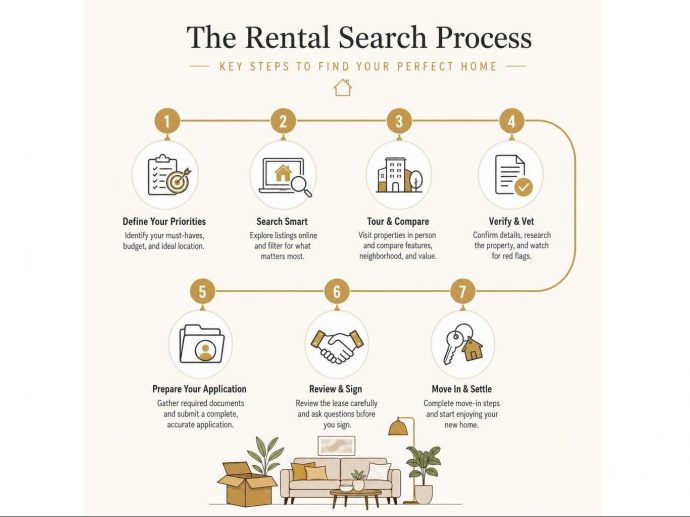
Finding the perfect rental accommodation is a significant undertaking, but with a strategic approach, it can be a rewarding experience. By diligently identifying your priorities, setting a clear budget that accounts for all costs, and leveraging efficient search strategies, you are well on your way to securing a home that truly fits your needs.
Remember to thoroughly inspect properties, verify listings to avoid scams, and prepare your application meticulously. Understanding legal protections like Fair Housing Laws and the SCRA, especially for service members, empowers you to navigate the process confidently. Whether you're seeking the vibrancy of city life or the tranquility of a lakeside retreat, these steps will lead to a seamless move-in and a comfortable new home.
Comments
