Categories more
- Adventures (199)
- Arts / Collectibles (315)
- Automotive (219)
- Aviation (279)
- Bath, Body & Health (513)
- Children (116)
- Cigars / Spirits (271)
- Cuisine (723)
- Design / Architecture (1117)
- Electronics (222)
- Entertainment (162)
- Event Planning (296)
- Fashion (550)
- Finance (195)
- Gifts / Misc (141)
- Home Decor (558)
- Jewelry (395)
- Pets (91)
- Philanthropy (124)
- Real Estate (386)
- Services (221)
- Sports / Golf (213)
- Vacation / Travel (1036)
- Watches / Pens (222)
- Wines / Vines (861)
- Yachting / Boating (3367)


How Climate Control Shapes the World's Finest Private Wine Cellars

Published
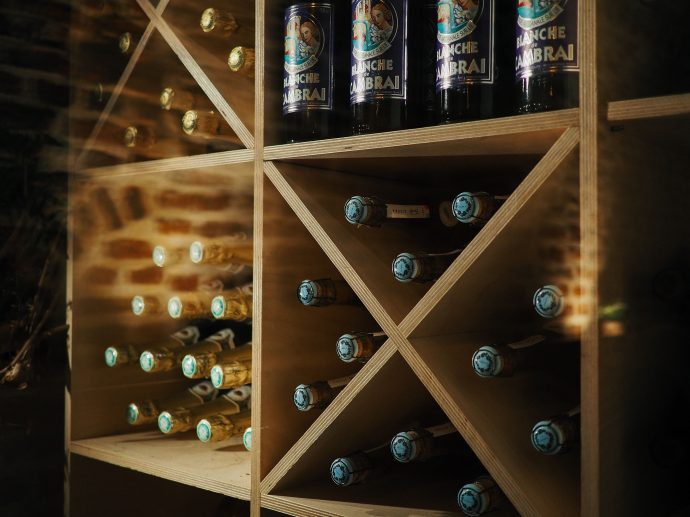
09/07/2026Among the many marks of a truly exceptional home, few speak as quietly yet as powerfully as a well-designed private wine cellar. It is, in the most refined sense, a room that works invisibly. To guests seated at a dinner table, it is a thing of beauty, a glass-walled showcase of curated vintages lit with warm precision, the labels of first-growth Bordeaux and rare Burgundies visible through custom racking. What they do not see is the engineering behind it: the humidification systems, the temperature sensors, the automated monitoring that keeps every bottle aging in conditions more stable than most historic chateaux could ever achieve.
For serious collectors, a wine cellar is no longer simply a room where bottles are stored. It is simultaneously an investment vault, a design statement, and a carefully managed microclimate. The world's most discerning homeowners, from private estates in Napa Valley to converted historic properties in Bordeaux and newly built super-prime residences in Mayfair, have come to understand that the difference between a great collection and a diminished one often has nothing to do with what was purchased. It has everything to do with how it was kept.
The Hidden Risk in Every Bottle
Wine is a living thing, and its vulnerability to environmental change is real and largely invisible. A cork that has dried out even slightly over several years will let in trace amounts of oxygen, initiating an oxidation process that silently ruins what should have been a transcendent bottle. Labels, which collectors of fine wine understand to be nearly as important as the wine itself when it comes to auction value and provenance, begin to peel and discolour long before any internal degradation becomes obvious.
The stakes are considerable. A single case of correctly aged, well-preserved 1982 Petrus is worth significantly more at auction than the same case stored in suboptimal conditions. Private collections held by serious collectors routinely represent seven-figure valuations, and the difference between a cellar that maintains correct humidity and one that does not can translate directly into hundreds of thousands of dollars of preserved, or destroyed, value. Insurance underwriters that specialise in fine wine collections are now asking more specific questions about storage conditions as a matter of course, and cellars with documented climate control systems are increasingly commanding better policy terms.
The Science of the Perfect Cellar
The science behind wine preservation is well established in the industry, even if it remains largely invisible to casual drinkers. Wine ages best within a relatively narrow band of environmental conditions. Temperature should remain consistently between 55 and 58 degrees Fahrenheit, without the fluctuations that cause wine to expand and contract inside the bottle. Relative humidity should be maintained between 50 and 70 percent, with most authorities on fine wine storage recommending the higher end of that range for serious long-term cellaring.
The humidity requirement is where most cellars, including many built into otherwise extraordinary homes, fail. Too little humidity and corks begin to dry and shrink over the course of years. The process is imperceptible in real time, but the damage accumulates. Too much humidity and you invite mould growth on labels, wooden racking, and corks. The ideal environment is one where moisture is present at the correct level, uniformly distributed throughout the space, and maintained without the surface wetness that causes its own problems.
Achieving that balance in a home environment, particularly in cellars carved into historic properties or retrofitted into modern high-rise residences, requires more than a good HVAC system. It requires humidification technology designed specifically for the task.
Adiabatic Humidification and Why It Matters for Fine Wine
The challenge with conventional humidification systems in a wine cellar context is surface moisture. Standard humidifiers work by generating droplets large enough that they settle on surfaces before evaporating, which can wet labels, damage wooden racking, and create the conditions for mould even while attempting to maintain appropriate humidity levels. For a collection of serious value, this is an unacceptable tradeoff.
Adiabatic humidification addresses this problem by dispersing sub-micron water droplets that evaporate completely before contacting any surface, maintaining precise, non-fluctuating humidity throughout the space without the wet deposition risk of traditional systems. Systems purpose-built for this environment, such as Smart Fog’s winery humidity control technology, were originally developed for professional winery and barrel room applications where the same exacting requirements apply: correct humidity without surface moisture, uniform coverage across the entire space, and reliable consistency over years rather than days. That same technology has found a natural home in the finest private cellars, where the requirements are no less demanding and the consequences of failure are no less serious.
The principle is elegant. When droplets are small enough that they evaporate before reaching any surface, the only thing that changes in the room is the humidity of the air itself. Labels remain pristine. Racking stays dry. Corks remain correctly hydrated from the ambient moisture rather than from direct contact. The cellar maintains the conditions of an ideal natural cave without the limitations of geography.
Cellars as Architecture: When Preservation Meets Design
The finest private wine cellars of the current era are no longer afterthoughts. They are commissions, in the truest design sense of the word. Architects working with ultra-high-net-worth clients increasingly find that the wine cellar is one of the most intensely considered spaces in a residential project, second perhaps only to the primary suite or the main kitchen. Glass walls, custom ironwork, climate-visible entry vestibules, curated lighting that allows the colour of the wine to glow against the labels: these are not decorative gestures. They are responses to how seriously collectors take their relationship with their collections.
Historic estates present their own specific challenges. A 16th-century stone cellar in Burgundy was naturally suited to wine storage by virtue of its mass and underground position, but it cannot provide the precision that a collection of contemporary value demands. Retrofitting such spaces for genuine climate control requires systems that integrate without disruption, that can maintain their parameters despite stone walls that breathe seasonally, and that can be monitored remotely so that an owner traveling between their London property, their Saint-Barths villa, and their Aspen residence can verify conditions from wherever they happen to be.
Purpose-built cellars in new construction have different advantages and constraints. Floor-to-ceiling glass, which has become one of the defining aesthetic statements in contemporary cellar design, creates thermal challenges that underground stone construction does not. The engineering required to maintain stable temperature and humidity behind glass walls that face into a living space requires both precision equipment and careful integration with the broader building systems.
The Investment Case for Climate Precision
The financial argument for investing in a correctly engineered climate system is not difficult to make. A humidification system of the quality appropriate for a serious collection represents a small fraction of the value of the collection it protects, and its effect on preservation, resale value, and insurability is demonstrably positive. The more interesting consideration is what incorrect storage costs, and that cost is rarely discovered until it is too late to do anything about it.
Wine that has been stored in conditions that are too dry ages differently than wine stored correctly, and not in a way that a sophisticated buyer will fail to notice. The ullage level changes. The cork condition deteriorates. At auction, these details are examined carefully and reflected in final prices. A collection valued at several million dollars, stored incorrectly for a decade, may sell for a fraction of what it would have achieved with appropriate care. The engineering investment becomes, in this context, a form of collection insurance more certain than the policy itself.
For collectors who plan to pass their collections to the next generation, the case is even more straightforward. Wine that has been correctly preserved for 30 years is a gift. Wine that has been quietly compromised over the same period is a disappointment. The cellar that makes that difference is not the one that cost more to build or that displays the bottles more attractively. It is the one where the humidity was right, every day, for all of those years.
Designing for the Long Term
Collectors building a new cellar or upgrading an existing one are well served by treating climate control as a foundational decision rather than a finishing detail. The systems that maintain temperature and humidity should be specified before the racking is designed and before the glass walls are ordered, because the engineering requirements of proper climate control should inform every other decision in the space.
Working with specialists who understand both the science of wine preservation and the practicalities of precision humidification produces significantly better outcomes than applying general HVAC thinking to a specialised environment. The finest residential wine cellars in the world are distinguished not by how they look, though they are often extraordinary to see, but by how reliably they maintain the conditions that allow a collection to fulfill its potential over decades. The racking and the lighting are the aesthetic of it. The climate control is the substance.
For collectors who understand that distinction, and who have built or inherited collections worth protecting, the engineering behind the glass is not a technical footnote. It is the most important feature in the room.
Comments
