Categories more
- Adventures (199)
- Arts / Collectibles (315)
- Automotive (219)
- Aviation (279)
- Bath, Body & Health (513)
- Children (116)
- Cigars / Spirits (271)
- Cuisine (723)
- Design / Architecture (1118)
- Electronics (222)
- Entertainment (162)
- Event Planning (295)
- Fashion (550)
- Finance (195)
- Gifts / Misc (141)
- Home Decor (558)
- Jewelry (396)
- Pets (91)
- Philanthropy (124)
- Real Estate (386)
- Services (221)
- Sports / Golf (213)
- Vacation / Travel (1036)
- Watches / Pens (223)
- Wines / Vines (861)
- Yachting / Boating (7031)


How to Train a Puppy for First-Time Owners

Published
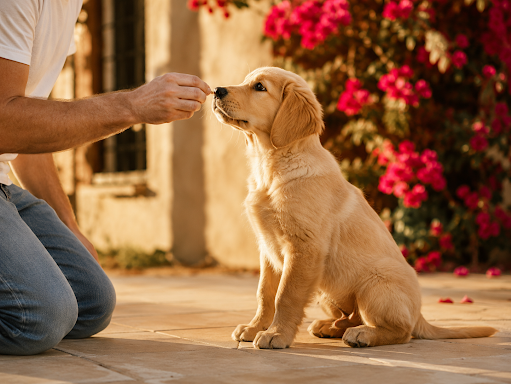
06/26/2026Bringing a puppy home at eight weeks and starting training the same day can feel aggressive until you see the timeline: by 14 to 16 weeks, the most important learning window of your dog's life is closing. What you teach (or don't teach) inside that window shapes the next 12 to 15 years.
We've worked with hundreds of Los Angeles puppies, and the biggest mistake new owners make is waiting until the dog is "old enough". However, by then, you're not training a puppy; instead, you're remediating one.
Puppy training is the structured teaching of basic cues, social skills, and house manners during the eight-to-16-week window when puppies learn fastest. It pairs positive reinforcement (rewarding wanted behavior with food, praise, or play) with controlled exposure to people, sounds, surfaces, and other dogs. Done early, it prevents the fear, reactivity, and house-soiling issues behind most behavior surrenders.
Key Takeaways
- Start the day you bring your puppy home, usually around eight weeks.
- The three-to-16-week socialization window matters more than any specific cue.
- Positive reinforcement is the only method backed by AVMA, AVSAB, and AKC.
- Short, frequent sessions (five minutes, three to four times a day) beat one long drill.
- Group puppy classes work best for most first-time owners by bundling socialization with cue work.
When Should You Start Training a Puppy?
AVMA's 2024 literature review on socialization is clear: meaningful exposure should begin by or before three weeks of age, which is the breeder's job. Your job starts at the eight week mark.
The six-to-16-week window is when puppies absorb experiences with the least fear. If you miss it, you're playing defense for the next decade. Structured help during that window, like our puppy training in Los Angeles, is built specifically around the calendar. There's also a fear period around eight to 11 weeks where one bad event can leave a lasting mark. Slow down during this stretch and stay closer to home.
The Puppy Training Rules That Matter Most
Why positive reinforcement works
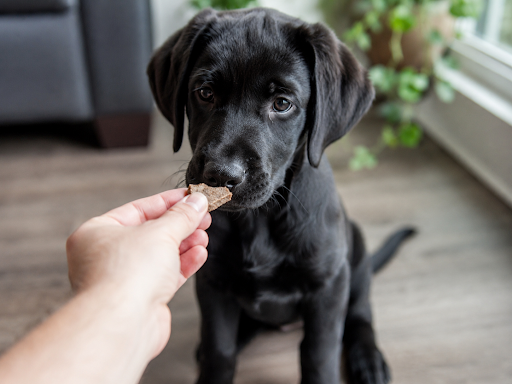
Positive reinforcement means rewarding the behavior you want. AVMA and the AVSAB position statement both back this method over shock, prong, and choke collars.
New Jersey, New York, and Massachusetts have all introduced legislation in 2024 and 2025 to restrict their use. England's e-collar ban took effect in 2024. The regulatory momentum runs one direction because the fallout (fear, redirected aggression, learned helplessness) keeps showing up in adolescent dogs. Find your puppy's currency in week one. For most dogs, that's food, toys or praise.
How long should puppy training sessions be?
Puppy training sessions generally should last five minutes, three or four times a day. A puppy's attention at 10 weeks is shorter than a toddler's. The goal isn't a 30-minute drill, it's a quick rep that ends on a win. Total daily training under 20 minutes is plenty.
Why consistency is harder than it sounds
Ensure you have one cue word per behavior. Most home training falls apart because three people teach three slightly different versions of the same cue.
Train in real-world environments
The cue your puppy obeys in your kitchen is a different cue on a Saturday morning walk. There are different smells, other dogs, and hikers stepping over them. As a result, skills don't transfer automatically.
Once a behavior is solid at home, practice on the driveway, then the sidewalk, and then a quiet park. Layer in distractions, and skip dog parks or beaches until the second round of puppy training is in.
Patience, but with benchmarks
Most puppies don't hold a reliable sit until 12 weeks. Most aren't fully potty trained until four to six months. Most pull on the leash until at least six months without consistent work.
How Do You Train a Puppy Step by Step?
This involves five core skills:
- House manners
- Crating
- Basic cues
- Leash
- Socialization
Potty training a puppy
Most puppies are reliably potty trained in two to four weeks, with full reliability between four and six months. Owners stuck on this step can short-cut the learning curve with focused help on potty training.
The method is unglamorous: outside every 60 to 90 minutes during the day, after every meal, after every nap, after every play session. Pick one outdoor spot, and wait three to five minutes. The second they finish, reward them with a small treat. Inside accidents get a calm clean-up with an enzymatic cleaner. Avoid scolding, as doing so mid-accident teaches a puppy not to potty in front of you.
Crate training without the guilt trip
In a 700-square-foot LA apartment, a crate is one of the cleanest ways to teach a puppy to settle. Pick a crate just big enough to stand, turn, and lie down. Bigger is worse, because they'll potty in one corner and sleep in the other. Feed meals inside for the first week with the door open. Add short closed-door sessions (30 seconds, then a minute) while you're in the room.
How do I teach sit, stay, and come?
Teaching a sit is the easiest trick. Hold a treat above the puppy's nose, raise it slowly, and the head goes up while the rear goes down. The instant the rear hits the floor, mark it ("yes!") and reward.
Stay starts at one second and one step. Come is taught on a 10-foot line with a high-value reward, calling once and only once. Never call your puppy to punish them. A full cue toolbox built right the first time is what our obedience training in Los Angeles page is built around.
Leash training in an LA neighborhood
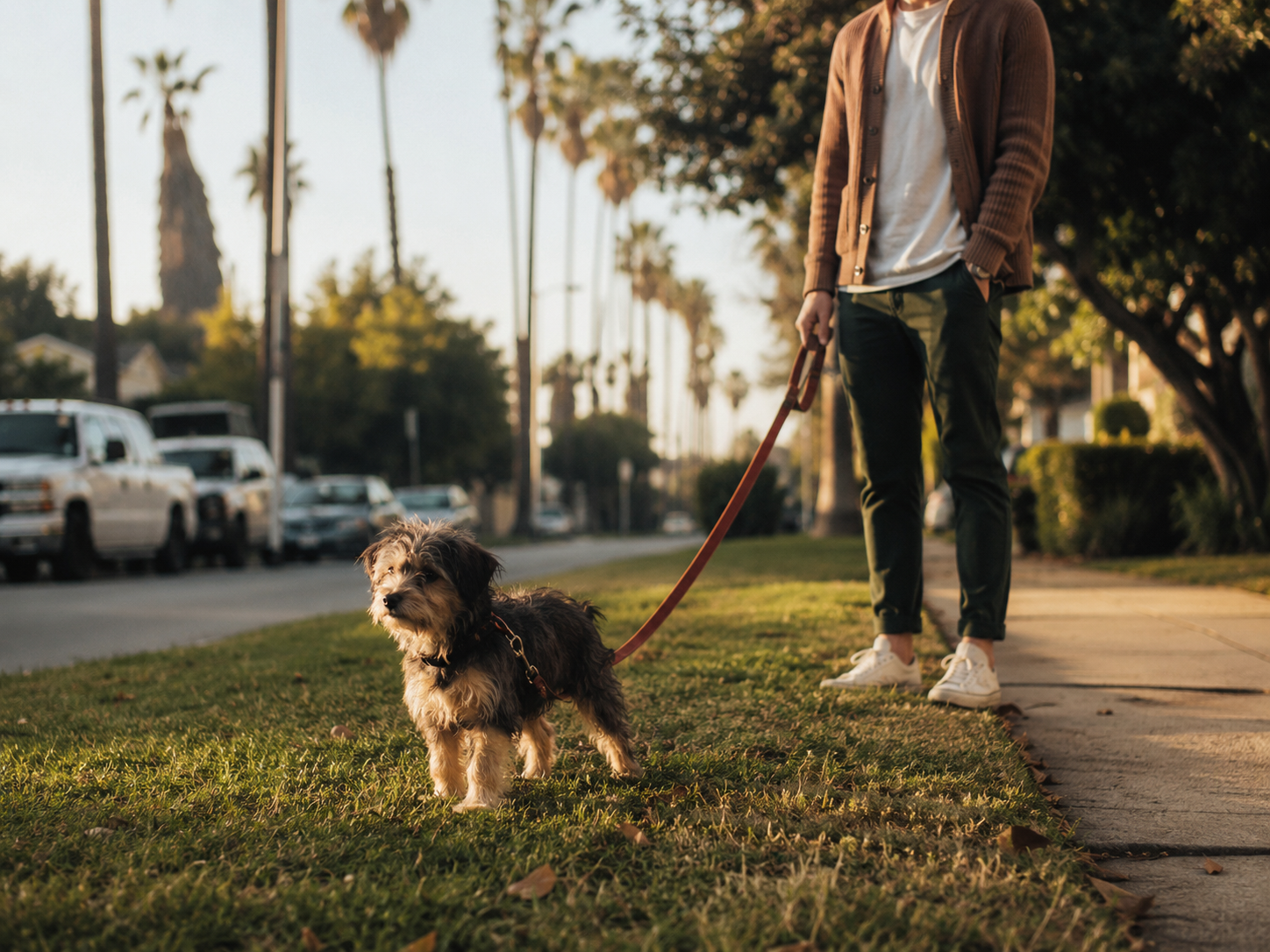
Start indoors, clip the leash on, let it drag a few minutes, and reward calm behavior. Pick up the leash, walk two steps, give them a treat for slack, and then walk two more.
When you go outside, expect to spend the first three or four sessions standing in your driveway while your puppy processes the world. Hot LA pavement is its own issue, so train early morning or after sunset from June through September.
Puppy socialization
The socialization window opens around three weeks and closes around 14 to 16 weeks. Everything your puppy meets, hears, walks on, smells, and rides in during that window becomes their definition of "normal."
The AKC's socialization guidance lays out the trade-off most owners get wrong: waiting until 16 weeks for full vaccine protection costs more behavioral ground than the marginal disease risk it avoids. AVSAB has held this position for over a decade. Done right, early socialization prevents most fear and reactivity cases we see later.
Carry the puppy in your arms down Abbot Kinney. Sit on a bench at the pier. Visit a friend's dog whose vaccines you can verify. Skip the dog beach, the off-leash hours, and group greetings with unknown dogs until the second round of shots clears.
A working LA checklist for the first month: five surface types, 10 sound categories, 15 different people, three dog-free public outings.
How Do You Choose a Puppy Training Program?
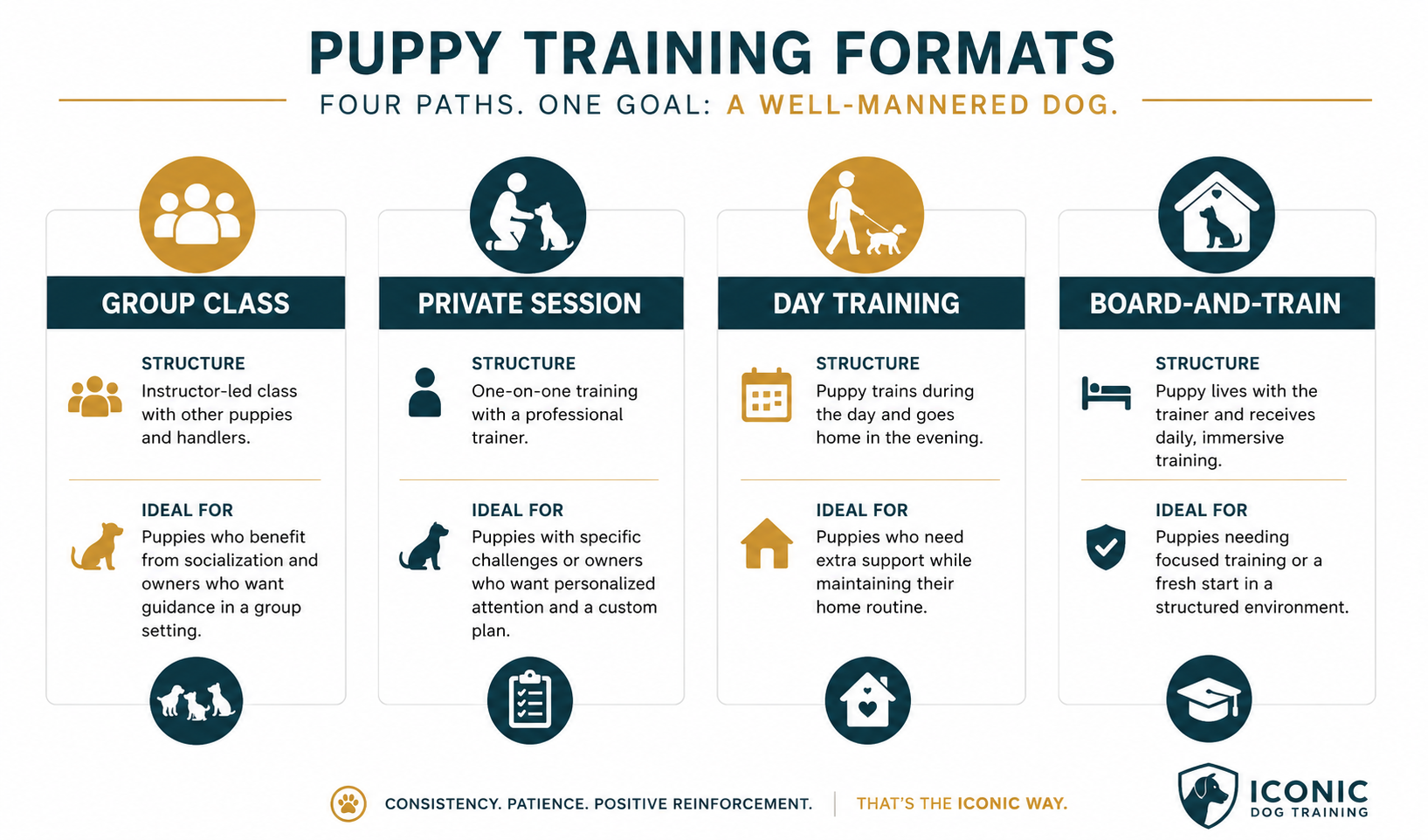
Three formats cover almost every puppy in LA. Group classes, private sessions, and board-and-train. Format matters more than any other variable for outcomes in the first six months.
BLS animal trainer occupational data projects the field to grow roughly 5% through 2034, with credentialed urban trainers driving most of that demand. That growth is concentrated in early-window puppy work because that's where the highest-impact behavioral outcomes happen.
|
Training Format |
How It Works |
|
Best Fit For |
|
Group puppy class |
Four to six weekly sessions with other puppies and owners, structured by a trainer |
|
First-time owners who want socialization plus basic cues in one package |
|
Private session |
One-on-one in your home or a studio, customized to your puppy and routine |
|
Specific issues like leash manners, recall, or schedule constraints |
|
Day training |
Trainer works with your puppy during the day, then transfers skills to you in a handoff |
|
Busy owners who can practice cues at home in the evenings |
|
Board-and-train |
Puppy lives with the trainer for two to three weeks, returns trained on agreed-upon goals |
|
Heavy behavior cases or households unable to run consistent training at home |
For most first-time owners, the strongest starting point is a group puppy class. It packages controlled socialization with cue work in the same calendar window when both matter most.

When is professional puppy training worth it?
A contrarian take: most LA puppies don't need a three-week board-and-train. They need four to six group sessions, a clear home routine, and an owner who shows up. Board-and-train videos look impressive, but the dog has to come home eventually, and the owner runs the program after that.
Where professional help earns its keep: socialization (controlled access to vetted dogs is hard to replicate solo), recall under distraction, and any sign of fear or reactivity before 16 weeks. If your 11-week-old is freezing, growling, or actively avoiding people or dogs, get a credentialed trainer on the calendar this week. AKC and AVSAB both flag behavior issues as the leading cause of death in dogs under 3, which is why early intervention isn't optional.
Iconic Dog Training built its LA practice around early intervention because the window doesn't reopen. We publish guides like this with help from a marketing team that works with local service businesses, because most of what new puppy owners need to know about the eight-to-16-week window isn't on the first page of Google.
FAQs
When can I start training my puppy?
Most puppies can start training at eight weeks, the same day they come home. The AVMA recommends socialization exposure begin by or before three weeks, which falls on the breeder. From eight to 16 weeks, you have the highest-impact training window of the dog's life. Wait past 16 weeks and you're working uphill.
Is it too late to train a six-month-old puppy?
No, but the critical socialization period largely closes by 14 to 16 weeks. New experiences after that take more reps and patience. Behavior issues are the leading cause of euthanasia in dogs under 3, which is why catching things early matters.
How long should I train my puppy each day?
Three to four short sessions, about five minutes each, for a total under 20 minutes daily. Puppies have shorter attention spans than toddlers. Socialization outings stack on top of that and shouldn't count toward your training minutes.
Can I train my puppy without hiring a professional?
The areas where DIY tends to fall short are socialization (hard to replicate controlled access to vetted dogs at home), recall under heavy distraction, and any fear or reactivity that surfaces inside the 16-week window. A few professional sessions early can prevent months of remediation later.
What's the difference between socialization and obedience training for puppies?
Socialization is structured exposure to people, dogs, surfaces, and sounds during the three-to-16-week window to prevent fear. Obedience training is cue work (sit, stay, come, leash manners). Both should run in parallel starting at eight weeks.
Should I use treats or just praise for puppy training?
Comments
