Categories more
- Adventures (114)
- Arts / Collectables (30)
- Automotive (89)
- Aviation (92)
- Bath, Body, & Health (184)
- Children (62)
- Cigars / Spirits (119)
- Cuisine (183)
- Design/Architecture (78)
- Electronics (93)
- Entertainment (55)
- Event Planning (136)
- Fashion (177)
- Finance (19)
- Gifts / Misc (49)
- Home Decor (188)
- Jewelry (134)
- Pets (33)
- Philanthropy (6)
- Real Estate (113)
- Services (69)
- Sports / Golf (56)
- Vacation / Travel (427)
- Watches / Pens (101)
- Wines / Vines (81)
- Yachting / Boating (122)



Post Title The Art of Custom Marine Canvas for Luxury Yachts


Published
02/08/2026Your luxury yacht represents a significant investment, a testament to craftsmanship and passion. Protecting this asset from the relentless marine environment is paramount. While a boat cover might seem like a simple accessory, its proper installation and quality are crucial for preserving your vessel's pristine condition and long-term value.
Forget generic, ill-fitting solutions. We understand that a luxury yacht demands more than just basic protection. This guide dives deep into the art of custom marine canvas. We will explore why precision is key throughout the process, from initial design to final installation. We will uncover the innovative techniques and materials that ensure a perfect fit and lasting durability.
This includes understanding the nuances of installing a boat cover effectively, ensuring every inch of your vessel is safeguarded. We'll also cover essential maintenance to maximize the lifespan of your custom canvas. When it comes to preserving your boat, especially with complex structures, seeking out providers of Precision yacht canvas covers can make all the difference.
For owners and operators of luxury yachts, the choice of marine canvas is not merely about aesthetics; it's a critical component of asset preservation. A custom-fitted cover acts as the first line of defense against a barrage of environmental threats that can rapidly degrade a vessel's surfaces and systems. From the relentless assault of UV radiation to corrosive saltwater spray, abrasive dust, and unexpected downpours, a yacht is constantly exposed to elements that accelerate wear and tear.
Consider the delicate balance of a yacht's exterior: polished gelcoat, gleaming brightwork, intricate electronics, and plush upholstery. Each component is vulnerable. UV rays can fade colors, crack plastics, and deteriorate fabrics. Saltwater leaves behind corrosive residues that can pit metal and dull finishes. Dust and debris can scratch surfaces, while persistent moisture can lead to mold and mildew. An ill-fitting or generic cover, far from offering protection, can exacerbate these problems by chafing surfaces, trapping moisture, or simply failing to cover critical areas.
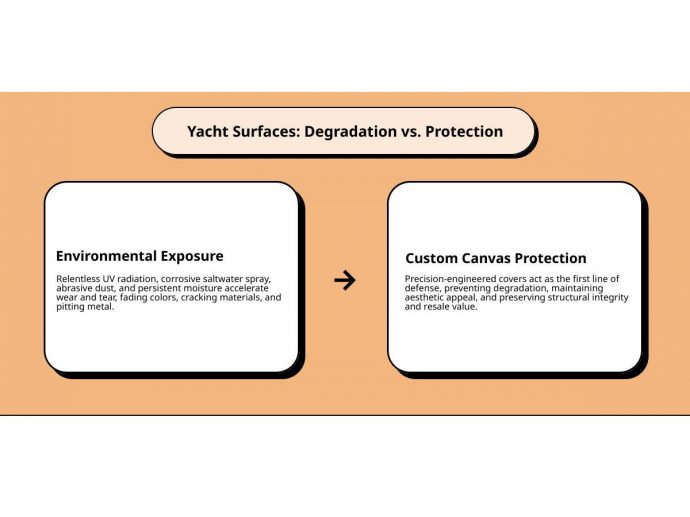
The degradation of yacht surfaces from UV, salt, and environmental exposure versus the protection offered by custom covers is stark. Without adequate protection, a yacht's aesthetic appeal and structural integrity can diminish rapidly, leading to costly repairs and a significant reduction in resale value. This is why a precision-engineered canvas, explicitly designed for your vessel, is not just an accessory but a fundamental necessity for long-term preservation.
The Shortcomings of Standard Covers in Professional Marine Operations
In the field of luxury yachts, where meticulous attention to detail and flawless presentation are paramount, generic, off-the-shelf boat covers do not suffice. These "one-size-fits-all" solutions, while perhaps adequate for smaller, less complex vessels, introduce a host of problems for yachts typically 60ft and larger.
The most immediate issue is the poor fit. Generic covers often sag, leaving pockets where water can pool, creating breeding grounds for mold and mildew, and putting undue stress on the fabric. Conversely, they can be too tight in certain areas, leading to premature tearing or inadequate coverage. This improper fit also makes them highly susceptible to wind damage. During even moderate breezes, loose fabric flaps violently, creating an abrasive action that can scour paint, gelcoat, and brightwork. This "wind chafe" is a silent destroyer, slowly but surely eroding the yacht's pristine finish.
Beyond physical damage, a poorly fitted cover's unprofessional appearance detracts from the yacht's grandeur—a luxury vessel, whether at anchor or in the marina, should always exude elegance. A saggy, flapping, or ill-fitting cover undermines this image, reflecting poorly on the owner and crew. Furthermore, the constant need to adjust, repair, or replace these inadequate covers significantly increases crew labor, diverting valuable time from other critical maintenance tasks. For professional marine operations, where efficiency and presentation are key, the shortcomings of standard covers are simply unacceptable.
The Hidden Costs of an Improper Fit
The initial appeal of a lower-cost, generic boat cover quickly fades when confronted with the hidden costs associated with an improper fit. What might seem like a saving upfront inevitably leads to greater expenses and frustrations down the line.
Firstly, compromised protection means your yacht is not truly safeguarded. Areas left exposed or inadequately covered remain vulnerable to the sun, salt, and weather, accelerating the degradation of materials. This directly translates into frequent replacements of the cover itself, as cheap materials and poor fit lead to premature wear and tear. Instead of a durable, long-term solution, you're investing in a recurring expense.
More critically, an improper fit can cause significant damage to the yacht's surfaces. Wind chafe, as mentioned, can abrade gelcoat and brightwork, necessitating expensive refinishing. Water pooling can stain decks and upholstery, and trapped moisture can foster mold growth in areas meant to be protected. These damages not only require costly repairs but also reduce the vessel's resale value. A yacht that shows signs of neglect, even if superficial, will command a lower price. The negative impression left by a shabby, ill-fitting cover at the dock can subtly but surely affect perceptions of the vessel's overall condition and care.
Functionality Gaps: Access, Vents, and Hardware
Standard covers often overlook the practicalities of yacht operation, creating significant functionality gaps that impede daily routines and compromise protection. A generic cover is designed with a broad stroke, not with the specific contours and operational needs of a luxury yacht in mind.
One common issue is blocked access hatches. Crew members often need quick, unobstructed access to various compartments, fuel fills, or storage areas. A cover that requires extensive removal or awkward maneuvering to access these points wastes valuable time and increases the likelihood of damage to the cover or the yacht. Similarly, inadequate ventilation is a critical oversight. Trapped stagnant air beneath a cover can lead to condensation, promoting mildew growth and unpleasant odors, especially in humid environments. Custom covers incorporate strategically placed vents to ensure proper airflow while keeping moisture out.
Furthermore, generic covers rarely account for the myriad of hardware, antennas, and sensors that adorn a modern yacht. This leads to chafe points where the fabric rubs against sharp edges or protrusions, causing premature wear to both the cover and the yacht's components. Interference with antennas and sensors can also occur if the cover is not designed to accommodate them adequately. Lastly, inadequate reinforcement at stress points, such as cleats, stanchions, or around complex structures like T-tops or radar arches, means these covers are prone to tearing where protection is needed most. Custom marine canvas, by contrast, integrates these considerations into its design, ensuring seamless functionality and superior protection.
Hallmarks of True Custom Marine Canvas Fabrication
Accurate custom marine canvas fabrication for luxury yachts transcends the simple act of cutting and sewing fabric. It is a highly specialized process that blends advanced technology with meticulous craftsmanship, ensuring a cover that is not only protective but also perfectly integrated with the vessel's design and operational needs.
At its core, custom fabrication begins with precision. This involves digital patterning, often utilizing sophisticated 3D scanning technology to capture every curve, contour, and protrusion of the yacht. This data is then used to create precise digital templates. CNC cutting tables translate these digital designs into flawlessly cut fabric panels, eliminating human error and ensuring repeatable accuracy.
The integrity of the seams is paramount. We employ advanced techniques, such as high-frequency welding for specific materials, or durable PTFE threads for stitching, which are resistant to UV degradation and harsh marine environments. Reinforcement strategies are also key, with extra layers of material and specialized stitching applied at stress points, corners, and around hardware. The choice of material itself is a science, selecting fabrics that offer optimal UV resistance, water repellency, and breathability for the yacht's specific climate and usage.
Custom marine canvas is about delivering a product that fits like a second skin, improves the yacht's aesthetic, and provides unparalleled protection. This level of detail and quality is what sets actual custom marine canvas apart. It is why professionals turn to experts in Precision yacht canvas covers for their most discerning clients.
The Importance of Digital Patterning for Perfect Fit
The foundation of a truly custom boat cover lies in its patterning, and for luxury yachts, this process has been revolutionized by digital technology. Traditional methods of hand-patterning with plastic sheeting or paper templates are prone to human error, time-consuming, and challenging to reproduce with exact precision. Digital patterning, however, ensures a perfect fit every single time.
We begin with 3D scanning technology, which captures the exact dimensions and complex geometries of your yacht, down to the millimeter. Tools like the ProLiner are employed to create a digital "twin" of your vessel's components, accounting for every curve, cleat, and antenna. This eliminates the guesswork and potential for errors inherent in manual measurements.
The benefits are manifold: it ensures the cover hugs every contour of your yacht without sagging or chafing. It guarantees that cutouts for hardware, such as stanchions, cleats, or radar arches, are perfectly aligned. Furthermore, for yacht builders or those with fleets of sister ships, digital patterning ensures repeatability. If a cover needs replacement years down the line, the exact digital file can be retrieved, guaranteeing an identical fit without the need for re-patterning. This precision not only improves the cover's protective capabilities but also contributes to the yacht's neat appearance, reflecting the high standards expected in luxury marine operations.
Advanced Materials: Choosing the Right Fabric for the Mission
The performance and longevity of custom marine canvas are intrinsically linked to the quality and type of fabric chosen. For luxury yachts, selecting the "right" fabric is a mission-critical decision, as different materials offer distinct advantages depending on the yacht's operational environment and specific protective needs. We carefully evaluate each cover's mission profile to recommend the optimal material.
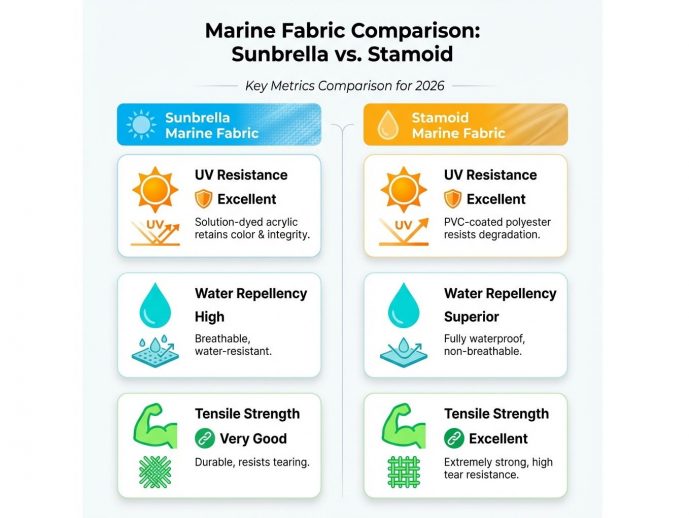
Consider the two titans of marine fabrics: Sunbrella and Stamoid. Both are premium choices, but they excel in different areas.
Feature Sunbrella Marine Fabric Stamoid Marine Fabric UV Resistance Excellent; Solution-dyed acrylic retains color Excellent; PVC-coated polyester resists UV degradation Water Repellency High; Breathable, water-resistant Superior; Fully waterproof, non-breathable Tensile Strength Very Good; Durable, resists tearing Excellent; Extremely strong, high tear resistance Cleanability Easy; Resists mold/mildew, can be cleaned with bleach Very Easy; Smooth surface, easy to wipe clean Breathability High; Allows air circulation, reduces condensation Low; Requires proper ventilation to prevent condensation Weight Moderate; Soft, pliable Moderate to Heavy; Stiffer, more structured Appearance Fabric-like, wide color range Smooth, glossy, modern look Suitability Covers, biminis, enclosures; Humid climates (e.g., South Florida) for breathability Mooring covers, cockpit covers, enclosures; Extreme weather, sleek aesthetic Sunbrella, a solution-dyed acrylic, is renowned for its exceptional UV resistance and colorfastness. Its breathable nature makes it ideal for covers in humid climates, such as South Florida, helping prevent moisture buildup and mildew. It's also soft, pliable, and comes in a vast array of colors, offering a more traditional fabric aesthetic.
Stamoid, a PVC-coated polyester, offers superior waterproofing and an incredibly smooth, sleek finish. It's powerful and easy to clean, making it a favorite for mooring and cockpit covers where a completely watertight barrier and a modern look are desired. However, its non-breathable nature means proper ventilation must be engineered into the cover design to prevent condensation.
Beyond these, other specialized fabrics exist for specific applications, such as clear vinyls for windows or mesh fabrics for sunshades. Our expertise lies in understanding these material properties and matching them to your yacht's unique requirements, ensuring optimal protection and longevity.
The Fabrication Process: A Fusion of Technology and Craftsmanship
The journey from a yacht's precise measurements to a perfectly fitted marine canvas cover is a sophisticated process that marries cutting-edge technology with the skilled hands of experienced artisans. It’s a testament to how modern manufacturing techniques improve, rather than replace, traditional craftsmanship.
It begins with the on-site 3D digital scanning, where every contour and detail of the yacht is carefully captured. This data then feeds into sophisticated CAD (Computer-Aided Design) software, allowing our designers to create a precise digital model of the cover. This digital blueprint ensures perfect alignment with the yacht’s structure, accounting for every cleat, stanchion, and antenna.
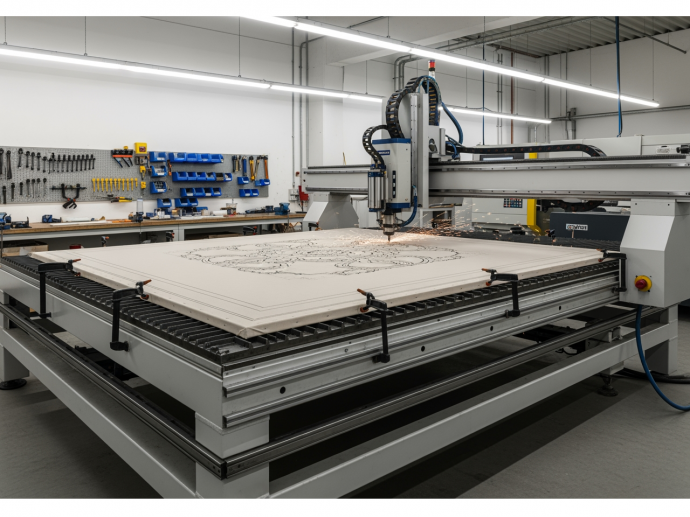
Once the design is finalized, it moves to the automated cutting phase. Large CNC cutting tables precisely cut the fabric panels, following the digital patterns with unparalleled accuracy. This ensures perfect seam allowances and minimizes material waste.
For certain materials and applications, high-frequency welding is employed to create robust, watertight seams. For stitched components, we use durable PTFE threads, known for their resistance to UV and chemical degradation, far outlasting conventional polyester threads. Throughout the entire process, rigorous quality control checkpoints are in place, from fabric inspection to seam strength testing, ensuring that every custom marine canvas product meets the highest standards of durability and finish. This fusion of technology and craftsmanship guarantees a cover that is not only functional but also a work of art.
From On-Site 3D Scan to Digital Template
The first, and arguably most critical, step in crafting a truly custom marine canvas cover is obtaining precise measurements of the yacht. In the past, this involved tedious and often inaccurate manual templating with plastic sheeting, a method prone to human error and difficult to replicate. Today, we leverage advanced on-vessel 3D scanning technology to revolutionize this process.
Our technicians use specialized equipment to perform comprehensive 3D scans of the yacht's exterior, capturing every curve, angle, and protrusion with millimeter-level accuracy. This process creates a detailed digital model, effectively a "digital twin" of the yacht, that serves as the foundation for the cover's design. This digital data is then converted into precise digital templates within our CAD software.
This method offers several significant advantages. It drastically reduces the time required to create physical templates, enabling a more efficient workflow. More importantly, it eliminates the potential for inaccuracies arising from manual measurements or shifting templates. The digital template ensures the final cover fits like a second skin, perfectly accommodating the yacht's unique features, such as complex T-tops, radar arches, or custom deck layouts. This precise digital foundation ensures the flawless fit and seamless integration that luxury yacht owners expect from their custom marine canvas.
The Role of CNC Cutting in Flawless Custom Marine Canvas
Once the digital templates are perfected, the next step toward a flawless custom marine canvas is CNC (Computer Numerical Control) cutting technology. This advanced automation plays a pivotal role in translating the intricate CAD designs into precisely cut fabric panels, a process that is impossible to replicate with manual cutting methods.
The CAD files, which contain all the precise measurements and contours captured during the 3D scanning phase, are fed directly into the CNC cutting machine. This machine then uses a high-precision blade or laser to cut the fabric with unparalleled accuracy. Every curve, every cutout for a stanchion, every seam allowance is executed exactly as designed, eliminating the variations that can occur with hand-cutting.
The benefits of CNC cutting are extensive:
- Speed: It significantly accelerates the cutting process, allowing for quicker turnaround times.
- Accuracy: Ensures every panel is cut to exact specifications, guaranteeing a perfect fit when assembled.
- Repeatability: For yachts with multiple identical covers or for future replacements, CNC cutting ensures consistent production every time.
- Material Optimization: The software can efficiently nest patterns, minimizing fabric waste and contributing to a more sustainable process.
- Complex Geometries: It can handle highly intricate designs and tight tolerances that would be impossible or extremely difficult to achieve manually.
This level of precision is critical for luxury yacht covers, where even minor fit discrepancies can lead to chafing, water ingress, or an aesthetically displeasing appearance. CNC cutting is therefore an indispensable tool in our pursuit of flawless custom marine canvas.
Integrating Custom Canvas into Yacht Operations and Maintenance
A custom marine canvas cover, no matter how precisely fabricated, only truly fulfills its purpose when it can be easily and efficiently integrated into a yacht's daily operations and long-term maintenance routine. For a busy crew, the ease of installation and removal is just as important as the protection it provides. We design our covers with the end-user in mind, ensuring they improve, rather than hinder, yacht management.
This involves designing intuitive fastening systems, clearly labeling components, and accounting for the physical challenges of handling large fabric sections. The goal is to make the process of covering and uncovering a yacht a smooth, one-person job where possible, or a streamlined team effort for larger, more complex covers.
Furthermore, the design must also facilitate proper storage and long-term care. This includes considerations for how the cover will be folded, stored when not in use, and maintained to maximize its lifespan. By focusing on these operational aspects, we ensure that our custom canvas solutions are not just protective barriers but integral, user-friendly components of a well-managed yacht.
Designing for the Crew: Ease of Installation and Storage
For the crew of a luxury yacht, time is a precious commodity, and efficiency is paramount. A beautifully crafted custom cover is only truly valuable if it can be installed and stored with ease, without requiring excessive labor or specialized tools. Our design philosophy centers on "designing for the crew."
This means incorporating intuitive fastening systems. Whether it's a combination of heavy-duty zippers, quick-release buckles, or strategically placed snaps, the goal is to make the process straightforward. Sections of multi-part covers are clearly labeled (e.g., "Port Bow," "Starboard Stern") to eliminate guesswork during deployment. Tensioning systems are designed to be easily adjustable, allowing the crew to achieve a snug fit without undue strain.
Lightweight yet durable material choices are also crucial, especially for larger covers that need to be handled by one or two individuals. We strive to balance robust protection with manageable weight. Furthermore, storage considerations are integrated into the design. Covers are often designed to fold or roll into compact, manageable bundles, sometimes with integrated storage bags, to prevent damage when not in use. This attention to practical details ensures that the custom canvas improves crew efficiency, allowing more time for other critical yacht operations and less time wrestling with cumbersome covers.
Best Practices for Maintaining High-End Custom Marine Canvas
Investing in high-end custom marine canvas is a commitment to protecting your yacht. To ensure this investment provides maximum longevity and performance, proper cleaning and maintenance are essential. Neglecting these practices can significantly shorten the lifespan of even the most durable fabrics.
Here are our best practices for maintaining premium marine canvas:
- Regular Cleaning: For most high-quality marine fabrics, such as Sunbrella or Stamoid, a simple routine of brushing off loose dirt and rinsing with a garden hose weekly is often sufficient.
- Deep Cleaning: For more stubborn stains or general grime, use a mild soap or specialized marine fabric cleaner. Apply with a soft brush, allow it to penetrate, and then rinse thoroughly with plenty of fresh water until all soap residue is gone. Avoid using harsh detergents, bleach, or abrasive cleaners, as these can damage protective coatings and fabric integrity.
- Avoid Machines: Never put marine canvas in a washing machine or dryer. The agitation can damage the fabric and coatings, and high heat can cause shrinkage or material degradation.
- Proper Drying: Always ensure the canvas is completely dry before folding and storing it. Storing a damp cover is the fastest way to encourage mold, mildew, and unpleasant odors. If possible, reinstall the yacht's cover to dry thoroughly.
- Storage: When not in use, store the cover in a clean, dry, well-ventilated area, preferably in a dedicated storage bag to protect it from dust and pests.
- Hardware Inspection: Regularly inspect all fastening hardware – snaps, zippers, buckles, and straps – for signs of wear, corrosion, or damage. Lubricate zippers as needed with a marine-grade lubricant.
- Stitching Check: Periodically examine the stitching for any signs of fraying or deterioration. While PTFE threads are highly durable, early detection of issues can prevent larger problems.
- Padding: Continue to use padding on any sharp edges or protrusions on the yacht, even with a custom-fitted cover, to prevent chafe and extend the cover's life.
By adhering to these best practices, you can significantly extend the lifespan of your custom marine canvas, ensuring it continues to provide unparalleled protection and maintain its pristine appearance for years to come.
Comments
