Categories more
- Adventures (62)
- Arts / Collectables (14)
- Automotive (77)
- Aviation (65)
- Bath, Body, & Health (123)
- Children (6)
- Cigars / Spirits (71)
- Cuisine (66)
- Design/Architecture (22)
- Electronics (63)
- Entertainment (36)
- Event Planning (115)
- Fashion (45)
- Finance (10)
- Gifts / Misc (6)
- Home Decor (118)
- Jewelry (41)
- Pets (3)
- Philanthropy (1)
- Real Estate (16)
- Services (44)
- Sports / Golf (14)
- Vacation / Travel (85)
- Watches / Pens (33)
- Wines / Vines (34)
- Yachting / Boating (67)


Saint-Émilion Grand Cru's Best-Kept Secret: The Estates, the Soils, and the Story

Published
06/11/2026Most wine regions have an official story — the one told in guidebooks, classification charts, and grand tasting evenings where the famous names pour in order of prestige. Saint-Émilion's official story is extraordinary enough on its own: a UNESCO World Heritage medieval town, a limestone plateau that produces some of the world's most sought-after Merlot, and a classification system that counts Château Ausone and Château Angélus among its highest-ranked estates.
But the more interesting story of Saint-Émilion has always run alongside the official one — quieter, less amplified, and considerably more rewarding for those willing to look for it. Château L'Hermitage Lescours is part of that story. And the further back you trace it, the more compelling it becomes.
A Royal Refuge: Seven Centuries of History on These Grounds
The land that Château L'Hermitage Lescours occupies today has been recorded in history since 1341, when a castle was built here by Pey de Lascortz, a squire of King Edward III of England. At that time, the Bordeaux region was under English rule — a political reality that shaped the wine trade for centuries and gave the region its enduring connection to export markets across the Channel. The estate was, from its earliest days, a significant property in the region.
The castle that stood on these grounds was built to withstand conflict. Surrounded by deep moats and fortified with defensive walls designed to repel enemies advancing from the Dordogne River — just 500 metres away — it was constructed as much for survival as for prestige. Those fortifications would prove relevant far sooner than anyone might have anticipated.
In 1582 and again in 1583, Henri de Navarre — the man who would become King Henri IV of France — sought refuge at the Château de Lescours. He came not as a king but as a hunted Protestant leader, navigating the murderous complexity of the French Wars of Religion. France was in the grip of a decades-long conflict between Catholic and Huguenot factions that had already produced the St. Bartholomew's Day Massacre a decade earlier. Henri de Navarre, as a Calvinist heir to the throne, was one of the most politically dangerous men in France. The estate's fortifications, its deep moats, and its position in the Bordeaux countryside offered him the discretion and security he needed.
He would go on to become King Henri IV in 1589 — one of the most consequential monarchs in French history, famous for issuing the Edict of Nantes in 1598 which granted religious tolerance to French Protestants and ended the Wars of Religion. The tower where he is said to have sheltered still stands on the estate today, known as the Tour Henri IV — a physical thread connecting the contemporary wines of Château L'Hermitage Lescours to one of France's most pivotal historical figures.
Few wine estates anywhere in the world can claim a history of this depth. Pétrus, for all its vinous greatness, dates its winemaking history to the 19th century. Château Angélus traces its modern reputation to the 1980s. The land beneath Château L'Hermitage Lescours was already strategically significant, politically consequential, and architecturally fortified before many of the appellation's most famous names had drawn their first vine.
The 19th century brought a different kind of cultivation. Vines were planted across the estate, and the property began its evolution from medieval stronghold to wine-producing estate within the Saint-Émilion Grand Cru wines appellation — the same appellation it holds today.
What Saint-Émilion Grand Cru Actually Means
The designation Saint-Émilion Grand Cru is one of the most misunderstood in Bordeaux. To the uninitiated, it sounds like a classification — a ranked position within a hierarchy of quality. In fact, it is an appellation in its own right, with its own strict production requirements that sit well above the standard Saint-Émilion AOC.
To qualify, estates must respect a maximum yield of 40 hectolitres per hectare — a meaningful constraint in a region where overproduction is always a commercial temptation. A minimum of 12 months of maturation is required before the wine can be released. The permitted grape varieties are tightly controlled: Merlot, Cabernet Franc, and Cabernet Sauvignon. Every bottle bearing the Saint-Émilion Grand Cru designation has passed through a tasting panel as part of its approval process.
The result is an appellation built around restraint and quality rather than volume. Château L'Hermitage Lescours operates entirely within these parameters, and the wines it produces reflect the discipline the appellation demands.
The Soils: Calcareous Clay and the Right Bank's Most Rewarding Geology
Saint-Émilion's reputation rests in no small part on its geology. The limestone plateau that runs beneath the medieval town and its surrounding communes provides the distinctive mineral character and natural drainage that allows Merlot — and to a lesser extent Cabernet Franc — to express a depth and aromatic complexity that the gravel-dominated soils of the Médoc rarely produce.
The estate sits in the commune of Saint-Sulpice-de-Faleyrens, where the dominant soil type is calcareous clay: a combination of limestone-derived calcium and fine clay particles. This soil profile manages water extremely well — draining quickly during heavy rainfall while retaining enough residual moisture to sustain vines through the drier months of the growing season. The controlled stress this creates forces vine root systems deeper into the subsoil, concentrating flavour compounds and building the structural complexity that defines wines built for the cellar.
Château Ausone, roughly five kilometres to the northwest and one of only two estates ever to hold the Saint-Émilion Premier Grand Cru Classé A designation, is celebrated globally for the mineral tension and precision its limestone plateau produces. The two estates draw from related geological foundations — the same ancient marine sediment deposits that define so much of the Right Bank's finest terroir. The expressions differ, as they should across different parcels and elevations of land, but the underlying logic is shared: calcareous soils, patient viticulture, and Merlot given the time and conditions it needs to become something genuinely complex.
The estate encompasses approximately 80 hectares in total, with eight hectares dedicated to vineyards. The remaining land is preserved as wetland ecosystem, supporting local biodiversity and providing a natural buffer that contributes to the microclimate around the vines. This ratio — relatively few productive hectares within a much larger landholding — is not accidental. It reflects a philosophy that prioritises the quality of what the land produces over the quantity.
Famous Neighbours: The Estate's Remarkable Geography
One of the most compelling things about Château L'Hermitage Lescours is where it sits within the Saint-Émilion landscape. The concentration of world-famous estates within a short drive of the property is not merely impressive — it says something meaningful about the quality of the terroir in this pocket of Bordeaux.
Château Monbousquet — 2.5 km
The closest major neighbour of note is Château Monbousquet, just two and a half kilometres away in the same commune of Saint-Sulpice-de-Faleyrens. Owned by Gérard Perse — who also owns Château Pavie, one of only two estates holding Premier Grand Cru Classé A status in the current Saint-Émilion classification — and with Michel Rolland as consulting oenologist, Monbousquet represents the level of investment and ambition the local terroir can attract and sustain. The fact that two estates sharing the same commune also share such different profiles of recognition tells you something about the discovery potential that still exists in this part of the appellation.
Château Ausone and Château Canon — 5 km
Nine minutes to the northwest, Château Ausone produces around 20,000 bottles per year from its ancient limestone terroir. Along with Château Cheval Blanc, it holds the rarest tier of the Saint-Émilion classification — a status so exceptional it exists in a category of its own. Tiny production, extraordinary critical scores, and a price point that places it beyond the reach of most buyers have made Ausone one of the most mythologised estates in wine. Château Canon, at roughly the same distance, is owned by the Wertheimer family of Chanel and carries Premier Grand Cru Classé B status. Its 18th century architecture and the consistency of its critical reception make it one of the appellation's most admired addresses.
Château Angélus and Château Pavie — 5.5 to 6 km
Château Angélus — Premier Grand Cru Classé A and internationally recognised in part through its appearance in the James Bond film Casino Royale — sits approximately ten minutes from the estate. Château Pavie, also Premier Grand Cru Classé A and also owned by Gérard Perse, is twelve minutes away. Together these two estates represent some of the most concentrated winemaking ambition in the entire appellation, and their proximity is a quiet indicator of the quality neighbourhood Château L'Hermitage Lescours calls home.
Château Cheval Blanc and Château Figeac — 11 km
Fifteen minutes to the northwest, Château Cheval Blanc occupies one of the two highest tiers in Saint-Émilion's classification alongside Ausone. Co-owned by LVMH and Bernard Arnault, it is famous for an unusual blend in which Cabernet Franc plays a dominant role — a rarity on the Right Bank and a defining characteristic of its profile. Château Figeac, neighbour and historic rival of Cheval Blanc, is considered one of the Right Bank's most intellectually serious estates and consistently earns some of the appellation's strongest critical scores.
Pétrus — 17 km
Twenty minutes from the estate, across the appellation boundary into Pomerol, sits the wine that many consider the single most famous in the world. Pétrus produces around 30,000 bottles per year from just under twelve acres of blue clay plateau — almost entirely Merlot, and vinified with a precision and patience that has made its name synonymous with the possibilities of the grape variety. It is not open to visitors and its bottles rarely appear at auction below four figures. Its proximity to Château L'Hermitage Lescours is simply a geographical fact — but it is a fact worth understanding when thinking about the winemaking context these vines occupy.
The Wines: What the Estate Produces Today
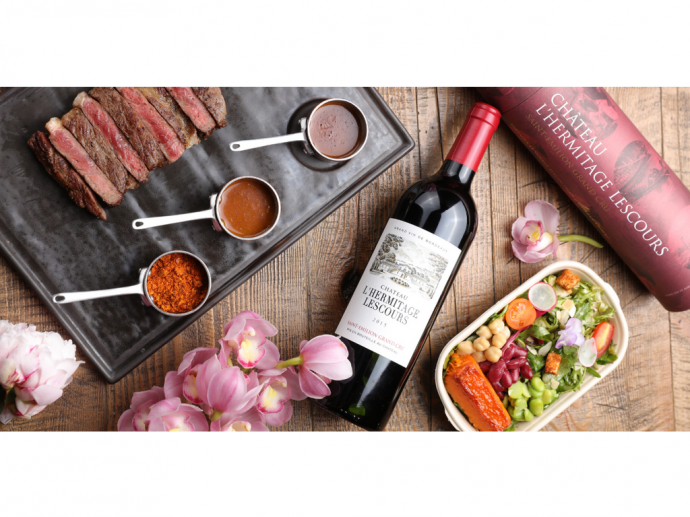
Château L'Hermitage Lescours produces two ranges under the Saint-Émilion Grand Cru appellation, both built on the same Merlot-dominant blend that has defined the estate's style since its vines were first planted in the 19th century.
The flagship range — Château L'Hermitage Lescours 2020 priced at $189 for the current vintages and $175 for the 2018 — is a blend of 80% Merlot, 15% Cabernet Sauvignon, and 5% Cabernet Franc. It has drawn consistent critical praise across three recent vintages: James Suckling awarded the current release 92–93 points, calling it the best wine the estate has ever produced. Neal Martin gave the preceding vintage 93–95 points. Antonio Galloni and Jeb Dunnuck have both rated the estate's wines in the 90–93 point range across multiple vintages. The 2018 earned a Silver Medal and 90 Points at the Decanter World Wine Awards.
Cuvée 9, priced at $99, is the estate's second expression — a wine with its own identity rather than a simplified version of the flagship. Deep ruby in colour, built around ripe plums and black cherries, with the warm generosity and lingering finish that characterises the best Right Bank Merlot. For collectors approaching the estate for the first time, it is the natural starting point.
Both ranges are produced under the strict parameters of the Saint-Émilion Grand Cru appellation, from vines planted in the calcareous clay soils that have defined the estate's character since its winemaking began. The blend, the yields, the maturation — all of it reflects the same philosophy that brought Henri de Navarre to these grounds four centuries ago: a belief that the land, when respected, offers something worth protecting.
Why This Estate Rewards Attention
Saint-Émilion Grand
Cru is a competitive appellation. There are 85 classified estates alone, and many more producing wines of genuine quality without official rank. In that context, Château L'Hermitage Lescours occupies an unusual position: a property with one of the deepest historical roots in the region, sitting in a commune shared with estates owned by some of the most serious operators in Bordeaux, producing wines that have earned multiple 90+ point scores from the critics who shape international buying decisions — and doing so at prices that remain meaningfully accessible relative to its neighbours.
The Tour Henri IV still stands. The moats are still there. The calcareous clay still pulls the vines toward the depth and complexity that has defined this corner of the Right Bank for centuries. And the wines that come from this ground carry that weight — quietly, without fanfare, in the way that the best-kept secrets always do.
Château L'Hermitage Lescours wines are available to purchase at chateaulescours.com. The estate produces red wines under the Saint-Émilion Grand Cru appellation, with the flagship range and Cuvée 9 available across recent vintages.
Comments
