Categories more
- Adventures (62)
- Arts / Collectables (14)
- Automotive (77)
- Aviation (59)
- Bath, Body, & Health (123)
- Children (6)
- Cigars / Spirits (71)
- Cuisine (64)
- Design/Architecture (22)
- Electronics (63)
- Entertainment (4)
- Event Planning (13)
- Fashion (45)
- Finance (10)
- Gifts / Misc (6)
- Home Decor (45)
- Jewelry (41)
- Pets (3)
- Philanthropy (1)
- Real Estate (16)
- Services (23)
- Sports / Golf (14)
- Vacation / Travel (69)
- Watches / Pens (14)
- Wines / Vines (33)
- Yachting / Boating (67)



Sealed and Graded: The Auction Market for Vintage Game Hardware

Published
08/21/2026In a Las Vegas gallery this spring, a rebuilt oak cabinet from 1905 sold for more than most people spend on a car. Elsewhere, a shrink wrapped Nintendo cartridge has done considerably better than that. Collectors of old play machines built a serious market while nobody was watching.
Cast Iron and Coin Chutes
Morphy's ran its Coin-Op and Advertising sale in Las Vegas from May 21 to 23, 2026, moving more than 1,700 lots for over $3 million. The star was a Caille Brothers "Centaur" from around 1905 to 1910, fully restored and still working, with the rare harp castings collectors chase. It closed at $227,500.
Three separate mechanisms, one oak cabinet, every part of it cast in Detroit. What Caille's engineers solved with iron and springs, Slotopia and its contemporaries now solve in code, which ships lighter and restores far worse. A Mills "20th Century" upright from roughly 1900 took $92,250, helped along by its scarce dollar denomination.
Not every lot in that room was a gaming device. A 1942 Rock-Ola Commando jukebox tripled its high estimate at $19,680, which says something about wartime cabinet designers and their sense of proportion.
The Cartridge Records
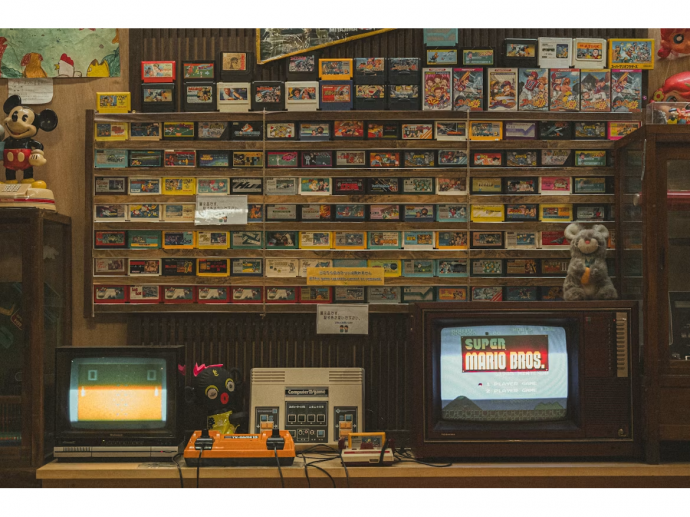
Sealed video games arrived in this world later and much louder. Heritage Auctions held its first dedicated video game sale in July 2021 and finished the weekend above $8.4 million. Nobody in that room had forecast the number.
Three results still mark the ceiling of the category:
- Super Mario 64, graded Wata 9.8 A++, went for $1.56 million in July 2021, the first game past seven figures.
- Two days earlier an early copy of The Legend of Zelda for the NES reached $870,000.
- January 2022 brought $480,000 for John Madden Football on the Genesis, a record for a sports title.
Hardware followed the software up. A factory sealed 1986 NES Deluxe Set, complete with R.O.B., the Zapper, Duck Hunt and Gyromite, brought $120,000 at Heritage. Limited run N64 color variants in graded condition sit between roughly $6,400 and $7,300, off production runs of ten to fifty thousand units.
Why Anything Is Rare Anymore
Here is the odd part. A sealed copy of Fortnite, the only Wata 10 A++ in the population, sold for $42,500 in late 2025. The old record for that game sat under $15,000. Fortnite is not old, and hundreds of millions of people have played it. So where does the price come from?
Almost nobody owned it in a box.
Physical editions thinned out as downloads took over, and scarcity did the rest. A sweeps slot launched this month has no box, no shrink wrap, nothing a grader could ever encase in plastic. Collectors now argue about whether that makes the last physical objects precious or simply closes the category.
Estimates put the retro collectibles market near $4.18 billion for 2026, up from something like $3.8 billion, though those figures trace back to a handful of industry reports and deserve a raised eyebrow.
Before You Bid
Treat grading as a cost rather than a blessing. Wata and VGA charge between $50 and $150 per item with turnaround times that test patience, so grading a common cartridge rarely earns back the fee.
Worth checking before the paddle goes up:
- Condition and completeness now move prices more than the name printed on the box.
- In January 2026, CGC widened its game grading to Famicom, Japanese Game Boy, GBA, Atari, Genesis, PS1 and Dreamcast, at a flat $40 on the standard tier.
- Original packaging, inserts and manuals hold value far better than a bare cartridge does.
- Morphy's runs its next coin-op sale in Las Vegas on October 16 and 17, 2026, for anyone drawn to the cast iron end of the hobby.
Buy the object you actually want to look at. Everything else is spreadsheet work.
Comments
