Categories more
- Adventures (62)
- Arts / Collectables (14)
- Automotive (77)
- Aviation (65)
- Bath, Body, & Health (123)
- Children (6)
- Cigars / Spirits (71)
- Cuisine (66)
- Design/Architecture (22)
- Electronics (63)
- Entertainment (36)
- Event Planning (115)
- Fashion (45)
- Finance (10)
- Gifts / Misc (6)
- Home Decor (118)
- Jewelry (41)
- Pets (3)
- Philanthropy (1)
- Real Estate (16)
- Services (44)
- Sports / Golf (14)
- Vacation / Travel (85)
- Watches / Pens (33)
- Wines / Vines (34)
- Yachting / Boating (67)



The Buyer Who Is Done Buying

Published
07/09/2026The luxury market is not shrinking evenly: it is losing its casual buyers and keeping its serious ones. The exit of the casual buyer is measurable. Bain & Company counted roughly 50 million people who left the personal luxury goods market in two years, pushed out by higher prices and disappointment with what those prices buy, and Bain's lead luxury analyst, Claudia D'Arpizio, has declared the era of carefree, constant buying, which she calls "the shopping spree era," over. The seriousness of the buyer who stayed is just as measurable. The industry's top clients carried 30 percent of luxury spending in 2019 and about 45 percent in 2024, and in YouGov's 2025 tracking, the Americans still planning a luxury purchase said they care most about quality, emotional satisfaction, and long-term value, with 61 percent convinced that luxury goods are simply made better. The market is being reduced to the buyers who take it seriously.
Take that seriousness to its logical end and you arrive at a specific person: the buyer who is buying in order to stop buying. This is not a minimalist; a minimalist wants to own as little as possible. This buyer wants to close a category: to buy the briefcase after which no other briefcase will ever be needed, and then to stop looking at briefcases entirely. At lower price levels a version of the same instinct already has a name: researchers at Toronto Metropolitan University describe "underconsumption core," a social media trend urging people to buy only what they truly need and to use it fully. The wealthy version has no hashtag. It is a private decision: buy once, and buy so well that the question never returns.
An industry built on the next purchase
This buyer is poorly served, because most of the luxury industry earns its money from the opposite customer, the one who comes back. The evidence that products are built for return visits keeps accumulating. Dana Thomas, the journalist who documented luxury's industrialization in her book Deluxe, described watching quality fall season by season: "What used to be a knitted one-piece were now pieces sewn together. The buttons fell off easily." Volkan Yilmaz, a leather craftsman who takes luxury goods apart for a large online audience, told CNN why he believes products now fail sooner: "you need people to keep consuming." The customers have noticed: in a 2026 Agility Research survey of wealthy consumers, two-thirds said too many luxury brands have raised prices without improving quality; among Americans, 70 percent.
In leather goods specifically, the reason a bag cannot be a final purchase is physical, and it sits on the surface. Most leather sold today, at every price, is coated with a thin film of pigment and resin. That film blocks care, because conditioner cannot pass through it to reach the hide, and the film itself fails, because it cracks with age and flexing. One leather-care reference states it exactly: "it is not the leather that is drying out and cracking but the pigment on the surface." The edges have the same weakness: they are cut, covered with paint, and the paint cracks too. So the typical bag can only age in one direction. Once its coating or its edge paint cracks, it looks worn out even if the hide beneath is still sound, and repair rarely rescues it; trade reporting has documented authentic bags refused for service without a receipt, and repairs quoted in months. A bag like that was never a candidate for a final purchase. It was always going to be replaced, and its maker planned on that.
What a final purchase requires
The alternative standard exists, and the very top of the market has sold it openly for decades: permanence as the product itself. Patek Philippe built the most famous line in luxury advertising on that idea in 1996: "You never actually own a Patek Philippe. You merely look after it for the next generation." Hermès writes in its own corporate filings that its objects are "designed to last, to be repaired, and to be passed on from one generation to the next," and reports that it serviced 200,000 products in 2024. Neither house treats longevity as a slogan. Both treat it as part of what the customer pays for.
A buyer can test any briefcase against that standard with three questions. First, does the material improve with use? Full-grain leather that is vegetable-tanned and left uncoated darkens and develops a soft shine as it is handled and exposed to light; that slow change is called patina, and it means the object looks better in year ten than in year one. Second, is there anything on the object that will wear out before the leather does? If the edges are folded into the leather instead of painted, there is no film anywhere on the bag that can crack. Third, has the maker committed to the object's future in writing? A guarantee measured in decades, with repair as the normal service rather than a reluctant exception, states how long the maker itself expects the piece to live.
A worked example
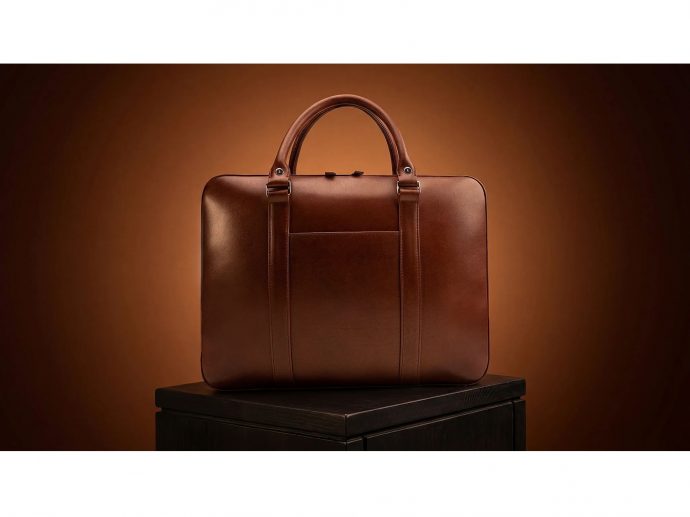
Judged by those three questions, consider Lunburg's Opus, the full grain leather briefcase built by the house that Amien Marghich, once a senior engineer at Google, founded between the Netherlands and Fes. Question one, the material: full-grain vachetta, an Italian vegetable-tanned cowhide, tanned in Tuscany with chestnut and mimosa extracts and left uncoated, chosen precisely so that it darkens and gains shine over the years. Question two, the parts that could expire before the leather: there are none, because the edges are done in rempliage, the turned edge, where the leather is folded back over itself by hand instead of being painted; nothing anywhere on the piece is painted or coated, so no film exists that could crack. Question three, the commitment: the briefcase, assembled over eight days on wooden forms in Fes by masters with more than thirty years of practice each, carries a fifty-year structural guarantee, and the house states that its first answer to any problem is repair, not replacement. That guarantee is the detail worth pausing on. A maker who has promised fifty years of repairs wants exactly what the owner wants: a briefcase that does not fail.
Comments
