Categories more
- Adventures (62)
- Arts / Collectables (14)
- Automotive (77)
- Aviation (59)
- Bath, Body, & Health (123)
- Children (6)
- Cigars / Spirits (71)
- Cuisine (64)
- Design/Architecture (22)
- Electronics (63)
- Entertainment (19)
- Event Planning (40)
- Fashion (45)
- Finance (10)
- Gifts / Misc (6)
- Home Decor (45)
- Jewelry (41)
- Pets (3)
- Philanthropy (1)
- Real Estate (16)
- Services (23)
- Sports / Golf (14)
- Vacation / Travel (69)
- Watches / Pens (14)
- Wines / Vines (33)
- Yachting / Boating (67)



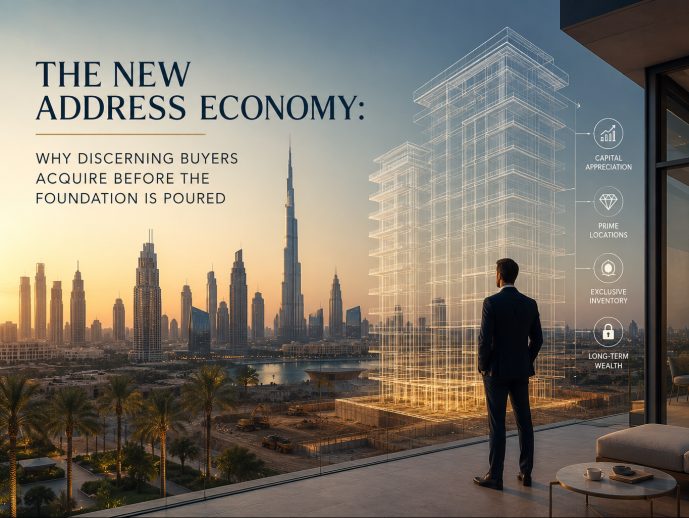
The New Address Economy: Why Discerning Buyers Acquire Before the Foundation Is Poured

Published
08/04/2026Nowhere is this rhythm more refined than in Dubai, a city that has spent two decades turning ambition into architecture. The emirate's off-plan market, meaning residences purchased during design or construction, has matured into the principal channel through which serious international buyers acquire. It rewards patience, judgement and access, which are precisely the qualities that distinguish a considered acquisition from a hurried one.
The Privilege of Choosing First
The most persuasive argument for buying early has little to do with price. It concerns selection. In a completed building, a purchaser inherits whatever remains: the north aspect, the floor above the plant room, the layout that never quite resolved itself. At launch, the buyer chooses. The half floor with the uninterrupted Gulf horizon. The duplex with its own lift lobby. The residence positioned so that morning light enters the principal bedroom rather than the service corridor. These decisions cannot be revisited once concrete is poured, and they account for a substantial share of what a home is ultimately worth.
Specification follows the same logic. Early buyers in the most accomplished schemes are frequently invited to amend layouts, combine adjacent units, or select from bespoke finishing palettes. A residence shaped to its owner from the outset carries a coherence that no subsequent renovation can imitate.
Where Architecture Meets Service
The past decade has seen the branded residence mature from novelty into a settled asset class. Houses that once confined themselves to hospitality now lend their name, their standards and their service culture to permanent homes. The appeal is not the monogram on the door. It is the certainty that the concierge understands discretion, that the residence will be immaculate on arrival after four months away, and that the building will be maintained to a standard its owners never have to enforce.
This is why the most sought-after penthouse residences in Dubai tend to sit within schemes where a recognised operator has been engaged from the earliest design stage. Service cannot be retrofitted. It has to be drawn into the plans, into the back-of-house circulation, into the staffing model, long before anyone takes possession.
The Shoreline That Cannot Be Extended
Scarcity remains the most reliable guardian of value, and there is no scarcity quite like frontage. A city can build upward indefinitely. It cannot manufacture more coastline. Dubai's engineered islands have produced some of the most tightly held addresses in the region, and demand for homes on Palm Jumeirah reflects a simple arithmetic that every seasoned collector understands: the supply is fixed and the audience is global.
The same principle governs the quieter enclaves, the low-density villa communities and the golf frontage where plot sizes were determined a decade ago and will not be revised. Rarity, once established, tends to compound.
Capital, Considered
For the internationally minded owner, Dubai's structural advantages are worth stating plainly. There is no annual property tax, no capital gains tax and no income tax on rental receipts. The dirham's peg to the US dollar removes a layer of currency uncertainty that complicates ownership elsewhere. Purchases from licensed developers are protected by mandated escrow arrangements overseen by the Dubai Land Department, which releases funds against verified construction progress rather than promises.
Payment is customarily staged across the build period rather than demanded at once, which allows capital to remain productive elsewhere while the asset takes shape. Prime districts continue to deliver net yields in the region of six to eight percent, figures that mature markets have not offered for a generation. Ownership above the two million dirham threshold also opens the ten year residency visa, which transforms a property decision into a family one.
The Craft of Choosing Well
None of this substitutes for judgement about the developer. Delivery record, financial depth, the quality of previous handovers and the honesty of the marketing material all matter more than the rendering. Specialist advisers such as My Dubai Off Plan exist precisely to make that assessment legible to buyers who are acquiring from another continent and have neither the time nor the inclination to learn a market from the outside in.
Conclusion
The address economy has changed shape. The most desirable homes are no longer discovered; they are secured, quietly, at the moment a scheme is conceived rather than the moment it is finished. For those accustomed to acquiring with foresight, whether a painting, a vineyard or a watch, the logic will feel entirely familiar. The reward for looking early has always been the privilege of choosing well.
Frequently Asked Questions
What exactly is an off-plan residence?
A home purchased before or during construction, selected from architectural plans, specifications and renderings rather than a completed unit. Payment is usually staged across the build programme.
Are funds protected before completion?
Purchases from licensed developers in Dubai are governed by regulated escrow accounts, with capital released progressively against verified construction milestones.
Can foreign nationals own property outright?
Yes. Freehold ownership is available to all nationalities within designated areas, which include the emirate's principal waterfront and central districts.
What returns are realistic?
Net rental yields in prime districts generally fall between six and eight percent, with waterfront and branded addresses tending toward the upper end. Actual performance depends on location, unit type and management.
Why acquire early rather than wait for handover?
Entry pricing is typically lower, payment is staged, and the buyer retains first choice of aspect, floor and layout, which are the elements that most reliably preserve value.
Comments
