Categories more
- Adventures (199)
- Arts / Collectibles (315)
- Automotive (219)
- Aviation (279)
- Bath, Body & Health (513)
- Children (116)
- Cigars / Spirits (271)
- Cuisine (723)
- Design / Architecture (1118)
- Electronics (222)
- Entertainment (162)
- Event Planning (296)
- Fashion (550)
- Finance (195)
- Gifts / Misc (141)
- Home Decor (558)
- Jewelry (396)
- Pets (91)
- Philanthropy (124)
- Real Estate (386)
- Services (221)
- Sports / Golf (213)
- Vacation / Travel (1036)
- Watches / Pens (223)
- Wines / Vines (861)
- Yachting / Boating (5017)



Vikrum Aiyer: Important Safety Tips Every Cyclist Should Know

Published
08/24/2026Vikrum Aiyer is a policy strategist and communications executive with experience spanning government, technology, and climate innovation. Since 2022, he has served as head of global public policy at Heirloom, a San Francisco-based carbon-removal technology company, where he has helped secure $600 million in federal funding and advanced supportive regulatory environments for climate technology. He previously served as vice president of global public policy and strategic communications at Uber/Postmates, building the company’s government relations strategy during a period of rapid growth in the gig economy, and he held roles in the Obama administration at the White House and the Department of Commerce. A political science graduate of the University of California, Berkeley, and a Wharton School Public Policy Fellow, Vikrum Aiyer was named to the Forbes 30 Under 30 and San Francisco Business Times 40 Under 40 lists. Outside of his policy work, he enjoys photography, cycling, and golf.
Important Safety Tips for Cyclists
Cycling is a popular outdoor activity in the United States. According to PeopleForBikes, more than 112 million Americans rode bikes at least once in 2024, including about 51 million people who rode their bikes on a regular basis. The benefits of cycling are manifold; in addition to physical advantages such as optimal cardiovascular health and increased core and leg strength, cycling contributes to lower levels of stress and improved mood.
In order to safely glean these benefits, individuals should observe a few key safety guidelines. To start, cyclists must learn how to effectively communicate with motorists, pedestrians, and other drivers via hand signals.
Some hand signals are straightforward. For example, riders can signal a left turn by raising their left arm parallel to the ground and fully extending their fingers, then pointing at the turn as they approach. They can signal a right turn in the same manner but with their right arm, or by extending their left arm and then bending at the elbow, pointing up to create a 90-degree angle. Pointing down, meanwhile, signals a stop.
Other signals help riders warn other cyclists about potential dangers in the road. If a cyclist is approaching a pothole or debris, they should extend their arm downward and point directly at the hazard with their index finger, using whichever arm is closer to the hazard. Riders can place their left hand behind their back and wave it up and down to indicate a tight space up ahead, signaling to other riders not to swerve out of the lane. These are only a few of the signals that are especially important for cycling safety when riding in a group.
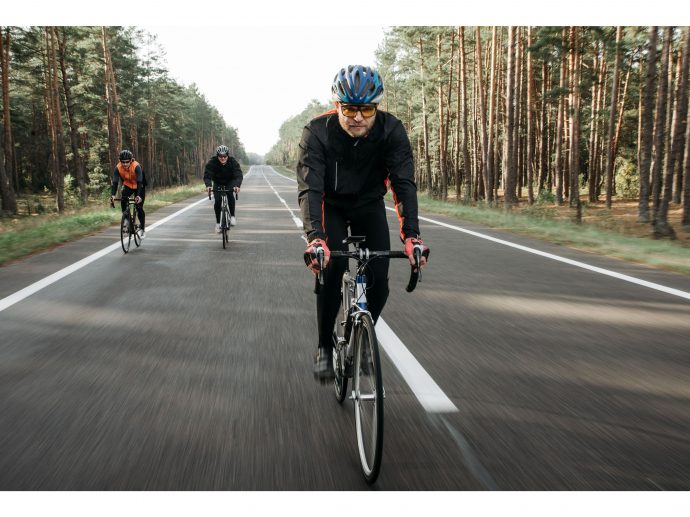
Riders must dress for safety, which means using the correct cycling equipment, as described by the National Highway Traffic Safety Administration (NHTSA).
A properly fitted helmet is arguably the most important piece of cycling equipment. Individuals can learn how to find a proper helmet by visiting the Bicycle Helmet Safety Institute website, helmets.org.
When riding at night, cyclists should outfit their body and bike with various lights and reflective strips, including a white front light, a red rear light, and a helmet light.
Riders may want to wear additional safety equipment, such as knee and elbow pads, particularly if they are riding in difficult conditions. During an off-roading or mountain biking excursion, riders should consider wearing padded shorts, gloves, and protective eyewear.
It is equally important for cyclists to select the correct bike for their ride. Taking a road bike onto a rocky, sandy trail can damage the bike and increase a person’s risk of injury, while riding a mountain bike on city streets can greatly hinder performance and comfort.
Finally, cyclists need to understand right-of-way rules and other critical aspects of interacting with traffic. Riders failing to yield the right of way is the leading cause of fatal bike crashes, followed by impaired cyclist visibility. Legally speaking, a bicycle is a vehicle, meaning it shares equal right-of-way rules with cars.
This means cyclists cannot simply ride through an intersection and assume cars will stop and allow them to pass. Both cars and bikes must give priority to pedestrians. Whenever possible, riders should use marked bike lanes, though they still need to remain aware of the surrounding traffic and make themselves visible at all times.
About Vikrum Aiyer
Vikrum Aiyer is a policy strategist and communications executive who currently serves as head of global public policy at Heirloom, a San Francisco climate-technology company he joined in 2022. He previously served in the Obama administration at the White House and the Department of Commerce, and as vice president of global public policy and strategic communications at Uber/Postmates. A UC Berkeley political science graduate and Wharton Public Policy Fellow, he has been recognized on the Forbes 30 Under 30 and San Francisco Business Times 40 Under 40 lists.
Comments
