Categories more
- Adventures (62)
- Arts / Collectables (14)
- Automotive (77)
- Aviation (65)
- Bath, Body, & Health (123)
- Children (6)
- Cigars / Spirits (71)
- Cuisine (66)
- Design/Architecture (22)
- Electronics (63)
- Entertainment (36)
- Event Planning (115)
- Fashion (45)
- Finance (10)
- Gifts / Misc (6)
- Home Decor (118)
- Jewelry (41)
- Pets (3)
- Philanthropy (1)
- Real Estate (16)
- Services (44)
- Sports / Golf (14)
- Vacation / Travel (85)
- Watches / Pens (33)
- Wines / Vines (34)
- Yachting / Boating (67)



What Does a Luxury Home Look Like Today?

Published
04/15/2026Luxury homes used to be defined in fairly simple terms. Larger footprints, grand entryways, and formal rooms were the standard markers of success. These homes were often designed to impress at first glance, even if many of the spaces saw little day-to-day use.
Today, that definition has shifted in a meaningful way. Modern luxury is less about scale and more about experience—how a home supports daily life, how it feels to move through each space, and how seamlessly it adapts to the people living in it. In places like the Washington DC metro area, and across global markets, luxury homes are becoming more personal, more functional, and more connected to lifestyle.
What defines a luxury home now is not just how it looks, but how it lives.
1. Luxury Feels Lived In, Not Formal
One of the most noticeable changes in high-end home design is the move away from formal, underused rooms toward spaces that feel comfortable and active throughout the day. Traditional dining rooms and sitting rooms are no longer the focal point. Instead, homeowners are prioritizing spaces where life actually happens.
This shift shows up in material choices and layout decisions. Bespoke cabinetry, layered textiles, and natural stone surfaces are selected not just for appearance, but for how they age and feel over time. Furniture is arranged for conversation and movement, not just symmetry. Lighting often leans toward a gallery-style approach, highlighting art, texture, and architectural moments rather than simply illuminating the room.
The result is a home that feels elevated but grounded, where a living room might host a quiet morning coffee, a working session, and an evening gathering without needing to change its identity.
2. Kitchens Have Become the Center of the Home
In modern luxury homes, the kitchen has taken on a central role that goes far beyond cooking. It is where daily life unfolds.
These spaces are often anchored by large islands designed as both functional work surfaces and sculptural focal points. Sometimes they are expansive enough to seat five or six, with stone that reads more like furniture than countertop. Sightlines are carefully considered so the kitchen connects naturally to adjacent living areas.
To support this level of use, many kitchens include secondary spaces that handle the more functional aspects of cooking and storage:
- Sculleries or back kitchens that keep preparation and cleanup out of view
- Walk-in pantries with built-in shelving systems
- Integrated coffee stations, beverage centers, or paneled appliances that disappear into the cabinetry
This layered approach allows the main kitchen to remain calm and visually cohesive, even during heavy use.
3. Indoor–Outdoor Living Is Fully Integrated
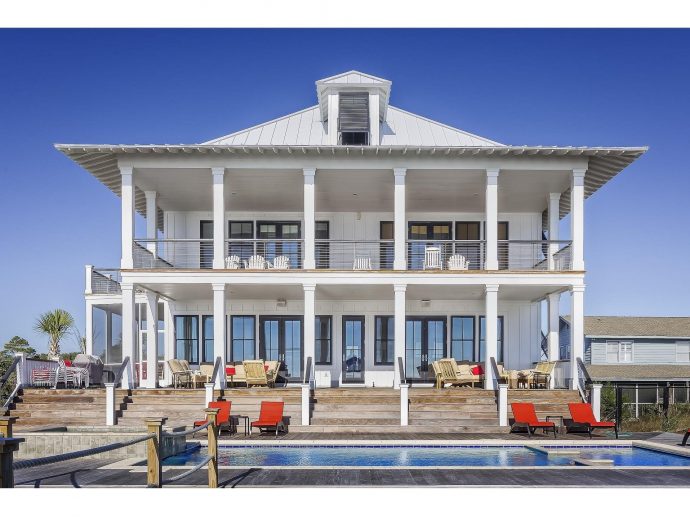
Luxury homes today are increasingly designed to extend beyond their interior walls. This is not just about adding outdoor features, but about creating a seamless architectural relationship between inside and outside.
Large-format openings allow entire sections of a wall to open onto terraces, gardens, or pools. In a DC rowhouse, that might mean a rear addition opening to a private courtyard. In Los Angeles, it could be a hillside glass pavilion overlooking the city. In London, a reworked terrace house might unfold into a layered garden space.
Outdoor areas are designed with the same level of intention as interiors. Heated stone terraces, built-in seating around fireplaces, and fully equipped outdoor kitchens allow these spaces to function throughout the day and across seasons. The transition is not an afterthought. It is part of the architecture itself.
4. Private Spaces Are More Personalized and Refined
As shared spaces have become more open, private areas of the home have become more tailored. The primary suite, in particular, now functions as a retreat within the home.
Bathrooms often include spa-like features such as steam showers, freestanding tubs, radiant heated floors, and in some cases, integrated sauna or wellness spaces. Dressing rooms are designed with custom storage systems, tailored lighting, and clear organization that makes daily routines feel effortless.
Home offices have also evolved. In many luxury homes, they are designed as fully integrated spaces with custom millwork, controlled acoustics, and carefully considered backdrops for virtual meetings. Some even include access to outdoor terraces or quiet garden views, creating a more balanced work environment.
These spaces reflect a broader shift in luxury, where privacy, comfort, and personalization are just as important as visual impact.
Luxury Is Defined by How a Home Lives
The most meaningful change in luxury home design is not tied to a single feature. It is a shift in priorities toward homes that support real life in a more seamless and intentional way.
In the DC metro area, that might take the form of a historic rowhouse with a modern rear addition. In other parts of the world, it may look entirely different—a glass hillside home in California, a refined townhouse in London, or a high-rise penthouse in Dubai—but the underlying idea is the same.
Luxury is no longer defined by how much space a home has. It is defined by how well that space supports the life happening inside it.
Comments
