Categories more
- Adventures (158)
- Arts / Collectables (107)
- Automotive (142)
- Aviation (187)
- Bath, Body, & Health (337)
- Children (69)
- Cigars / Spirits (155)
- Cuisine (439)
- Design/Architecture (173)
- Electronics (133)
- Entertainment (90)
- Event Planning (209)
- Fashion (311)
- Finance (27)
- Gifts / Misc (77)
- Home Decor (336)
- Jewelry (233)
- Pets (41)
- Philanthropy (8)
- Real Estate (202)
- Services (134)
- Sports / Golf (107)
- Vacation / Travel (805)
- Watches / Pens (144)
- Wines / Vines (548)
- Yachting / Boating (196)



When a new strap can make an old watch useful again

Published
10/19/2026A watch can remain mechanically sound long after its strap has become uncomfortable or tired. Cracked leather, stretched holes, frayed stitching and loose keepers are easy to dismiss because the watch itself still works. Yet the strap is the part that secures the case to the wrist. Its condition affects safety, comfort and how often the watch gets worn.
Replacing a worn strap is one of the simplest ways to return a neglected watch to regular use. It can also correct a poor fit or change the character of a watch without altering the case, dial or movement. The job begins with deciding whether the old strap is merely marked or genuinely at the end of its service life.
Visible wear can reveal a safety problem
Leather often shows distress around the adjustment hole used most frequently. Fine creases are normal, but deep cracking, torn edges or layers beginning to separate suggest that the structure is weakening. Stitching that has broken near the spring bar or buckle deserves prompt attention because those are load-bearing areas.
Rubber can harden, split or tear around its holes. Fabric may fray where it passes through hardware, while metal bracelets can develop excessive play or damaged clasps. Any strap can fail if a spring bar is bent or its tips no longer engage properly. A quick inspection under good light is more useful than waiting for the watch to fall.
Replacement is also a chance to improve the fit
A strap can be in good condition and still be wrong for its owner. The buckle may sit too far to one side, the tail may be awkwardly long or the watch may rotate around the wrist. These are often length and proportion problems rather than faults in the watch.
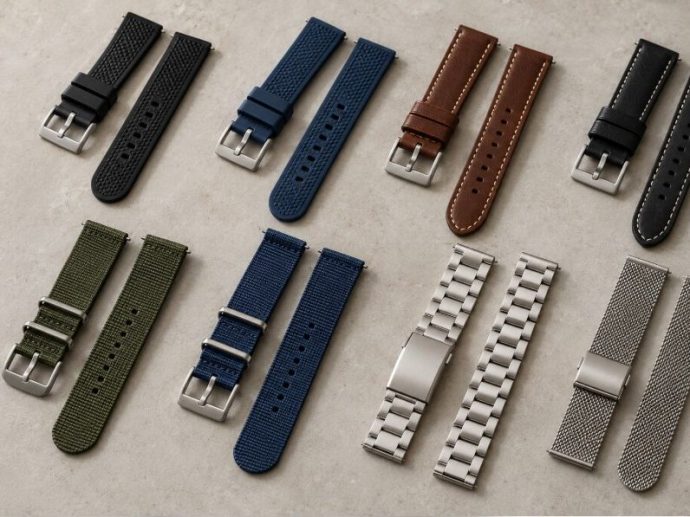
Choosing a Watch strap replacement gives the owner a chance to address those details instead of buying a close copy of the original by habit. Watch Obsession offers straps organised by width, length, material, colour and brand, which makes it easier to treat comfort as part of the decision.
The two-piece length is especially important. A shorter buckle side can bring the buckle towards the centre of a smaller wrist, while a longer overall strap may be necessary for a larger wrist or a watch worn over clothing. Measuring a comfortable existing strap provides a practical benchmark, as long as the case sizes are broadly similar.
Measure the lugs rather than guessing
Lug width is the inside distance between the watch lugs. It is normally expressed in millimetres and must match the strap at the watch end. A one millimetre difference can be enough to create a gap or make fitting difficult. The measurement should be taken at the point where the strap sits, not across the outside of the lugs.
The buckle width may be narrower because many straps taper. Anyone planning to reuse an original branded buckle should measure its inside width and confirm that the new strap has the correct taper and thickness. A deployant clasp may impose further limits, since the strap needs to pass through or seat within the mechanism correctly.
Curved-end and integrated straps require more care. The nominal lug width alone does not confirm that the end shape, spring bar position and case profile will match. Product compatibility information should be checked, and uncertain buyers should ask the retailer before forcing a part into place.
Material should follow the way the watch is worn
Leather remains a natural partner for dress watches and many vintage designs. Smooth calfskin looks restrained, while grain, contrast stitching and padded construction add more presence. Water-resistant leather exists, but ordinary leather should not be treated as a swimming strap unless its maker says otherwise.
Rubber suits moisture, exercise and warm weather when the specific model is intended for those conditions. Fabric and nylon can make a watch feel lighter and more casual. Metal can add durability and visual weight, though bracelet sizing and end-link compatibility may demand more tools and care.
There is no need to preserve the original material if another option better suits daily life. A formal watch on textured leather can become easier to wear with knitwear and casual clothing. A sports watch on soft rubber may become more comfortable during summer. The most successful change respects the case proportions even when it alters the style.
Fitting can be simple but still deserves care
Quick release spring bars allow many straps to be changed without a separate tool. The small lever should be pulled in far enough to clear the lug, then released only when both tips line up with their holes. A gentle tug confirms engagement. If the strap moves freely away from the case, one end may not be seated.
Standard spring bars require a suitable tool and a stable work surface. Masking the backs of polished lugs can reduce the chance of scratching, and working over a folded cloth helps prevent a loose bar from bouncing away. Force is a warning sign. The wrong width, end shape or bar diameter should be corrected rather than pushed into place.
A watchmaker is the better option when access is restricted, the watch has fixed bars, the case is valuable or the owner is not confident. Fitting cost is modest compared with repairing a scratched case or replacing a dropped watch.
Keep the old parts and note what worked
An original buckle, clasp or strap may be worth retaining even when it is no longer suitable for daily wear. Store it dry, label it with the watch model and keep small spring bars in a sealed packet. This makes it easier to restore the original configuration later or pass the complete set to a future owner.
It is also useful to record the lug width, preferred length and buckle size. Those details turn the next purchase into a straightforward choice. More importantly, a sound and comfortable strap puts the watch back where it belongs. A modest replacement can be the difference between a watch that stays in a drawer and one that becomes part of daily life again.
Comments
