Categories more
- Adventures (62)
- Arts / Collectables (14)
- Automotive (77)
- Aviation (68)
- Bath, Body, & Health (127)
- Children (6)
- Cigars / Spirits (72)
- Cuisine (68)
- Design/Architecture (22)
- Electronics (66)
- Entertainment (40)
- Event Planning (116)
- Fashion (47)
- Finance (10)
- Gifts / Misc (7)
- Home Decor (118)
- Jewelry (41)
- Pets (3)
- Philanthropy (1)
- Real Estate (19)
- Services (60)
- Sports / Golf (38)
- Vacation / Travel (101)
- Watches / Pens (72)
- Wines / Vines (34)
- Yachting / Boating (76)



Why Does Winter Boat Storage Matter for Long-Term Vessel Care?

Published
10/12/2026Owners who spend the season on Lake Michigan tend to think of their boat as an investment worth protecting, yet the months after haul-out decide how well that investment holds up. A vessel that runs beautifully in July can develop expensive problems by spring if it sits through a hard freeze without the right preparation. The offseason is less downtime than a test of how carefully the boat was put away.
This is why owners along the Calumet River and across the Great Lakes treat cold-weather layup as part of ownership rather than an afterthought. Choosing proper winter boat storage in Chicago gives a vessel the level of protection appropriate for its systems, materials, and service needs through the freeze-thaw cycles that define a Midwestern winter, and it keeps the boat ready to launch the moment the ice clears. The gap between a stored boat and a neglected one usually shows up in the repair bill, not on the first sunny weekend.
What Cold Weather Does to a Vessel
The damage a winter inflicts is rarely gradual. Water left in cooling passages, raw-water systems, bilges, and plumbing expands as it freezes, and that expansion cracks engine blocks, manifolds, and through-hull fittings while splitting hoses that looked sound in the fall. Outside the hull, freeze-thaw cycles blister and fade gelcoat while heavy snow loads break down canvas and enclosure clears.
Moisture does quieter harm. Snowmelt trapped under a loose cover creates a damp, sealed space that rots upholstery, warps interior wood, and spreads black mold across cushions and headliners. Rodents add their own line to the bill: mice and squirrels nest in cabins and lockers and chew through wiring harnesses, dashboard cables, and foam seating, some of the costliest damage to trace and repair.
Where the Boat Spends the Winter
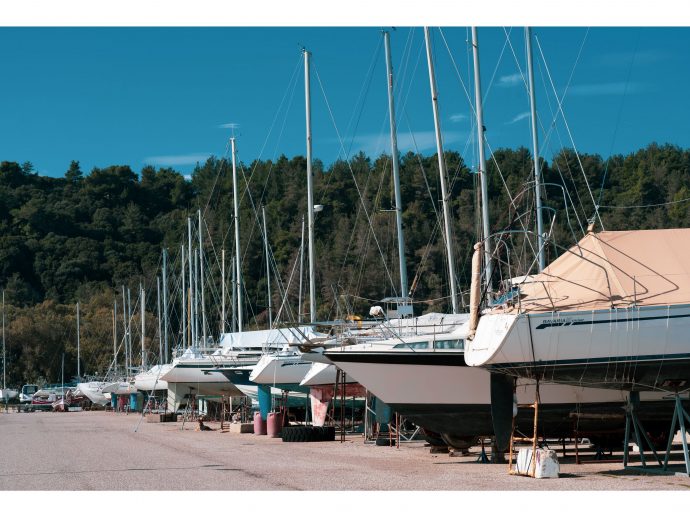
The storage environment decides how much of that risk a vessel actually faces, and most yards along the lake offer a few tiers. A few owners skip the question and chase warmer waters for the season, at the cost of moving the boat south and arranging dockage there. For boats that stay on the lake, indoor heated storage holds a stable temperature and gives the strongest protection against freeze damage and condensation, the natural choice for higher-value vessels and owners who want service or refit work done before spring. Indoor unheated and rack storage cost less and still shield the boat from snow, rain, and wind, though the air inside a cold building drops below freezing and full winterization remains essential.
Outdoor storage remains a practical option when the boat is properly winterized and protected with an appropriate cover or shrink-wrap system. A capable yard hauls each vessel with a travel lift, power-washes the hull before it goes into place, and keeps the property under security surveillance through the offseason. That first wash matters beyond appearance: rinsing the hull and running gear strips off the organisms and residue that hitch a ride between waterbodies, a step that agencies raising awareness of invasive species recommend every time a boat leaves the water.
The Preparation That Makes Storage Work
Storage protects only a vessel that has been laid up correctly. These four steps do most of the work across power and sail, and each is worth confirming before the cover goes on:
- Drain and protect the systems. Raw-water cooling loops must be fully drained or flushed with non-toxic marine antifreeze so nothing is left inside to freeze and crack.
- Stabilize the fuel. Adding stabilizer to a full tank keeps gasoline from breaking down and gumming up carburetors or injectors over a long layup.
- Service the batteries. Charge them fully, disconnect them, and store them somewhere dry and above freezing so they hold their charge into spring rather than dying in the cold.
- Ventilate the interior. Leave lockers and cabin doors slightly open with moisture absorbers inside so the trapped air stays dry, and the cabin does not turn musty.
Conclusion
None of this is dramatic when it is done well. It is the quiet routine that keeps a vessel out of the repair queue and stretches the years an owner gets from it. A vessel that comes out of storage clean, dry, and mechanically sound rewards the owner with a season that begins on the water instead of in the yard.
Cold weather arrives regardless. What an owner controls is whether the boat meets it in a managed environment or on its own, and treating the off-season with the same care as the season is what protects the vessel over the long run.
Comments
