Categories more
- Adventures (68)
- Arts / Collectables (24)
- Automotive (78)
- Aviation (73)
- Bath, Body, & Health (133)
- Children (51)
- Cigars / Spirits (76)
- Cuisine (82)
- Design/Architecture (28)
- Electronics (68)
- Entertainment (46)
- Event Planning (118)
- Fashion (54)
- Finance (13)
- Gifts / Misc (7)
- Home Decor (123)
- Jewelry (47)
- Pets (4)
- Philanthropy (5)
- Real Estate (26)
- Services (61)
- Sports / Golf (39)
- Vacation / Travel (112)
- Watches / Pens (72)
- Wines / Vines (36)
- Yachting / Boating (79)


Why High-End Audio Gear Is Becoming An Essential Part Of The Luxury Lifestyle

Published
09/04/2026Luxury has evolved beyond visible markers of wealth. For today's discerning consumer, the definition increasingly centers on quality, craftsmanship, technology, and personal experience. That shift is particularly evident in audio.
High-end audio gear transforms listening from a background activity into an intentional experience. A carefully assembled system can reveal detail, dynamics, spatial information, and tonal characteristics that conventional consumer equipment may obscure.
For affluent consumers who already invest in premium interiors, automobiles, watches, or travel, sophisticated audio is a logical extension of the same philosophy: buy fewer things, but choose them carefully.
The Luxury Of Exceptional Sound
The appeal of high-end audio begins with a simple premise: music deserves accurate reproduction. Grammy-winning recording engineer and audio innovator George Massenburg puts the listening experience into perspective: "It all comes down to listening, and what best supports listening is a reliable monitoring system."
That principle extends well beyond professional studios. A serious home audio system is designed around the quality of the entire signal chain. Headphones or loudspeakers are only one component. Digital-to-analog converters (DACs), amplifiers, streamers, cables, source components, and system configuration can all influence how an audio system performs.
For luxury consumers, this level of attention to detail is familiar territory. The objective is not simply to own expensive equipment. It is to create an environment in which every component has a defined purpose.
Technology Is Driving The Premium Audio Market
Modern high-end audio combines sophisticated engineering with increasingly compact hardware. Digital audio has transformed what is possible. High-resolution playback, advanced DAC architectures, balanced amplification, dedicated streaming components, and high-performance digital processing let manufacturers pursue performance levels that would have been impractical in previous generations.
Portable audio has also benefited from this technological progression. Contemporary digital audio players can incorporate powerful processors, advanced digital-to-analog conversion, isolated audio circuitry, and high-quality amplification into compact enclosures.
The result is a significant change in expectations. High-fidelity listening is no longer restricted to a dedicated listening room. Premium headphones, in-ear monitors, portable players, and compact DAC-and-amplifier combinations can provide sophisticated playback at a desk, while traveling, or in other personal listening environments.
Craftsmanship Matters As Much As Specifications
Luxury is rarely defined by specifications alone. Materials, manufacturing quality, engineering decisions, and attention to detail all contribute to the ownership experience. This is especially apparent with specialist audio companies that hand-build equipment. Custom manufacturing lets companies build products around specific requirements rather than forcing every customer into an identical configuration.
Moon Audio (available at moon-audio.com) exemplifies this approach. Founded in 2003, the company began as a home-based endeavor before expanding into a full-fledged audio business. In 2010, Drew Baird P.E. and Nichole Baird committed fully to the venture and began placing greater emphasis on bringing their Dragon Audio Cables to a wider audience.
Today, Moon Audio operates from an 8,000-square-foot facility in Cary, North Carolina. Its offering extends beyond its own custom, handmade cables to include headphones, digital-to-analog converters, amplifiers, streamers, in-ear monitors, and other high-fidelity equipment.
Its own Dragon Audio Cables are particularly relevant to the luxury market because they can be custom-made and precision-engineered according to individual specifications. That level of personalization reflects a broader luxury trend: customization is increasingly valued because it makes an object feel genuinely owned rather than simply purchased.
Expert Guidance Has Become Part Of The Product
The complexity of high-end audio can be both its greatest strength and its biggest barrier. A premium audio system may involve multiple components with different specifications, connections, impedance requirements, power demands, and technical characteristics.
Choosing individual products without understanding how they interact can lead to an expensive system that fails to deliver its potential. Consequently, expert advice has become an important part of the high-end buying experience.
Moon Audio, for example, differentiates its retail model through a dedicated concierge service that provides personalized guidance and support throughout the purchasing process. This is particularly relevant for customers building sophisticated systems rather than purchasing a single product.
The company also emphasizes product curation, with its collection selected by CEO Drew Baird, P.E., alongside reviews and expertise intended to help customers make informed decisions.
That consultative approach reflects a wider luxury trend. At the premium end of the market, consumers are often paying for knowledge as much as hardware. Being able to speak with someone who understands system matching and can explain technical differences can be far more valuable than simply browsing a product catalog.
High-End Audio Is An Investment In Experience
Robert Harley, audio writer and editor of The Complete Guide to High-End Audio, captures the motivation behind the category: "High-end audio is about passion — passion for music, and for how well it is reproduced."
That distinction matters.
High-end audio is not necessarily about pursuing the most expensive component available. It is about improving the relationship between listener and recording. A well-designed system can make familiar music more engaging by exposing subtle details, changes in dynamics, spatial cues, and instrumental textures.
For someone who spends considerable time listening to music, that improvement can have more practical value than another decorative luxury purchase.
The market's economics also show how seriously some consumers take audio. Moon Audio reports that some high-end customers spend $20,000 to $30,000 in a single purchase, with many buyers building systems over time and seeking expert validation before committing. Pre-orders are also common, reflecting the considered nature of premium audio purchasing.
The Modern Luxury Listening Room
The luxury listening environment is also changing. A traditional high-end system might occupy a dedicated room containing large loudspeakers, amplification, source components, and extensive cabling. Today, however, premium listening can take many forms.
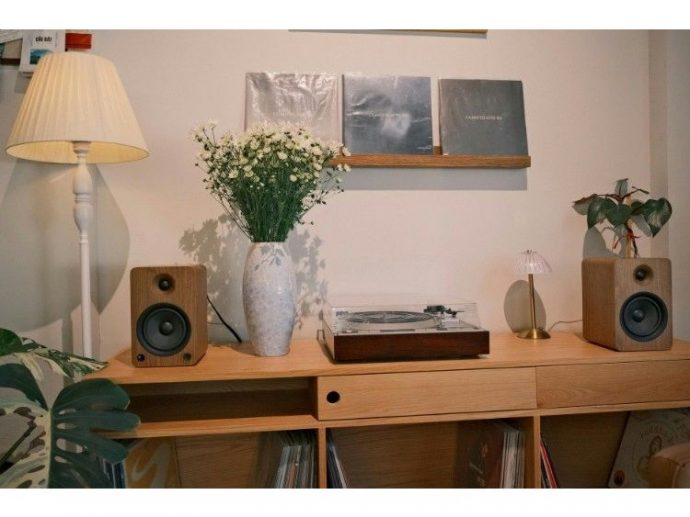
A minimalist living room might incorporate an elegant streaming system. A private office can accommodate a reference headphone setup. A traveler might carry a sophisticated digital audio player and high-end in-ear monitors. A dedicated listening room can go considerably further, combining carefully selected components into a complete system.
This flexibility makes high-end audio particularly compatible with contemporary luxury lifestyles. It can be integrated into an existing environment without compromising aesthetics or convenience.
For consumers researching specialist equipment and complete audio solutions, Moon Audio offers a curated high-fidelity marketplace spanning multiple categories.
What To Look For In High-End Audio Gear
Price shouldn't be the only factor when evaluating premium audio equipment. A more useful approach is to assess the entire listening system.
- Start with the source. Determine whether music will come primarily from streaming, digital files, vinyl, or another source.
- Consider system compatibility. Headphones, amplifiers, DACs, and other components need to work together technically and sonically.
- Prioritize build quality. Materials and construction should match the intended use and expected lifespan.
- Consider customization. Custom cables or other personalized components can be valuable when a system has specific connectivity or configuration requirements.
- Seek expert advice. Particularly with expensive multi-component systems, professional guidance can prevent costly mismatches.
- Listen before deciding where possible. Specifications provide useful information, but the listening experience remains the ultimate test.
Why Audio Belongs In The Luxury Category
High-end audio has many of the characteristics traditionally associated with luxury: specialist craftsmanship, advanced engineering, personalization, exclusivity, expert service, and a strong emphasis on experience.
More importantly, its value is inherently personal. A watch can be admired, a vehicle can be driven, and a piece of furniture can define a room. High-end audio creates something different: an environment in which music can be experienced with exceptional attention to detail.
For consumers who view luxury as an investment in quality rather than status, that distinction matters more than ever.
The modern luxury lifestyle is becoming less about accumulating possessions and more about improving everyday experiences. Few experiences are more immediate or enduring than listening to music — and high-end audio gives that experience the engineering, craftsmanship, and precision it deserves.
Comments
