Categories more
- Adventures (209)
- Arts / Collectibles (374)
- Automotive (804)
- Aviation (378)
- Bath, Body & Health (1040)
- Children (118)
- Cigars / Spirits (278)
- Cuisine (723)
- Design / Architecture (1118)
- Electronics (230)
- Entertainment (162)
- Event Planning (295)
- Fashion (552)
- Finance (199)
- Gifts / Misc (141)
- Home Decor (575)
- Jewelry (409)
- Pets (92)
- Philanthropy (124)
- Real Estate (393)
- Services (223)
- Sports / Golf (213)
- Vacation / Travel (1054)
- Watches / Pens (233)
- Wines / Vines (862)
- Yachting / Boating (9083)



Why Some of the Most Accomplished People Have the Weakest Dating Profiles


Published
10/29/2026There is a quiet irony in modern dating. People who spend their lives in beautiful places, with access to the best tailors, the best restaurants and, in many cases, professional photographers at work events, often have some of the least convincing dating profiles on the apps.
The pictures are rarely bad in a technical sense. They are simply the wrong pictures. A conference headshot with a lanyard cropped out. A corporate portrait lifted from the company website. A distant shot on the deck of a boat, sunglasses on, face barely visible. A group photo at a gala in which it is genuinely unclear which of the four men in dinner jackets is the one hoping for a match.
The problem with borrowed photos
Busy people tend to assemble dating profiles from photographs that already exist. Time is the scarcest resource, and scrolling back through a camera roll feels more efficient than arranging anything new.
The trouble is that almost none of those photographs were taken for this purpose. A corporate headshot was designed to project competence to clients. A charity gala photo records the event, not the person. Holiday snapshots were composed around the view. None of them says what a dating profile needs to say, which is simply who this person is and what it might be like to spend an evening with them.
What comes out is something closer to a résumé with a few holiday pictures attached. It is polished, but it is not warm, and warmth is what people are actually looking for when they swipe.
When luxury reads as a warning sign
The second problem is subtler. Photographs that signal wealth tend to work against their owner on dating apps.
A supercar, a yacht, a watch held deliberately towards the lens. In a lifestyle magazine these images communicate taste and success. On a dating profile, some viewers read them as an attempt to buy attention. Others, having been warned about romance scams, read them as a red flag, because staged displays of wealth are a common feature of fake accounts. Either way, the viewer stops thinking about the person and starts thinking about the props.
What quiet luxury looks like in a photo
The same principle that governs understated style applies here. Quality shows in details, not in logos.
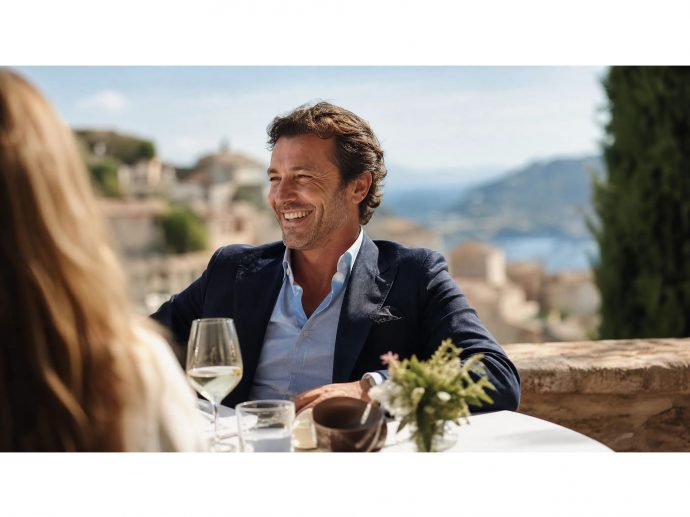
A well-cut jacket that fits properly says more than an expensive brand worn badly. Soft, natural light on a face says more than a dramatic backdrop. A relaxed moment at a favourite restaurant, with the setting visible but not the centrepiece, says more about a person's life than a photograph of the bill. Settings work as context rather than subject: a terrace in Provence works when the person is clearly enjoying the afternoon, not when they are posed to show off the view.
Building a set that feels complete
A strong profile works less like a portfolio and more like an introduction over several courses. The first photograph should be a clear, warm portrait in good light, face fully visible, no sunglasses. The next should show the whole person, ideally in something that reflects their actual style. Then come the images that give texture: a genuine laugh with friends, a hobby being enjoyed rather than displayed.
Most accomplished people discover the same thing when they lay their photos side by side. Their archive is enormous and almost none of it is usable. There are hundreds of images from conferences, board dinners and client events, and perhaps two where they look relaxed, unposed and lit by daylight. An unhurried Sunday with a friend who is handy with a camera will usually solve that. Where the diary genuinely does not allow it, a service such as DatePhotos AI can turn a few ordinary phone selfies into natural-looking ai dating photos in a range of settings, so the empty slots in a lineup can be filled without anyone having to book a shoot.
A note on discretion
People with a public profile face an extra consideration. Photographs taken at recognisable events or offices can reveal an employer, a home location or a routine more precisely than intended. Crop out lanyards and logos, avoid number plates and house exteriors, and save the specifics for conversation once there is some trust on both sides.
Presentation as courtesy
Understatement is a form of respect for the people around you. It says that you are secure enough not to need to impress. The best dating profiles follow the same instinct. They offer an honest, flattering and accurate picture of a person worth meeting, and they let the rest come out over dinner. That is, after all, where the real impression is made.