Categories more
- Adventures (17)
- Arts / Collectables (14)
- Automotive (36)
- Aviation (11)
- Bath, Body, & Health (76)
- Children (6)
- Cigars / Spirits (32)
- Cuisine (16)
- Design/Architecture (22)
- Electronics (13)
- Entertainment (4)
- Event Planning (5)
- Fashion (45)
- Finance (10)
- Gifts / Misc (6)
- Home Decor (45)
- Jewelry (41)
- Pets (3)
- Philanthropy (1)
- Real Estate (16)
- Services (23)
- Sports / Golf (14)
- Vacation / Travel (59)
- Watches / Pens (14)
- Wines / Vines (24)
- Yachting / Boating (17)


Amethyst: How One Gemstone Shaped 2,000 Years of Religious Authority

Published
03/16/2026A purple stone sat in the ring of nearly every Catholic bishop for over a thousand years. Not ruby. Not sapphire. Amethyst — a gemstone the ancient Greeks believed could keep a man sober at a feast, and one the medieval Church adopted as its most potent symbol of spiritual humility.
The amethyst history most people know starts and ends with "it's purple and pretty." But the real story involves a Greek god's drunken rage, a secret vote at a 7th-century Spanish council, the British Crown Jewels, and a massive geological discovery in Brazil that nearly erased the stone's prestige overnight. This is the full journey — from pagan amulet to holy office, and from the rarest gem in a king's treasury to something you can hold in your hand today.
A Stone Named After Sobriety
The word "amethyst" comes from the Greek amethystos — literally "not intoxicated." Ancient Greeks and Romans wore amethyst amulets and carved drinking goblets from the stone, convinced it would protect them from the effects of wine. Pliny the Elder mentioned this belief in his Natural History, though even he seemed skeptical.
The mythology gets stranger. A widely circulated story claims the god Dionysus pursued a maiden named Amethystos, who prayed to Artemis for protection. The goddess turned her into white quartz, and Dionysus — remorseful — poured wine over the stone, staining it purple forever. Dramatic story. One problem: it was invented by French poet Remy Belleau in the 16th century, not by the ancient Greeks at all. The actual ancient source — the late-antiquity writer Nonnus — simply records that Dionysus received an amethyst from his grandmother Rhea to preserve the wine-drinker's sanity.
Regardless of the mythology's accuracy, the stone's reputation stuck. For the Greeks and Romans, amethyst meant clear-headedness. That association would matter enormously in a few centuries.
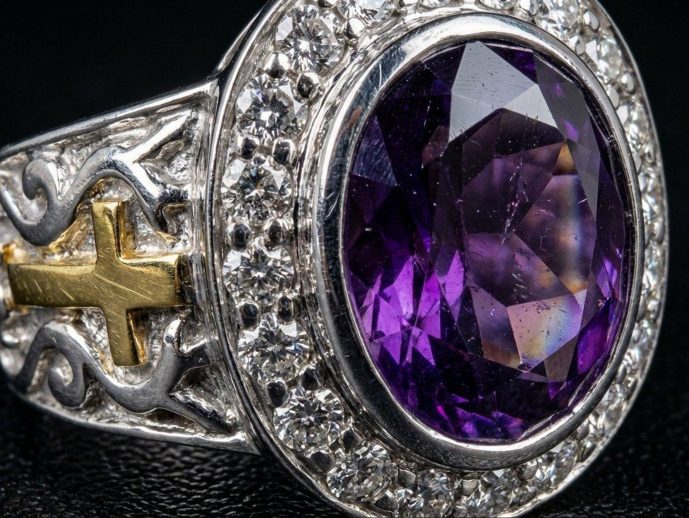
Close-up of a natural amethyst set in a sterling silver bishop ring — the purple stone that defined religious authority for centuries.
From Aaron's Breastplate to the Bishop's Right Hand
Amethyst appears in the Bible twice by name — Exodus 28:19 and 39:12 — as one of twelve gemstones set into the breastplate of Aaron, the first High Priest of Israel. The Hebrew term aḥlamah was translated as "amethyst" in the Septuagint, though scholars still debate whether the original stone was actually what we call amethyst today. The identification stuck, and it planted the seed: purple stone, priestly garment, divine authority.
Early Christians pushed the connection further. They saw in amethyst's violet hue the color of penance, mourning, and the wounds of Christ's Passion. The stone's ancient reputation for promoting sobriety aligned perfectly with the virtues expected of clergy — temperance, humility, self-control. By the 4th and 5th centuries, high-ranking churchmen were already wearing amethyst as a mark of spiritual office.
The Council That Made It Official
The turning point came in 633 AD at the Fourth Council of Toledo, presided over by Isidore of Seville. The council decreed that every newly ordained bishop must receive three objects: a stole, a pastoral staff, and an anulum — a ring to be worn on the right ring finger as an emblem of pastoral dignity. While the decree didn't specify amethyst by name, the stone was already the default choice by custom. The ecclesiastical ring tradition formalized at Toledo would shape clerical dress for the next fourteen centuries.
The symbolism was layered. The ring itself represented a bishop's spiritual marriage to his diocese — the same way a wedding band signifies union. The amethyst in particular communicated sobriety, piety, and a rejection of worldly excess. In a church that governed empires, that message carried political weight.
Why Purple? The Color That Cost More Than Gold
The choice of amethyst for religious authority didn't happen in a vacuum. Purple had been the color of power for millennia before Christianity existed.
Tyrian purple — extracted from predatory sea snails along the Phoenician coast — required roughly 10,000 murex snails to produce a single gram of dye. The cost was astronomical. Roman sumptuary laws restricted purple garments to senators and emperors. A pound of Tyrian-dyed wool cost more than most people earned in a year. When the early Church adopted purple for its vestments and episcopal regalia, it inherited all of that symbolic weight — royalty, authority, separation from the common world.
Amethyst was the gemstone equivalent. A purple stone for a purple office. Its rarity and cost before the 19th century meant that wearing one wasn't just symbolic — it was a display of institutional power.
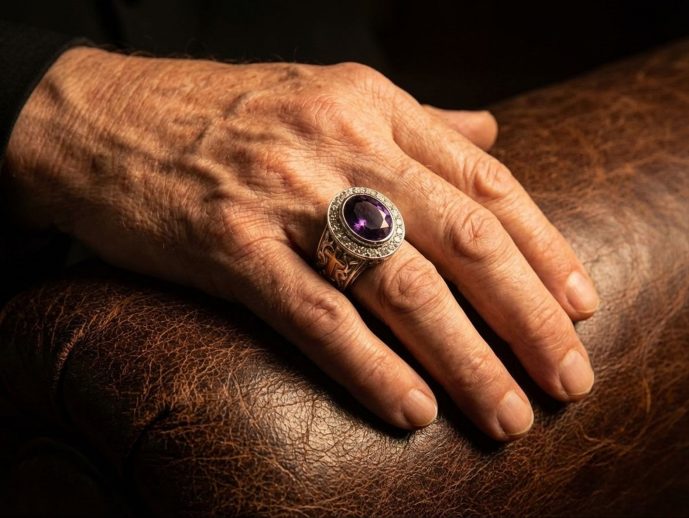
A bishop ring worn on the right hand — the same placement decreed at the Fourth Council of Toledo in 633 AD.Key Takeaway: Amethyst became the bishop's stone not because of one decision, but through a slow accumulation of cultural meaning — Greek sobriety myths, biblical priestly garments, Roman color symbolism, and early Christian theology all converged on the same purple stone.
Crowns, Queens, and the Stone's Royal Double Life
Bishops weren't the only ones who claimed amethyst. For most of European history, the stone lived a double life — sacred in the cathedral, regal in the palace.
In England, it was once illegal for commoners to wear amethyst jewelry. The stone was reserved for the royal family and nobility. St. Edward's Crown — the centerpiece of the British coronation regalia, completed in 1661 — is set with 444 gemstones, amethysts among them. The Sovereign's Sceptre with Cross features a large faceted amethyst orb surrounded by diamonds, emeralds, and rubies.
Queen Charlotte owned an amethyst bracelet valued handsomely in the early 18th century. Two hundred years later, the same bracelet was appraised at just 100 pounds. The difference wasn't damage or fashion — it was geology. But we'll get to that.
The Kent Amethyst collection — a suite of brooches and jewelry featuring deep royal-purple stones set with diamonds — passed from the Duchess of Kent to Queen Victoria in 1861, who designated them official crown heirlooms. Queen Mary wore the amethyst tiara at state events throughout the early 20th century. The stone that sat on a bishop's finger also sat on a queen's brow.
Brazil Changed Everything
Before the early 1800s, amethyst was genuinely rare. The primary sources were small, difficult mines in Russia's Ural Mountains, Sri Lanka, and India. Quality specimens commanded prices comparable to diamonds, rubies, and sapphires. Amethyst sat in the top tier of precious stones — not semi-precious as we classify it today.
Then geologists found volcanic geode deposits in southern Brazil — particularly in Rio Grande do Sul and Bahia. The scale was staggering. Thousands of tons of amethyst flooded the global market within decades. A stone that once required years of careful mining from remote mountain sources could now be extracted from enormous cavities in basalt rock.
The price collapsed. Amethyst dropped from the precious gem category entirely. Queen Charlotte's bracelet story illustrates the shift perfectly — the same stones, the same craftsmanship, but a fraction of the value because the world suddenly had more amethyst than it knew what to do with.
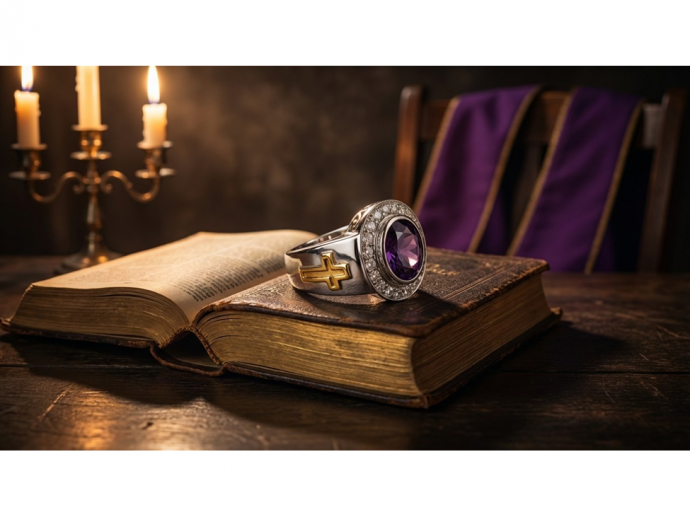
For the Church, this was irrelevant. A bishop's amethyst ring was never about the stone's market price. It was about what purple meant — and purple still meant penance, authority, and the shepherding of souls. The Brazilian discovery cheapened amethyst for jewelers. It did nothing to diminish the stone's spiritual significance. Retailers who specialize in handcrafted bishop rings in sterling silver and gold still set amethyst as the default stone in clergy ring designs — not because it's expensive, but because 1,400 years of unbroken tradition have made it the only stone that reads correctly on a bishop's right hand.
The Bishop's Stone in the 21st Century
Walk into a Catholic ordination ceremony today and you'll see the same ritual described at the Fourth Council of Toledo — nearly word for word. The newly consecrated bishop receives a ring from his consecrator. He wears it on the right ring finger. The stone is almost always amethyst.
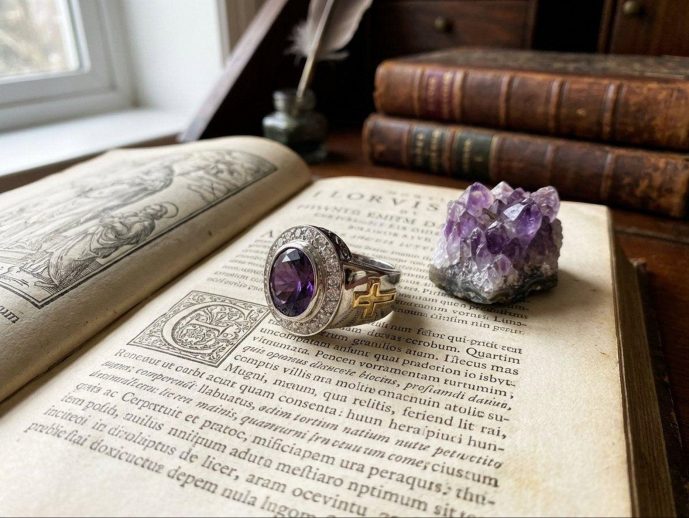
The tradition continues — amethyst bishop rings remain the standard for episcopal ordination in the 21st century.
Canon law no longer mandates a specific gemstone. A bishop could technically wear sapphire, ruby, or no stone at all. But custom is stronger than law in institutions this old. Amethyst remains the default because it carries fourteen centuries of accumulated meaning that no other stone can replicate. Purple for penance. Purple for humility. Purple for the marriage of a pastor to his flock.
Outside the church, amethyst's symbolism has found a second life. Collectors of ecclesiastical jewelry — people drawn to the weight and craftsmanship of clergy-style rings regardless of whether they serve in ministry — wear bishop ring designs as statement pieces. The stone reads as intentional, historical, serious. Bikerringshop's guide to bishop ring symbolism breaks down why the design appeals beyond the pulpit — the combination of bold metalwork, deep-set amethyst, and cross detailing translates into men's jewelry that commands attention without explanation.
Frequently Asked Questions
Why is amethyst called the Bishop's Stone?
The term comes from centuries of tradition linking amethyst to episcopal office. The stone's purple color symbolizes penance, humility, and spiritual authority in Christianity. Since at least the 7th century, bishops have worn amethyst rings as part of their consecration regalia, and the association became so strong that amethyst earned the informal title "Bishop's Stone" across European languages.
Was amethyst really as valuable as diamonds?
Before the 19th century, yes. With limited sources in Russia, Sri Lanka, and India, fine amethyst specimens were classified alongside diamonds, rubies, sapphires, and emeralds as precious stones. The massive Brazilian discoveries in the early 1800s flooded the market and dropped prices dramatically, reclassifying amethyst as semi-precious — though its spiritual and cultural value remained unchanged.
Do modern bishops still wear amethyst rings?
Most do, though it's no longer formally required by canon law. Custom and tradition keep amethyst as the default stone for episcopal rings. A bishop's ring symbolizes his marriage to his diocese, and amethyst — carrying 1,400 years of accumulated religious meaning — remains the most recognized and appropriate choice for the role.
Where does the myth of Dionysus and amethyst come from?
The popular story about Dionysus pursuing a maiden named Amethystos was actually written by French Renaissance poet Remy Belleau in the 1500s — not by the ancient Greeks. The real ancient connection is simpler: the Greek word amethystos means "not intoxicated," and both Greeks and Romans believed the stone protected against drunkenness.
Is amethyst mentioned in the Bible?
Yes. Amethyst appears in Exodus 28:19 and 39:12 as one of twelve stones set in the breastplate of Aaron, the High Priest of Israel. The Hebrew term aḥlamah was translated as amethyst in the Greek Septuagint. It also appears in Revelation 21:20 as one of the foundation stones of the New Jerusalem.
Few gemstones carry this much accumulated weight — a Greek name rooted in sobriety, a biblical pedigree stretching to the first High Priest, a formal decree from a 7th-century council, and a royal history that spans from St. Edward's Crown to Queen Victoria's brooches. Amethyst didn't become the bishop's stone by accident. Every century added another layer of meaning, and each layer made it harder for any other gemstone to take its place.
About the Author: This article was written by a specialist in handcrafted sterling silver and gold jewelry with over 15 years of experience in gemstone selection and ecclesiastical ring design, based in Bangkok at Bikerringshop.
Comments
