Categories more
- Adventures (62)
- Arts / Collectables (14)
- Automotive (77)
- Aviation (65)
- Bath, Body, & Health (123)
- Children (6)
- Cigars / Spirits (71)
- Cuisine (66)
- Design/Architecture (22)
- Electronics (63)
- Entertainment (36)
- Event Planning (115)
- Fashion (45)
- Finance (10)
- Gifts / Misc (6)
- Home Decor (118)
- Jewelry (41)
- Pets (3)
- Philanthropy (1)
- Real Estate (16)
- Services (44)
- Sports / Golf (14)
- Vacation / Travel (85)
- Watches / Pens (33)
- Wines / Vines (34)
- Yachting / Boating (67)


How to Know If Your AC Problem Is a DIY Fix or a Professional Job

Published
07/22/2026Your air conditioner stops blowing cold air. It's 95 degrees outside. The first instinct is to grab a screwdriver — the second is to panic. Neither gets you far without a clear framework. Knowing the difference between a fix-it-yourself moment and one that demands a licensed technician can save you a weekend of frustration, or prevent a costly mistake that voids your warranty. If you're already past the tipping point, this guide on emergency air conditioner repair covers what urgent service actually involves. For broader system concerns across the Pacific Northwest, Conrad Heating and Cooling handles residential and commercial HVAC.
Now — back to the decision you're actually trying to make.
The Signals That Actually Tell You Something
Most homeowners focus on symptoms. That's understandable, but the symptom alone rarely tells you enough. A unit that won't turn on could be a dead thermostat battery or a failed compressor — the gap in repair cost between those two is roughly $10 versus $1,500.
What matters more is the pattern of the problem. Ask yourself:
- Did it start suddenly, or has performance been declining for weeks?
- Does the unit run but fail to cool, or does it not start at all?
- Are there unusual sounds — grinding, hissing, clicking — alongside the drop in performance?
- Has anything changed recently — a power surge, a forgotten filter, a new thermostat install?
Sudden failures after a storm or a tripped breaker lean DIY. Gradual loss of cooling, a refrigerant smell, or a system cycling on and off every few minutes — that pattern points to a tech.
What You Can Safely Handle
Filters, Thermostat Batteries, and Tripped Breakers
These three account for a surprising share of "broken AC" calls that turn out to be nothing. A clogged filter — especially one that hasn't been swapped in three months or more — restricts airflow enough to make a working system feel useless. Replace it first. Always.
A thermostat set to "heat" instead of "cool," or one running on a dead battery, explains roughly 5–10% of no-cooling complaints. It sounds obvious. People still call technicians for it.
A tripped breaker falls in the same category. Reset it once. If it trips again immediately, stop — that's a wiring or compressor issue, and it needs professional eyes.
Dirty Condenser Coils and Closed Vents
The outdoor unit collects debris over a season. Grass clippings, cottonwood fluff, and general grime pack into the fins and choke airflow. Rinsing the coils gently with a garden hose — low pressure, directed top-down — is a legitimate DIY task. Skip the pressure washer. Bent fins restrict airflow worse than dirt.
Inside, check every supply and return vent. Closed vents force the system to work against its own design pressure. The result is reduced output and unnecessary compressor stress. Open them.
The Line That Separates DIY from Dangerous
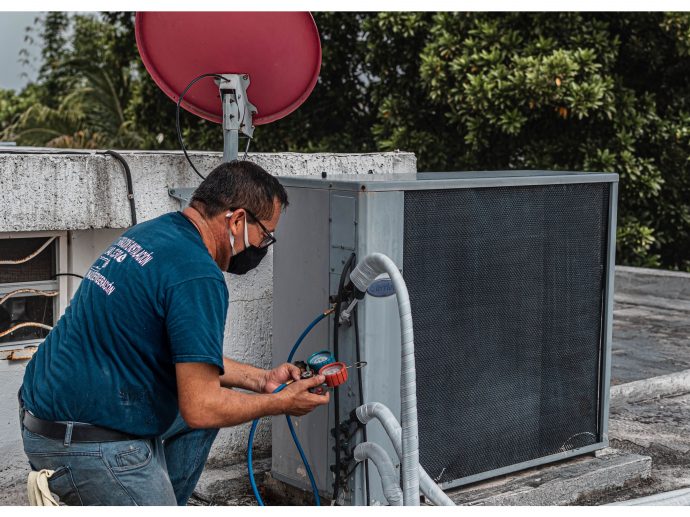
Refrigerant, Electrical, and Anything Inside the Air Handler
Refrigerant is where most people need to stop. Handling it without an EPA 608 certification is illegal — and that's not even the worst part. Overcharging or undercharging refrigerant doesn't just reduce efficiency; it kills compressors. Replacement runs $800–$2,500 depending on the unit. That cost dwarfs any savings from skipping a technician.
Electrical work inside the air handler carries real risk. Capacitors store charge even when the unit is powered off. One discharge from a run capacitor can knock a person down. Opening that panel without knowing exactly what you're doing isn't brave — it's avoidable.
Refrigerant leaks, compressor failures, frozen evaporator coils with no airflow explanation, and any electrical burning smell require licensed service. Full stop.
When Waiting Costs You More
Speed matters in two specific situations. A refrigerant leak that runs long enough will damage the compressor — what starts as a $200 recharge becomes a $2,000 repair. A system short-cycling — turning on and off every few minutes — stresses every component simultaneously. Each cycle adds wear equivalent to hours of normal operation.
Calling quickly in these cases isn't about comfort. It's about protecting the equipment you already own. Three DIY attempts across a long weekend on a compressor problem almost always make the eventual repair bill larger.
How Conrad Heating and Cooling Handles the Hard Calls
Conrad Heating and Cooling runs full diagnostic assessments before quoting any repair — the technician identifies the actual fault, not just the symptom. That distinction matters when a system shows multiple warning signs at once, and it prevents the return visits that follow a misread root cause.
Their Beaverton team handles:
- Refrigerant leak detection and certified recharge
- Capacitor and contactor replacement
- Compressor diagnostics and full replacement
- Smart thermostat calibration and integration
- Airflow and duct pressure testing
No parts are swapped speculatively. If a capacitor tests within spec, it stays. That keeps repair costs honest.
For situations that qualify as emergency air conditioner repair — a complete shutdown during a heat event, a refrigerant smell, or a system repeatedly tripping breakers — priority scheduling is available. Call early in the day when possible; same-day slots go fast during peak season.
The difference between a $15 filter and a $1,500 compressor often comes down to acting on the right information at the right time. Know what you're dealing with before touching anything — and know when the smartest move is to hand it off.
Comments
