Categories more
- Adventures (62)
- Arts / Collectables (14)
- Automotive (77)
- Aviation (68)
- Bath, Body, & Health (127)
- Children (6)
- Cigars / Spirits (72)
- Cuisine (68)
- Design/Architecture (22)
- Electronics (66)
- Entertainment (40)
- Event Planning (116)
- Fashion (47)
- Finance (10)
- Gifts / Misc (7)
- Home Decor (118)
- Jewelry (41)
- Pets (3)
- Philanthropy (1)
- Real Estate (19)
- Services (60)
- Sports / Golf (38)
- Vacation / Travel (101)
- Watches / Pens (72)
- Wines / Vines (34)
- Yachting / Boating (76)



Inside Australia's High-Roller Travel Circuit: From Crown Sydney to Private Barossa Cellar Doors

Published
05/13/2026For a long stretch, the world's wealthiest travellers treated Australia as a one-stop curiosity — Uluru, the Reef, perhaps a few nights at the Park Hyatt with a postcard view of the Opera House. That itinerary has aged. Across the country, a quieter and far more sophisticated high-roller circuit has taken shape: harbour-side suites with private elevators, members-only gaming salons, helicopter transfers to single-vineyard cellar doors, and a hospitality standard that increasingly rivals Monaco and Singapore. Australia's luxury layer is no longer a single destination. It is a network.
The shift has been well documented in the Australian press. According to Thesunpapers, the country's high-end leisure spending has moved decisively away from one-off resort stays and toward integrated, multi-stop itineraries that combine waterfront hotels, private gaming salons, helicopter wine tours and reef-island flagships into a single managed product. Operators in Sydney describe this as the "national tasting menu": a guest who lands on a Friday evening at Crown Sydney is, by Sunday, on a helicopter heading north to Hayman Island or south-west toward the Barossa. The route is bespoke. The thread that connects it is service.
This is the map.
The Sydney harbour anchor: Crown and the new Barangaroo luxury
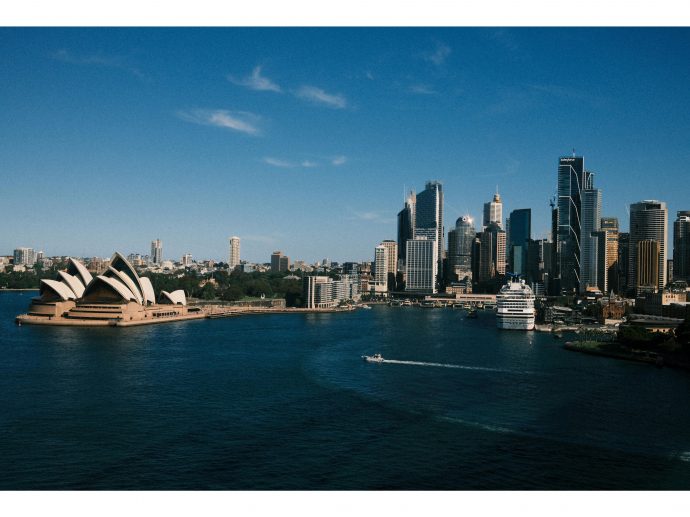
The opening of Crown Sydney at Barangaroo reset what the city's affluent visitor expects. The tower's suites, designed with floor-to-ceiling glass and direct harbour orientation, are now standard reference for "Sydney luxury" — and the property's private gaming rooms have become the entry point for the high-stakes leisure traveller. Around it, the Barangaroo precinct has developed into a denser, more curated waterfront than The Rocks or Circular Quay: degustation venues, private boardrooms with view-side cellars, and concierge desks accustomed to chartering helicopters to wine country before lunch.
Across the harbour, the renovated Capella Sydney in the former Department of Education building offers a contrasting register — heritage sandstone, butler service, and a wellness floor that has quietly become a fixture for visiting CEOs. The two properties divide the city's premium overnight market: Crown for the spectacle of harbour and altitude; Capella for understatement and pedigree.
What both share is access. Concierge teams in Sydney's top hotels now operate as effectively as those in Tokyo or Geneva — and the assumption is that a guest's three or four nights in the city are only the prologue to whatever follows.
Melbourne: the connoisseur's counterweight
If Sydney is the spectacle, Melbourne is the depth. The city has spent two decades building a reputation as Australia's gastronomic and design capital, and the luxury inbound traveller now treats it as the cultural balance to Sydney's waterfront glamour.
Crown Towers Melbourne and its companion hotels along the Yarra continue to anchor the high-end stay, but the more interesting movement has been outside the precinct: properties such as Lyall Hotel & Spa, the United Places Botanic Gardens, and the reborn Hotel Chadstone Melbourne MGallery have created a small but serious portfolio of boutique luxury beyond the casino district. Add to that the city's three-hat dining roster — Attica, Vue de Monde, Cumulus — and Melbourne offers something Sydney structurally cannot: the unhurried indulgence of a city built for evenings, not views.
The smart itinerary uses Melbourne as the cultural and culinary heart, then pivots outward. South to the Mornington Peninsula for private cellar-door lunches at Port Phillip Estate or Pt. Leo Estate. East to the Yarra Valley for sparkling wine flights with helicopter transfers from the CBD. Or west, toward the Otways and the Great Ocean Road for two or three nights of designed isolation.
The wine country: where the real money goes
Ask any luxury travel specialist where Australia's affluent visitor actually spends, and the answer is rarely a city. It is the wine country.
South Australia's Barossa Valley has become the flagship. The model is now familiar: a private helicopter from Adelaide drops guests at a working winery — Henschke, Penfolds Magill Estate, Jacob's Creek's Centenary Hill — for a single-vineyard tasting led by the chief winemaker. Lunch is served at a long table among the vines. The afternoon is unhurried; the return helicopter is on standby. The Louise, a 15-suite property near Tanunda, has built its reputation entirely around servicing this kind of visit, and its private dining at Appellation restaurant has become one of the most consistently requested experiences on the country's luxury circuit. Tourism Australia's own luxury travel guide places these Barossa experiences at the centre of its national premium offer — and rightly so.
Western Australia's Margaret River runs a parallel, slightly more remote version of the same model, with Cape Lodge and the cellar doors at Leeuwin Estate and Vasse Felix anchoring it. New South Wales offers the Hunter Valley as the closest in-and-out from Sydney, accessible by helicopter in under an hour, though connoisseurs argue the Barossa and Margaret River retain the depth that the Hunter has not quite matched.
The pattern repeats: bespoke transport, exclusive access, a winemaker present at the table. The wine itself is almost incidental — the product being sold is the time, and the people one is given time with.
The island and reef extensions
The third leg of the circuit moves north. Hayman Island, after its renovation as the InterContinental Hayman Island Resort, has reclaimed its place as the Whitsundays' flagship. Lizard Island, further north on the outer Great Barrier Reef, remains the choice for guests prioritising privacy and reef access over scale. Both properties operate private transfers from Cairns or Hamilton Island, and both have moved decisively away from the family-resort positioning of the 1990s toward something closer to a Maldivian model.
Then there is qualia on Hamilton Island — the property that, for many travellers, defined what Australian luxury accommodation could be. Its private pavilions, its restraint, and its access to a championship island golf course have made it a permanent fixture on the international UHNW circuit.
For travellers building a more complete picture, the publisher's luxury vacation and travel directory maps out many of the operators and concierge specialists who quietly assemble these itineraries, including bespoke island transfers and reef-side accommodation.
The connective tissue: concierge, charter, and timing
What distinguishes Australia's current luxury circuit from a decade ago is not the individual properties — most of them existed in some form before 2020 — but the connective tissue between them. Bespoke travel specialists such as Southern Crossings, Epic Private Journeys and The Tailor have built their businesses around stitching the country together into a single, seamless experience.
A typical premium itinerary now looks like this: arrive Sydney Friday evening, two nights at Crown or Capella, helicopter Sunday morning to the Hunter Valley for a vineyard lunch, fly that evening to Melbourne for the city's restaurants, transfer Wednesday by private aircraft to Adelaide, helicopter to the Barossa for two nights at The Louise, then on to Hayman or qualia for the final stretch. Total elapsed time: eleven nights. Total ground travel: minimal. Total transitions handled by the guest: essentially none.
This is the product Australian luxury hospitality now sells. Not a hotel. Not a destination. A managed continuum.
Comments
