Categories more
- Adventures (62)
- Arts / Collectables (14)
- Automotive (77)
- Aviation (65)
- Bath, Body, & Health (123)
- Children (6)
- Cigars / Spirits (71)
- Cuisine (66)
- Design/Architecture (22)
- Electronics (63)
- Entertainment (36)
- Event Planning (115)
- Fashion (45)
- Finance (10)
- Gifts / Misc (6)
- Home Decor (118)
- Jewelry (41)
- Pets (3)
- Philanthropy (1)
- Real Estate (16)
- Services (44)
- Sports / Golf (14)
- Vacation / Travel (85)
- Watches / Pens (33)
- Wines / Vines (34)
- Yachting / Boating (67)


Shipping a Luxury Car for the First Time: A Beginner's 2026 Guide

Published
08/03/2026The biggest misconception first time shippers have is that money buys them a private truck. It doesnt. You can spend four thousand dollars moving a Continental GT from Miami to Los Angeles and that car is still riding in a trailer alongside four or five others, on a route somebody built around fuel stops and delivery clusters — not around you. The price you pay changes the kind of trailer your car rides in and the care it gets during loading. It does not buy you a dedicated rig and it does not buy you a calendar date. That gap between what people expect and what the industry can actually deliver is where almost every bad first experience comes from.
So before you book anything, here's the short version: a luxury car moving across the country in 2026 usually runs somewhere between $1,800 and $4,500 depending on the route, enclosed costs roughly 40 to 50 percent more than open, cross country takes about seven to ten days once the truck is loaded, and the single most useful thing you can do is check the actual carrier's federal record before the car goes on the ramp. Everything below is why.
The Company You Pay Is Usually Not the Company That Shows Up
Most people assume they're hiring a trucking company. You call a name you found online, you get a quote, you pay a deposit, and you picture that company's truck pulling up.
But in reality most of those names are brokers. They don't own trailers. What they own is access — to a load board where thousands of owner operators are scrolling for freight that fits the lane they're already running. Your car gets posted with a price attached. If that price is good relative to the miles and the route, a driver claims it within hours. If it's low, your car sits on the board while better paying loads move ahead of it.
This is not a scam and it is not something to be scared of. Good brokers are genuinely useful because they know which carriers actually handle high value cars properly and which ones just say they do. A well connected broker like Rivalane Auto Transport can put your car in front of the right thirty drivers instead of the wrong three thousand. But you should know how it works, because it explains something that confuses almost every first timer: why a cheap quote can somehow take three weeks to get picked up. The quote was never a price.. it was a bid.
Enclosed Is Not About Looking Expensive, Its About the Ramp Angle
People hear "enclosed" and think of it as the fancy upgrade. Leather seat treatment for your car. A nice to have.
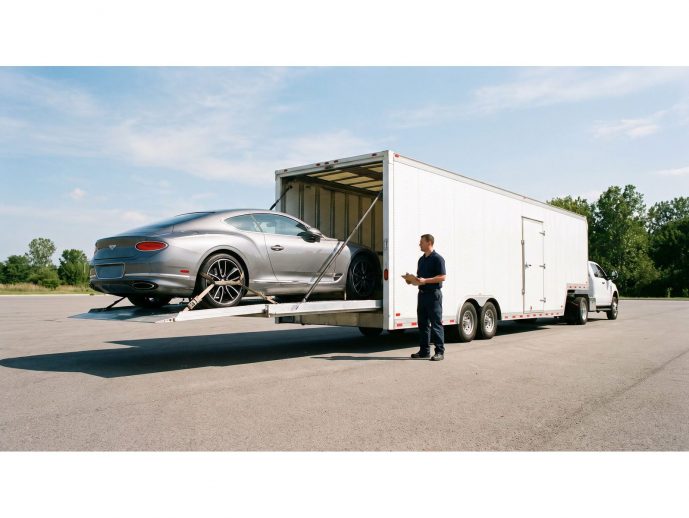
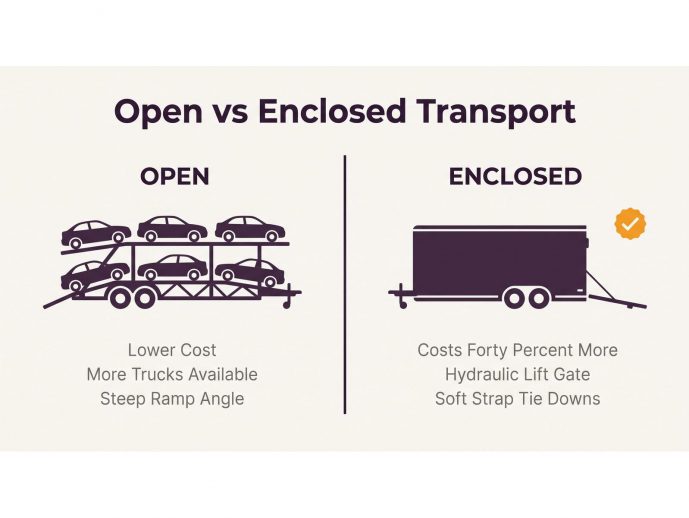
But in reality the reason most exotic and low slung cars end up enclosed has almost nothing to do with weather. It has to do with geometry. A standard open car hauler loads at a ramp angle that will drag the nose, the splitter, or the exhaust on anything sitting under about five inches of clearance. Drivers know this, and a driver who has already scraped one front lip in his career will simply skip your load rather than risk it. That's the real filter. Its not snobbery, it's liability.
What enclosed auto transport actually gives you is equipment: a hydraulic lift gate that raises the car flat instead of dragging it up an incline, soft nylon straps that wrap the tires rather than hooking the suspension or frame, and usually a driver who has strapped down a few hundred cars worth more than his house. Weather protection is real too, and dust and road debris matter over 2,500 miles. But the ramp is the thing. If your car is low, enclosed stops being optional.
There's a second effect nobody mentions. Enclosed trailers hold fewer cars — typically six or seven versus nine or ten on an open hauler — and there are far fewer of them on the road. Fewer trucks and fewer slots means less flexibility on dates. That tradeoff is worth understanding before you commit to a hard pickup day. A deeper look at how those trucks get matched to specific cars is worth reading if you're new to it, and this breakdown of shipping exotic car logistics covers the dispatch side of it well.
Price Is Set by the Lane, Not by Your Car
The assumption is that a $300,000 car costs more to ship than a $30,000 one because it's worth more. Insurance premium, extra care, whatever.
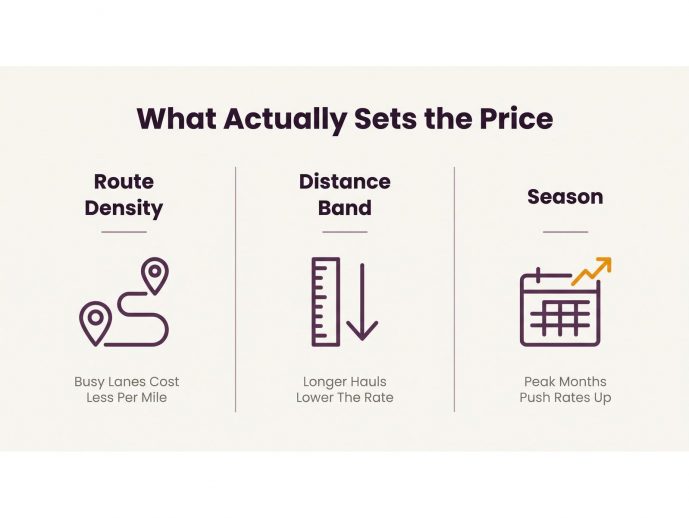
But in reality the number that moves your quote the most is the route. Dense corridors — Los Angeles to Dallas, Chicago to Atlanta, anything up and down I-95 — are cheap per mile because trucks run them constantly and a driver can fill a trailer in a day. Thin lanes are expensive because somebody has to deadhead empty to get to you. Distance works backwards from what people expect too: short moves under 500 miles run around $1.55 to $2.50 per mile, while a 2,500 mile haul drops to roughly $0.50 to $0.65 per mile. The total is bigger, the rate is smaller.
Then there's season. January and the summer months are peak, and the snowbird lanes into and out of Florida can nearly double in the fall and spring when everybody moves the same direction at the same time. Book a Florida run in October at July prices and you'll watch your car sit.. book the same run in a soft month and you'll wonder why it was so easy.
Vehicle value does affect the quote a little, because carriers hauling higher value cars pay more for cargo coverage and price that in. But it's a rounding error next to the lane.
Door to Door Does Not Mean Your Driveway
Everyone books door to door and pictures the truck at the curb outside the house.
But in reality a loaded car hauler is around 75 to 80 feet long and needs room to turn, room to lower the ramp, and clearance overhead. Low hanging branches, tight cul de sacs, gated communities with height bars, narrow residential streets with cars parked both sides — any one of those means the truck physically cant get in. What happens then is the driver calls and asks you to meet at a wide commercial lot a few miles away. A shopping center, a large gas station, somewhere with space.
This is normal. Every experienced shipper expects it. The people who get upset are the ones who were told "door to door" and took it literally. Plan for a short drive on both ends and it stops being a problem.
The Paperwork Is the Part That Actually Protects You
Most first timers treat the Bill of Lading as a receipt to sign quickly so the driver can get moving.
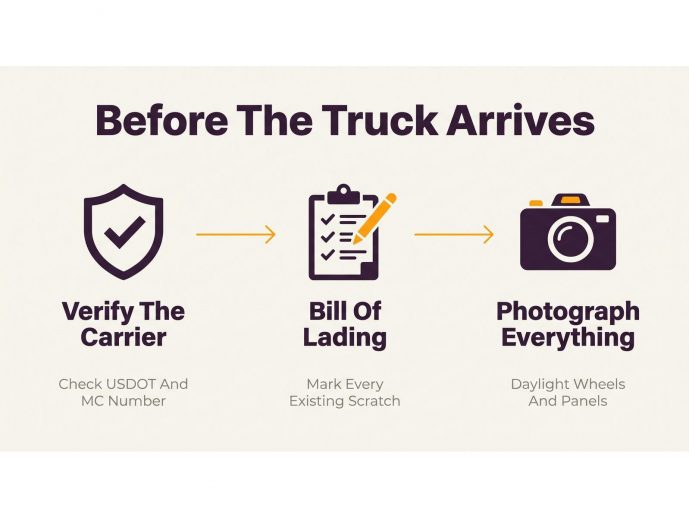
But in reality that document is your entire claim. At pickup the driver walks the car and marks existing damage on it. At delivery you do the same thing before you sign. If a scratch shows up and it wasnt noted at pickup but you noted it at delivery, you have a case. If you signed a clean delivery form and called two days later, you generally dont. Photograph everything yourself at both ends, in daylight, including the wheels and the lower valances.
The other piece is coverage. Every legitimate carrier hauling interstate carries liability and cargo insurance, and cargo limits commonly sit between $100,000 and $250,000 per load — which matters when there are six cars on that trailer. Ask what the cargo limit is and whether the deductible applies per vehicle or per load. And spend two minutes running the carrier's USDOT or MC number through the free federal carrier lookup to confirm the authority is active and see the safety record. It's free, it takes a minute, and it's the single highest value check available to you.
Questions People Ask Before Their First Shipment
How far ahead should I book a luxury car shipment? Two to three weeks is comfortable for enclosed. One week works in dense corridors during a soft season. If you're moving in or out of Florida in October or April, give it a month.
Can I leave belongings in the car? A small amount in the trunk is usually tolerated, but it isn't covered by cargo insurance and it adds weight the driver has to account for. Keep it light or keep it out.
Does my own auto policy cover the car in transit? Usually not while it's on a trailer. The carrier's cargo policy is what's in force. Confirm the limit rather than assuming your own coverage follows the car.
The one thing worth remembering: the driver who ends up with your car cares far more about whether it will load safely than about what badge is on the hood. Give him a clean car, a realistic meeting spot, and a marked up inspection form, and the rest of it tends to take care of itself.
Comments
