Categories more
- Adventures (62)
- Arts / Collectables (14)
- Automotive (77)
- Aviation (68)
- Bath, Body, & Health (127)
- Children (49)
- Cigars / Spirits (72)
- Cuisine (68)
- Design/Architecture (22)
- Electronics (66)
- Entertainment (40)
- Event Planning (116)
- Fashion (47)
- Finance (10)
- Gifts / Misc (7)
- Home Decor (118)
- Jewelry (41)
- Pets (3)
- Philanthropy (1)
- Real Estate (19)
- Services (60)
- Sports / Golf (38)
- Vacation / Travel (101)
- Watches / Pens (72)
- Wines / Vines (34)
- Yachting / Boating (76)



Streamlining Your Next International Vacation



Published
07/07/2026Essential First Steps in International Travel Planning
International travel promises incredible experiences. From exploring ancient cities to relaxing on pristine beaches, venturing abroad is incredibly rewarding. However, planning such a journey can feel overwhelming. Many travelers spend an average of 30 hours organizing their vacations. This involves researching destinations, booking flights, and managing countless other details.
Our goal with this extensive guide is to simplify that process. We understand the complexities of international travel planning in June 2026. We aim to equip you with the knowledge and tools for a stress-free adventure.
Throughout this article, we will cover essential steps. We will discuss everything from securing the right documents and setting a realistic budget to understanding cultural nuances and handling last-minute logistics. By following our comprehensive advice, you can transform your travel dreams into seamless realities.
Embarking on an international adventure begins long before you pack your bags. The initial decisions you make lay the groundwork for a successful and enjoyable trip. These foundational steps involve choosing your destination, determining your travel duration, and assessing any potential risks or requirements.
First, consider what kind of experience you're seeking. Are you dreaming of bustling cityscapes, serene natural landscapes, or a deep dive into historical sites? Your interests will guide your destination choice. Once a potential destination is in mind, it's crucial to consult official government travel advisories. For U.S. citizens, the State Department's website provides up-to-date information on safety and security, local laws, health conditions, and entry requirements for countries worldwide. This initial check helps you understand the current situation and make informed decisions about your travel plans.
Next, think about the length of your trip. While a short city break might be perfect for a nearby European capital, a journey to Asia or Oceania often warrants a longer stay, perhaps 10-15 days, to truly immerse yourself and account for travel time. For regions closer to home, like Central or South America, 4-7 days might suffice. This early decision impacts everything from your budget to the number of activities you can realistically plan.
Finally, we recommend familiarizing yourself with comprehensive planning resources. The official International Travel Checklist from the U.S. Department of State offers a thorough overview of necessary preparations, ensuring you don't overlook critical steps. This checklist is an invaluable tool for both first-time and seasoned international travelers.
Determining the Best Time to Visit and Setting Dates
Choosing the right time to visit your international destination is paramount to your experience. It involves more than just picking dates that fit your schedule; it requires careful consideration of seasonality, weather patterns, and local crowd levels.
Researching the climate for your chosen destination is a crucial first step. Websites like the National Oceanic and Atmospheric Administration (NOAA) or local meteorological services can provide historical weather data, helping you understand typical temperatures, rainfall, and humidity during different months. Avoiding extreme weather, such as monsoon seasons or intense heatwaves, can significantly enhance your comfort and ability to enjoy outdoor activities.
Beyond weather, consider the impact of peak tourist seasons versus the off-season. Traveling during peak times, often coinciding with school holidays or major festivals, can mean higher prices for flights and accommodations, as well as larger crowds at popular attractions. Conversely, the off-season might offer better deals and a more tranquil experience, though some attractions or services might have reduced hours or be unavailable. Crowd calendars, often available through destination-specific tourism boards or travel blogs, can provide insights into expected visitor numbers.
When it comes to booking flights, timing can also impact cost. Industry data suggests that the optimal window for purchasing airline tickets to secure the cheapest prices is anywhere from 70 to 207 days prior to departure. This wide range highlights the importance of starting your search early and monitoring prices. Being flexible with your travel dates, even by a few days, can often lead to substantial savings. For instance, flying mid-week (Tuesday, Wednesday, Thursday) can sometimes be more economical than weekend travel.
Establishing a Realistic Budget for Your Journey
Creating and managing a realistic budget is a cornerstone of successful international travel planning. Without a clear financial roadmap, you risk overspending or, worse, running out of funds mid-trip. Our approach involves comprehensive cost estimation, understanding currency exchange, building a financial cushion, and diligent expense tracking.
Start by breaking down your trip into major cost categories: flights, accommodations, transportation within the destination, food, activities, and travel insurance. Research average prices for each category in your chosen destination. For example, a one-week trip to Japan, for budget travelers, can cost a little under $1,700 USD. This figure can vary wildly based on your travel style, so be honest about your preferences for luxury versus economy.
Understanding currency exchange rates is also vital. As of June 2026, for instance, $1 USD is approximately ¥161.78 JPY. While this gives you a baseline, actual rates can fluctuate, and fees for currency exchange at airports or banks can eat into your budget. We recommend using local ATMs for cash withdrawals, as they often offer better rates than exchange kiosks, especially if your bank waives international ATM fees. Also, inform your bank and credit card companies of your travel plans to avoid account freezes due to suspicious international activity.
We always advise building a financial cushion into your budget, typically an extra 10-15% of your total estimated costs. This buffer accounts for unexpected expenses, emergencies, or simply indulging in an unplanned experience. Overestimating costs slightly can also provide peace of mind.
For managing expenses during your trip, consider using budgeting apps or a simple spreadsheet. Tracking your spending daily helps you stay on track and adjust if necessary. While travel agents charge fees (averaging around $20 for airline tickets and $50 for cruises, or $100-$200 for a full itinerary), they can sometimes save you money through exclusive deals or by finding optimal routes, potentially saving up to $500 on airfare. This can be a worthwhile investment for complex trips.
Securing Essential Travel Documents and Health Preparations
Once your destination and budget are taking shape, the next critical phase involves securing all necessary travel documents and prioritizing your health and safety abroad. This section covers passports, visas, and health-related preparations, which are non-negotiable for smooth international travel.
Navigating Visas and Entry Requirements for International Travel Planning
Understanding visa and entry requirements is a critical step that often varies significantly by destination and your nationality. A visa is an official endorsement placed in your passport, indicating that you are authorized to enter a particular country for a specific purpose (e.g., tourism, business, study) and for a limited period.
Begin by checking the official government website of your destination country well in advance. These sites will provide the most accurate and up-to-date information on visa requirements, application processes, required documents, and processing times. Some countries offer visa-free entry for short tourist stays, while others require you to obtain a visa before departure. Some even have electronic visa (eVisa) systems, simplifying the application process. For example, travelers planning a trip to Malaysia might utilize the Malaysia eVisa international travel planning portal for a streamlined application.
It's also essential to be aware of transit rules. Even if your final destination doesn't require a visa, a layover in a third country might. Always check if you need a transit visa for any intermediate stops.
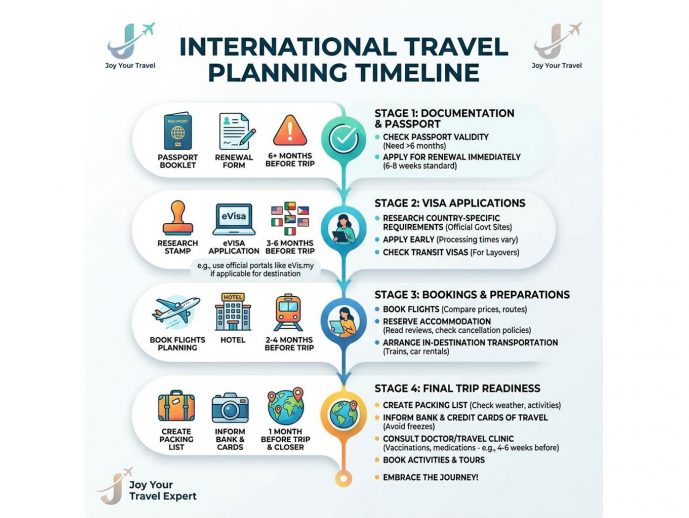
Passport validity is another key consideration. Many countries require your passport to be valid for at least six months beyond your intended departure date from that country. If your passport is nearing this six-month mark, apply for renewal immediately. Normal passport processing can take 6-8 weeks, with expedited services available for an additional fee, typically taking 2-3 weeks. Don't underestimate this timeline, especially if you have upcoming travel plans.
An International Driving Permit (IDP) might also be necessary if you plan to drive abroad. An IDP is a translation of your domestic driver's license and is valid for one year, accepted in over 175 countries. You can obtain one through organizations like AAA or AATA in the U.S.
Here's a quick comparison of these essential documents:
Document Type Purpose Validity How to Obtain Key Considerations The Timeline of International Travel Planning
Health and Safety Protocols Abroad
Your well-being is paramount when traveling internationally. Proactive health and safety preparations are essential to mitigate risks and ensure a smooth journey.
First, consult your doctor or a specialized travel clinic at least 4-6 weeks before your trip to discuss necessary vaccinations. The Centers for Disease Control and Prevention (CDC) website is an excellent resource for country-specific vaccine recommendations and health advisories. Ensure all routine vaccinations are up-to-date, and consider any recommended or required immunizations for your destination, such as Yellow Fever, Typhoid, or Hepatitis. If you take prescription medications, bring an adequate supply in their original, labeled containers, along with a copy of your prescription and a doctor's note, especially for controlled substances. Verify that your medications are legal in your destination country to avoid issues at customs.
Travel medical insurance is a critical, often overlooked, component of international travel planning. While your domestic health insurance (including Medicare and Medicaid) typically does not cover medical care abroad, travel medical insurance can provide coverage for unexpected illnesses, accidents, and emergency medical evacuations. Policies like Atlas Travel, for example, can start from as little as $0.50 per day for travel outside the U.S. (or $0.96 per day for travel including the U.S.), offering peace of mind for potentially costly medical emergencies. We strongly recommend purchasing comprehensive travel insurance that includes medical coverage and emergency evacuation. The U.S. government does not provide insurance or pay medical costs for citizens abroad.
For safety, we advise enrolling in the Smart Traveler Enrollment Program (STEP) offered by the U.S. Department of State. This free service allows U.S. citizens traveling or living abroad to register their trip with the nearest U.S. Embassy or Consulate. STEP provides important alerts and updates about security conditions, natural disasters, or civil unrest in your destination, and helps the Embassy locate you in an emergency. It also facilitates communication with your family and friends back home if necessary.
Beyond official programs, research local emergency numbers, understand common scams in your destination, and share your itinerary and emergency contacts with a trusted person at home. Being prepared for potential health and safety challenges allows you to focus on enjoying your international experience. A comprehensive Trip Readiness Checklist: Check Your Travel Passport Before You Fly can help you identify and address practical preparation gaps before you even book or pack.
Booking Accommodations, Transportation, and Local Logistics
With your documents in order and health preparations underway, the next phase focuses on the practicalities of your journey: where you'll stay, how you'll get around, and how you'll navigate your chosen destination. This involves researching and selecting the right accommodations, understanding local transportation options, and strategically booking flights.
When it comes to accommodations, your options are vast, ranging from hotels and resorts to vacation rentals, hostels, and guesthouses. Consider your budget, travel style, and desired amenities. For a luxurious escape, a full-service resort might be ideal, while budget-conscious travelers might opt for hostels or guesthouses. Vacation rentals can offer more space and a local experience, especially for families or longer stays. We recommend researching various platforms and reading recent reviews to ensure the accommodation meets your expectations. Always book through reputable sites or directly with the property.
Transportation within your destination is equally important. Will you rely on public transit, taxis, ride-sharing apps, or rent a car? Researching local commutes and public transportation networks (buses, trains, subways) can save you money and provide an authentic local experience. For more remote areas or specific itineraries, a rental car might be necessary, but remember to secure an International Driving Permit if required. Understanding the local transportation landscape before you arrive minimizes stress and helps you move efficiently. For more detailed guidance on navigating travel logistics, resources like the Travel Logistics - Office of Education Abroad - UNC Charlotte can offer valuable insights, especially for longer stays or educational travel.
Booking flights is often one of the largest expenses and requires careful timing. As mentioned, purchasing tickets 70 to 207 days in advance often yields the best prices. Utilize flight comparison websites to monitor fares, but consider booking directly with the airline once you've found a suitable option. This can sometimes offer more flexibility or better customer service in case of changes or cancellations. When planning complex itineraries with multiple flights, ensure you have sufficient layover time, especially when changing airlines or airports, to account for potential delays.
Researching Cultural Etiquette and Local Customs
Traveling internationally offers a wonderful opportunity to experience diverse cultures. To ensure a respectful and enriching journey, research and understand the cultural etiquette and local customs of your destination before you depart. This preparation helps you avoid unintentional offense and fosters positive interactions with locals.
Start by familiarizing yourself with basic greetings and common phrases in the local language. Even a simple "hello," "please," and "thank you" can go a long way in showing respect and appreciation. Many apps and online resources can help you learn these essentials.
Research local laws and social norms, as these can differ significantly from your home country. For example, laws regarding alcohol consumption, public displays of affection, or even photography can vary widely. Understanding these helps you navigate situations appropriately and avoid legal troubles.
Tipping customs are another area where cultural differences are prominent. In some countries, tipping is expected and a significant part of service workers' income, while in others, it might be considered rude or unnecessary, with service charges already included. A quick online search for "tipping etiquette in [destination]" will usually provide clear guidance.
Dress codes, particularly when visiting religious sites or conservative areas, should also be researched. Modest attire, covering shoulders and knees, is often required in such places. Even in less formal settings, observing how locals dress can help you blend in and feel more comfortable. For instance, when considering the relaxed yet refined atmosphere of a European river cruise, understanding the appropriate attire for excursions versus onboard dining can enhance your experience, as detailed in various River Cruising Tips.
Finally, be aware of non-verbal communication. Gestures, eye contact, and personal space can carry different meanings across cultures. A little research into these nuances can prevent misunderstandings and facilitate smoother interactions. Embracing these cultural considerations is key to a truly immersive and respectful international travel experience.
Utilizing Professional Expertise for Seamless International Travel Planning
While many travelers enjoy the process of planning their own trips, the complexities of international travel, especially for intricate itineraries or first-time explorers, can often benefit from professional expertise. Travel advisors, with their specialized knowledge and industry connections, can transform a daunting planning process into a seamless experience.
Travel agents are particularly valuable for complex trips involving multiple destinations, intricate logistics, or large groups. They can navigate the nuances of flight connections, visa requirements, and local transportation, ensuring that every detail is meticulously planned. For example, planning an International Virgin Mediterranean planning cruise or an extensive Travel Agent for Europe Vacation with multiple cities and activities can be significantly simplified with expert guidance.
Beyond basic bookings, travel advisors can offer personalized recommendations based on your preferences, budget, and travel style. They often have access to deals and amenities that aren't publicly available, potentially saving you money or providing added value. While travel agents do charge fees, which can average around $20 for airline tickets, $50 for cruises, or between $100 and $200 for a full itinerary, these costs can be offset by the savings they find and the invaluable time they save you. Some travelers report saving up to $500 on airfare with the right travel agent.
Moreover, a professional advisor acts as your advocate if unexpected issues arise during your trip, such as flight cancellations, lost luggage, or medical emergencies. Their ability to quickly rebook, re-route, or resolve problems can be a lifesaver, providing a level of peace of mind that DIY planning often lacks. Services like Concierge Services further extend this support, offering on-demand assistance throughout your journey.
For those seeking a truly bespoke and worry-free international vacation, exploring the services of reputable travel agencies, such as Court Travel Ltd.: Home, can be a wise investment. They handle the intricate details, allowing you to focus on the excitement of your upcoming adventure.
Managing Last-Minute Logistics and Staying Organized
As your departure date approaches, a final checklist of last-minute logistics ensures you're fully prepared and minimizes stress. These crucial steps cover financial notifications, communication plans, efficient packing, and digital organization.
One of the most important financial steps is to notify your bank and credit card companies of your travel dates and destinations. This prevents your cards from being flagged for suspicious activity and frozen while you're abroad. Additionally, inquire about foreign transaction fees and consider using a credit card that waives these charges to save money.
For communication, research international phone plans offered by your current carrier. Many providers offer daily passes or international roaming packages. Alternatively, consider purchasing a local SIM card upon arrival, using an eSIM (electronic SIM), or relying on Wi-Fi for calls and messaging through apps like WhatsApp. Ensure you have a plan for internet access, as this is vital for navigation, communication, and emergencies.
Packing efficiently is an art. Start with a comprehensive packing list well in advance, categorizing items by clothing, toiletries, documents, and electronics. Consider the climate of your destination, the length of your trip, and any planned activities. Roll clothes to save space, utilize packing cubes, and always pack essential medications, a change of clothes, and important documents in your carry-on bag. Don't forget universal power adapters and voltage converters if needed for your electronics.
Finally, ensure all your important documents are organized and accessible. Make digital copies of your passport, visa, flight confirmations, hotel reservations, and travel insurance policy. Store these copies securely in a cloud service (like Google Drive or Dropbox) and email them to yourself and a trusted contact at home. Carrying a physical photocopy of your passport separately from the original is also a good practice. For U.S. citizens, registering with the Smart Traveler Enrollment Program (STEP) is a vital last-minute step, ensuring the embassy has your contact information in case of an emergency.
Digital Tools and Resources for Travelers
In today's interconnected world, a wealth of digital tools and resources can significantly streamline international travel planning and enhance your journey. From itinerary builders to offline maps, these technologies help you stay organized and informed. Travelers, on average, visit 38 different websites when planning a trip, highlighting the need for consolidated resources.
Itinerary builder apps are invaluable for consolidating all your bookings, reservations, and planned activities into one accessible place. Platforms like Free Trip Planner AI: Free & Customizable Travel Itinerary App | Trip-Planner.ai and Poulpigo - Smart and free online travel planner allow you to create custom itineraries, often with AI assistance, that can include flights, accommodations, activities, and even local transportation. Some even offer collaborative features, making group travel planning much easier. These tools can automatically organize your plans by simply forwarding confirmation emails, providing real-time alerts for flight changes, and offering guidance on international requirements.
Offline maps are another essential tool, especially in areas with unreliable internet access or to avoid data roaming charges. Google Maps and Maps.me allow you to download maps of entire regions or cities to use without an internet connection, providing navigation and points of interest.
Translation apps are incredibly helpful for overcoming language barriers. Google Translate, for example, offers real-time voice translation and camera translation for signs and menus. Currency converter apps provide instant exchange rates, helping you manage your budget on the go.
Government websites, such as the U.S. Department of State, remain crucial for official travel advisories, visa information, and emergency services. Additionally, review sites like TripAdvisor or Yelp can help you find highly-rated restaurants and attractions based on other travelers' experiences. By leveraging these digital resources, you can keep all your travel information at your fingertips, stay informed, and navigate your international adventure with confidence.
Frequently Asked Questions
How far in advance should I begin planning an international trip?
We generally recommend starting your international travel planning at least 6-12 months in advance, especially for complex itineraries, peak season travel, or destinations requiring extensive visa processes. This timeline allows ample time for passport renewal (which can take 6-8 weeks normally), visa applications, and securing the best deals on flights and accommodations. As noted, the optimal window for purchasing airline tickets is often 70 to 207 days before departure. For less complicated trips or off-season travel, 3-4 months might suffice, but earlier is always better for peace of mind and potential savings.
What should I do if my passport expires within six months of my trip?
If your passport expires within six months of your planned return date, you should apply for renewal immediately. Many countries enforce the "six-month validity rule," requiring your passport to be valid for at least six months beyond your intended period of stay. If your passport doesn't meet this requirement, you could be denied boarding by the airline or refused entry upon arrival, regardless of whether you have a valid visa. Expedited passport services are available for urgent travel, but they come at an additional cost. Always check the specific entry requirements of your destination country to confirm their passport validity rules.
Is travel insurance absolutely necessary for international travel?
While not always legally mandatory, we strongly advise that travel insurance is absolutely necessary for international travel. Your domestic health insurance, including Medicare and Medicaid, typically does not cover medical emergencies abroad, and the costs for unexpected medical treatment or emergency evacuation can be astronomical. Travel insurance policies can cover these medical expenses, as well as trip cancellations, interruptions, lost luggage, and other unforeseen events. For instance, Atlas Travel policies start at very affordable rates (e.g., $0.50 per day for travel outside the U.S.), offering critical financial protection and peace of mind against a wide range of potential disruptions. The small investment in travel insurance can save you from significant financial hardship and stress during your international adventure.
Conclusion
International travel is an enriching experience, offering memories that last a lifetime. While the planning process can seem extensive, by breaking it down into manageable steps and utilizing the right resources, you can navigate the complexities with confidence. From the initial excitement of choosing a destination and setting a budget to securing essential documents, prioritizing health, and handling last-minute logistics, each stage contributes to a seamless journey.
Remember to leverage digital tools for organization, research cultural nuances for respectful interactions, and consider the invaluable support of travel professionals for complex itineraries. By being proactive and prepared, you transform potential stressors into opportunities for deeper engagement with your adventure. We hope this guide empowers you to embark on your next global exploration with peace of mind and an eagerness to discover.
Ready to turn your travel dreams into reality? Let our experts assist you in crafting the perfect international getaway. Request a personalized quote today and start planning your unforgettable vacation!
Comments
