Categories more
- Adventures (62)
- Arts / Collectables (14)
- Automotive (77)
- Aviation (65)
- Bath, Body, & Health (123)
- Children (6)
- Cigars / Spirits (71)
- Cuisine (66)
- Design/Architecture (22)
- Electronics (63)
- Entertainment (36)
- Event Planning (115)
- Fashion (45)
- Finance (10)
- Gifts / Misc (6)
- Home Decor (118)
- Jewelry (41)
- Pets (3)
- Philanthropy (1)
- Real Estate (16)
- Services (44)
- Sports / Golf (14)
- Vacation / Travel (85)
- Watches / Pens (33)
- Wines / Vines (34)
- Yachting / Boating (67)


The New Modern Heirloom: Why Meaningful Jewelry Outlasts the Trend Cycle

Published
08/25/2026Open a jewelry box that has been kept for twenty years and the most interesting pieces are not always the most expensive ones.
There may be a fine gold chain bought for an important birthday, earrings worn repeatedly on holidays, a bracelet received at graduation or a pendant linked to a relationship, a film or a place.
Their value is personal before it is financial.
This is the territory of the modern heirloom: jewelry chosen not primarily because it is rare enough to be stored away, but because it is meaningful enough to keep.
Luxury Is Becoming More Personal
Traditional ideas of luxury were heavily connected to scarcity, materials and price.
Those factors still matter, particularly in fine jewelry. But they no longer explain every purchase consumers regard as special.
Presentation matters. Design matters. Provenance matters. Above all, the emotional connection between a piece and its owner increasingly matters.
That change has created space for jewelry that sits outside conventional definitions of investment luxury while still delivering a premium experience.
A beautifully presented crystal necklace can become more important to its owner than a technically more valuable item if it marks the right moment.
The object becomes a container for memory.
Why Recognizable Jewelry Has an Advantage
Some pieces begin that process with an existing cultural association.
The blue heart necklace connected with Titanic is a particularly strong example. Its shape and color are recognizable even without explanation, which is unusual in jewelry.
For one wearer, it may represent the film. For another, romance. Someone else may simply be attracted to the contrast between a deep blue crystal and a polished silver-toned setting.
This flexibility helps explain why the “Titanic necklace” has continued to inspire contemporary jewelry rather than remaining a piece of late-1990s movie memorabilia.
The reference is specific, but the symbols behind it are much older: the heart, the color blue, the sea and the idea of an extraordinary jewel.
From Cultural Symbol to Contemporary Jewelry Brand
There is an important difference between a recognizable inspiration and the commercial identity of the jewelry sold today.
Heart of the Ocean® has developed that distinction into a brand.
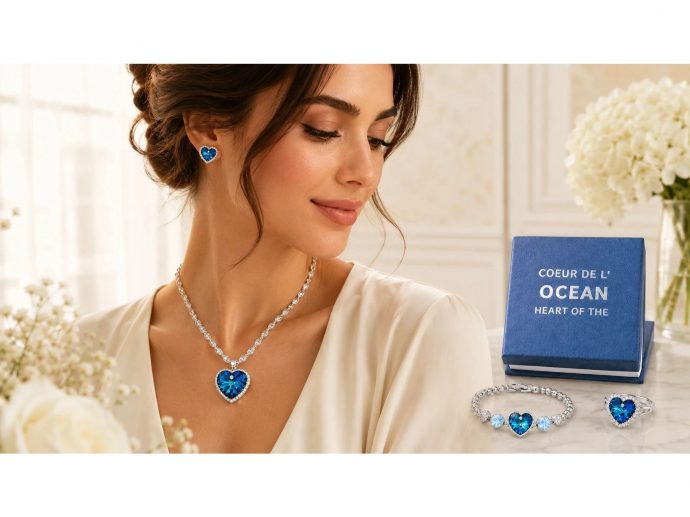
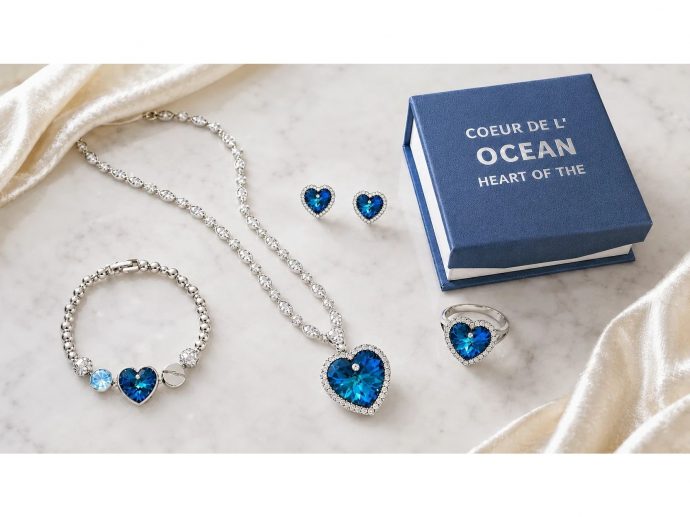
Registered as a jewelry brand in the European Union, Heart of the Ocean® creates an independent collection centred on the familiar blue-heart aesthetic. The wider Heart of the Ocean® jewelry collection extends beyond the necklace to coordinated earrings, a bracelet and a ring.
Rather than positioning the pieces as official movie merchandise, the collection takes the romantic visual language associated with the famous jewel and translates it into contemporary, wearable jewelry.
That distinction matters because modern luxury increasingly depends on knowing the source of what we buy.
A recognizable design may attract attention. A coherent brand gives the buyer somewhere to place trust.
The Importance of Presentation
Jewelry is one of the rare purchases in which the experience begins before the object is actually worn.
The box is opened first.
That moment is particularly important when the piece is a gift. Packaging gives context to the object and signals that the jewelry was intended to be kept rather than treated as a disposable accessory.
For accessible luxury brands, this can be as important as adding another decorative element to the product itself.
A signature box, consistent visual identity and careful product photography help create continuity between what the buyer sees online and what eventually arrives.
Small details accumulate.
They are often what separates a product that feels generic from one that feels considered.
Blue as a Luxury Color
Deep blue has an unusual position in jewelry.
It can feel formal without the severity of black, colorful without being playful and dramatic without relying on oversized proportions.
Historically, intense blue gemstones have also carried associations with rarity, royalty and the night sky. Contemporary crystal jewelry can borrow that visual vocabulary without pretending to possess the material value of a natural sapphire or diamond.
That transparency is important.
Luxury does not require one material to masquerade as another. A well-cut European crystal can be appreciated for the brilliance, color and light effects it actually provides.
When the design is confident enough, the material does not need an invented story.
Why the Heart Shape Continues to Work
Few motifs in jewelry have survived as consistently as the heart.
Part of its durability comes from simplicity. It can be rendered as a tiny outline, a sculptural metal form, a gemstone cut or a large statement pendant and remain immediately understandable.
The challenge is avoiding sentimentality.
Color and proportion make the difference. A substantial blue heart, for instance, feels quite different from a tiny pink charm even though both use the same underlying symbol.
That versatility allows heart jewelry to move between romantic gifting and personal style.
Not every wearer needs another person to give it meaning.
Jewelry That Can Move Between Occasions
The most useful statement jewelry has range.
A distinctive necklace may initially be purchased for an anniversary, Valentine's Day, a wedding or as a gift for someone fascinated by Titanic. But its long-term value depends on what happens afterward.
Can it be worn with an evening dress?
Can it work against a simple black top?
Does it still feel intentional when there is no themed event attached to it?
Jewelry that answers yes has a better chance of entering a regular wardrobe. Repetition then creates attachment.
The item associated with one special occasion slowly accumulates others.
The Modern Heirloom Does Not Need to Wait a Generation
“Heirloom” traditionally suggests something inherited.
The modern interpretation begins earlier.
It is the object we already know we would never casually throw away. The necklace whose box remains in a drawer through several house moves. The ring associated with a trip. The bracelet that appears repeatedly in photographs.
These pieces earn permanence rather than beginning with it.
For brands, this creates a different definition of luxury. Materials and craftsmanship remain essential, but they work alongside identity, presentation and emotion.
A jewel has to be desirable when it is purchased.
The best ones become more valuable to their owners after they have been worn.
And that may be the most enduring form of luxury of all.
Comments
