Categories more
- Adventures (17)
- Arts / Collectables (14)
- Automotive (36)
- Aviation (11)
- Bath, Body, & Health (76)
- Children (6)
- Cigars / Spirits (32)
- Cuisine (16)
- Design/Architecture (22)
- Electronics (13)
- Entertainment (4)
- Event Planning (5)
- Fashion (45)
- Finance (10)
- Gifts / Misc (6)
- Home Decor (45)
- Jewelry (41)
- Pets (3)
- Philanthropy (1)
- Real Estate (16)
- Services (23)
- Sports / Golf (14)
- Vacation / Travel (59)
- Watches / Pens (14)
- Wines / Vines (24)
- Yachting / Boating (17)


The Scandinavian Innovation Quietly Becoming the Most Coveted Feature in the World's Finest Homes

Published
04/30/2026There is a certain category of object that transcends its function entirely. A Patek Philippe does not merely tell the time. A Rolls-Royce does not merely transport its passenger. The finest residential architecture does not merely provide shelter. These things speak a different language, one of intention, craft, restraint, and a quality of thinking about the long term that distinguishes them completely from the merely expensive.
The luxury home lift has entered that conversation. Not loudly, and not by accident. It has arrived through a combination of Scandinavian engineering rigour, a genuine shift in how the world's most discerning homeowners think about the vertical dimension of their residences, and a handful of manufacturers who understood early that this category deserved to be treated with the same seriousness as any other design object placed inside a fine home.
The result is a product that bears almost no relationship to the residential elevator of even a decade ago, and everything to do with how the most considered private homes in Stockholm, London, Dubai, Sydney, and Singapore are being designed and lived in today.
Where the Innovation Was Born
Sweden has always produced objects that demonstrate a particular quality of thinking. The Swedes have a word for it, lagom, a philosophy of sufficiency and precision that resists excess without sacrificing quality, that values what works over what impresses, and that produces, at its finest, things that feel inevitable rather than designed. It is no coincidence that the global benchmark for residential lift technology in the premium segment emerged from this tradition.
Swift Lifts was founded in Stockholm by a team of engineers and entrepreneurs who believed that the residential lift market had fundamentally misunderstood what homeowners at the quality end of the market actually needed. The category was dominated either by commercial systems scaled down for residential use and carrying all the aesthetic baggage that implied, or by accessibility-focused products that prioritised function so completely that they seemed to actively resist integration into a well-designed interior.
What was missing was a product conceived from the beginning as a luxury object. Something that would be designed with the same care as the kitchen it would be adjacent to, the staircase it would complement, and the interior it would inhabit for the next twenty years. That is what Swift set out to build, and the luxury home lift that resulted from that founding ambition has become the reference point for the category globally.
The Engineering That Makes Beauty Possible
The aesthetic achievements of a premium residential lift are only possible because the engineering beneath them is genuinely innovative. Understanding what Swift changed at the technical level explains why the design possibilities are so much broader than they were with the systems that preceded it.
Traditional residential elevator technology imposed structural demands that constrained where a lift could be placed and how it could be integrated. Deep pit excavations beneath the lowest landing. Overhead machine rooms requiring significant ceiling clearance above the highest stop. Three-phase power connections that added electrical infrastructure cost and complexity. Structural loading requirements that limited the positions where a lift could be inserted into an existing building without major intervention.
Swift's proprietary EcoDrive screw-and-nut drive system eliminates these constraints systematically. It requires no pit deeper than 50mm in most configurations. It carries its machine room within the shaft structure itself, requiring no additional overhead clearance. It runs on a standard single-phase 230-volt supply. And it is fully self-supporting structurally, meaning it can be placed in a freestanding configuration within an open-plan space, adjacent to an existing stairwell, or against an external wall with a glazed rear panel, without imposing any load on the surrounding structure that the building's existing framework cannot handle.
The EcoDrive system also recharges its battery dynamically on every descent, meaning that a household making thirty or more vertical journeys per day draws less energy over the course of a month than a standard kitchen refrigerator. For the UHNWI homeowner who has invested in solar generation, battery storage, and the full suite of premium home energy management, this is a system that integrates naturally rather than contradicting the home's energy philosophy.
The SWIFT Pro: A Design Object in Its Own Right
The product that most completely realises Swift's founding ambition is the SWIFT Pro, the flagship residential model that has set the standard for what a luxury home lift can be and how it should look and feel within a premium interior.
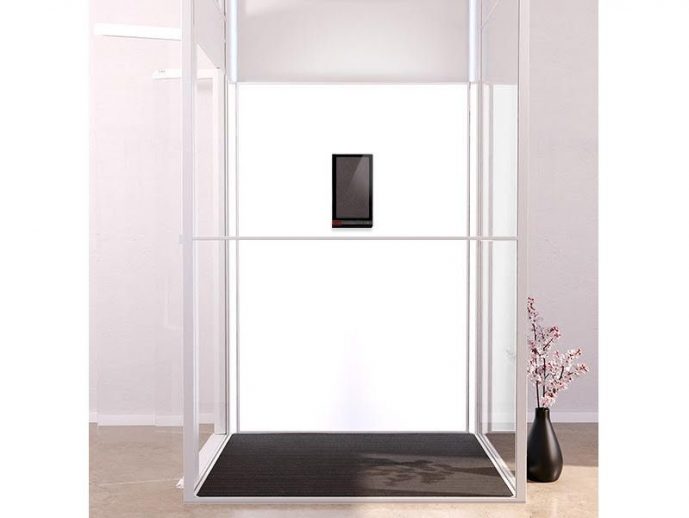
The SWIFT Pro's 15.4-inch dynamic touch display is the most immediately striking element for anyone encountering the product for the first time. It functions as the lift's primary interface while simultaneously serving as a design object, its surface displaying ArtWall content developed in collaboration with Scandinavian design studios and drawing on visual themes ranging from natural landscapes to architectural abstractions. The display's colour temperature and brightness can be adjusted by the user to respond to time of day, season, or simply mood, with the same intuitive control that the finest home automation systems now offer for lighting and climate.
The ArtWall panel system extends that design intent throughout the cabin interior. Each panel is developed as a standalone artwork, with curated imagery, material textures, and lighting interactions designed as a complete aesthetic composition rather than a decorative surface. The cabin flooring options include sustainably sourced carpet collections from Ege, one of Scandinavia's most respected design-driven material houses, with yarns produced from ECONYL recycled nylon derived from ocean plastic. In a market where provenance and sustainability credentials matter as much as aesthetic quality to the most discerning buyers, this is not a peripheral consideration.
Five exterior colour options and six cabin size configurations allow the SWIFT Pro to be specified with the same level of bespoke precision that a fine interior design project demands. The dual safety brakes, Tesla-inspired battery backup that continues to operate through power outages, Thor Engineering control software that responds to user commands twenty percent faster than conventional systems, and child lock and floor access controls complete a technical specification that matches the product's aesthetic ambition at every point.
How the World's Most Considered Interiors Are Using It
The most interesting development in how the premium residential lift is being approached by architects and interior designers at the highest level is the shift from concealment to celebration. The instinct with previous generations of residential lift technology was to find a position where it could be placed without drawing attention to itself, and to finish it in a way that allowed it to recede into the background of the interior.
The SWIFT Pro invites an entirely different approach. Positioned at the visual centre of an entrance hall, it becomes the vertical accent around which the spatial sequence of the home is organised. Set within a glass shaft in an open-plan living space, it animates the full height of the room with light and movement. Specified with an ArtWall panel that references the artwork elsewhere in the home, it becomes part of a coherent design narrative that extends from the ground floor to the uppermost level of the property.
Architects working on premium private residences in the Scandinavian capitals, in the most desirable addresses across London and the Home Counties, in the luxury villa communities of Dubai and Abu Dhabi, and in the hillside estates of Sydney and Melbourne are increasingly treating the residential lift not as an accessory to be specified late in the process but as a primary design element that influences the spatial composition of the home from the concept stage.
The Property Dimension That Matters to Sophisticated Buyers
For the UHNWI buyer evaluating a premium property, the presence of a well-specified residential lift communicates something beyond the feature itself. It communicates a quality of thinking about the property, about its long-term performance, about the comfort of everyone who will inhabit it, and about the relationship between architecture and daily lived experience, that is recognisable immediately to buyers who think about property at that level.
The financial case is correspondingly clear. Properties at the premium end of established markets globally, from Mayfair to Mosman to Djursholm, that include a properly specified luxury residential lift are consistently commanding stronger interest from the most financially capable buyers, attracting faster sales in comparable conditions, and achieving premiums over otherwise equivalent properties that more than justify the cost of installation.
For the homeowner building or renovating to the highest standard, the question is no longer whether the home should include a luxury home lift. It is which one, and how it should be positioned, specified, and integrated to serve the home at its fullest potential.
Comments
