Categories more
- Adventures (62)
- Arts / Collectables (14)
- Automotive (77)
- Aviation (65)
- Bath, Body, & Health (123)
- Children (6)
- Cigars / Spirits (71)
- Cuisine (66)
- Design/Architecture (22)
- Electronics (63)
- Entertainment (36)
- Event Planning (115)
- Fashion (45)
- Finance (10)
- Gifts / Misc (6)
- Home Decor (118)
- Jewelry (41)
- Pets (3)
- Philanthropy (1)
- Real Estate (16)
- Services (44)
- Sports / Golf (14)
- Vacation / Travel (85)
- Watches / Pens (33)
- Wines / Vines (34)
- Yachting / Boating (67)


What Makes a Luxury Nature Resort Different from a Traditional Hotel?

Published
06/15/2026When most people imagine a luxury stay, the image that comes to mind is still a hotel. A grand lobby, a restaurant on the ground floor, a spa somewhere on level two. But a growing number of travelers are discovering that a very different kind of accommodation can offer something a hotel simply cannot. NOA Villas, a luxury villa nature resort in Finland, is a useful example of what that difference actually looks like in practice.
Location Is Not Just a Detail
A traditional hotel sits where guests are convenient to reach: near airports, town centers, or tourist corridors. A nature resort is built around a specific landscape and what that landscape can offer.
In Lapland, that means rivers, forests, open skies, and the kind of silence that is genuinely hard to find elsewhere. When a resort is positioned by a riverbank, deep in the wilderness, the location itself becomes the experience rather than just a backdrop for it.
This is a fundamental shift. You are not staying near nature. You are staying inside it.
Privacy as a Design Principle
Hotels are built for volume. Corridors, shared lifts, dining rooms with fifty tables, a queue at the reception desk. Even high-end hotels operate on the assumption that guests will be around each other for much of the stay.
A nature resort built around private villas works from the opposite assumption. Each unit is its own space. Your terrace, your sauna, your outdoor hot tub. Nobody else's schedule intersects with yours.
For couples, honeymooners, or anyone traveling specifically to disconnect, this kind of structural privacy matters more than most hotel amenities.
What Sets a Nature Retreat Apart
The differences between a nature resort and a traditional hotel show up across several layers of the stay:
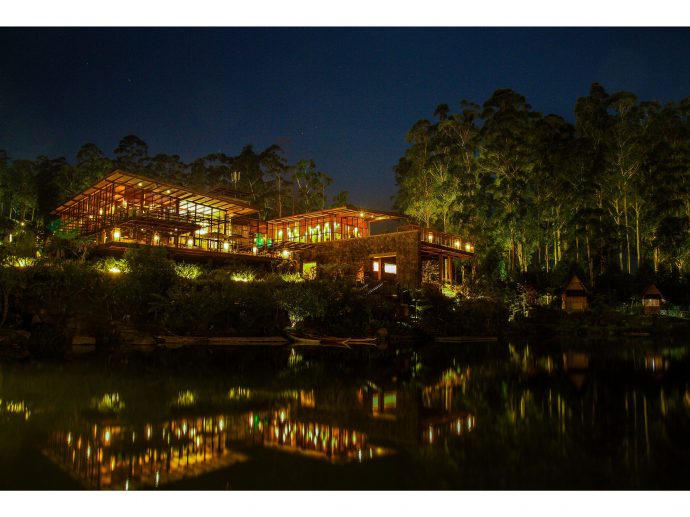
- Architecture: Nature resorts use materials and designs that respond to the landscape. Floor-to-ceiling glass, natural wood, open terraces. The building works with its surroundings rather than against them.
- Wellness: A private sauna in your villa is a different experience than a shared spa on a hotel floor. The Finnish sauna tradition, particularly in Lapland, is about quiet ritual and personal rhythm.
- Activities: Nature resorts often offer experiences connected to the destination, such as snowmobile safaris, husky visits, ice fishing, and aurora viewing opportunities.
- Food: Nordic cuisine in a wilderness setting, sometimes delivered directly to your villa, carries a different quality than a hotel buffet breakfast.
- Pace: There is no check-in crowd, no early-morning noise from neighboring rooms, no pressure to vacate for housekeeping by eleven.
Why a Wilderness Stay Suits Lapland Particularly Well
Lapland is not a destination you travel to for its cities. The draw is the landscape: snow-covered forests, frozen rivers, polar nights, and the Northern Lights. A traditional hotel can give you a comfortable base, but it keeps you at some remove from all of that.
NOA Villas is the kind of accommodation that closes that gap. Staying in a private villa directly on the Kitinen River, with unobstructed views of the sky and no light pollution disturbing the darkness, means that watching the aurora is not a scheduled activity requiring transport. It is something you can do from your own outdoor space, on your own time.
That accessibility changes how a Lapland trip feels. You are not visiting the wilderness. You are living in it for a few days.
Why Choose a Private Nature Retreat in Lapland?
The honest answer is that it depends on what you are looking for. If you need a hub for day trips around a larger region, a traditional hotel in a town center makes practical sense.
But if the goal is immersion, rest, privacy, and a genuine connection to the Arctic environment, a nature retreat offers something that a hotel structurally cannot. The landscape, the silence, the rhythm of the place become part of how you rest and recover.
NOA Villas reflects this approach directly in how it was designed and where it was built. Adults-only, riverside, and oriented entirely around the natural environment of northern Finland.
Lapland rewards travelers who give it proper attention. A stay that keeps you close to the landscape rather than separated from it is usually the one that stays with you longest.
Comments
