Categories more
- Adventures (209)
- Arts / Collectibles (374)
- Automotive (801)
- Aviation (377)
- Bath, Body & Health (1032)
- Children (118)
- Cigars / Spirits (278)
- Cuisine (723)
- Design / Architecture (1118)
- Electronics (230)
- Entertainment (162)
- Event Planning (295)
- Fashion (552)
- Finance (199)
- Gifts / Misc (141)
- Home Decor (575)
- Jewelry (409)
- Pets (92)
- Philanthropy (124)
- Real Estate (393)
- Services (223)
- Sports / Golf (213)
- Vacation / Travel (1054)
- Watches / Pens (233)
- Wines / Vines (862)
- Yachting / Boating (9083)



What Residents Love Most About Waterfront Apartments in Dubai

Published
10/28/2026Ask people who live in luxury waterfront apartments in Dubai what they would miss if they moved inland, and the answers rarely begin with the view. They begin with the light, the walk before breakfast, the fact that dinner happens outdoors for eight months of the year, and the quiet that settles over a marina after the last boat comes in. The view is the thing that sold the apartment. The daily life around it is the thing that keeps people there.
Dubai now has enough mature waterfront communities for clear patterns to emerge in what residents actually value. The findings are consistent, and several of them are not what buyers expect before they move in.
Why Does Living Near Water Feel Different?
The sense of calm residents describe near water has a documented basis. A BlueHealth study published in Health and Place analysed survey responses from nearly 26,000 adults in England and found that proximity to the coast was associated with better mental health, even after accounting for other contributing factors. Researchers measured distances from under one kilometre to more than fifty.
In Dubai the effect is compounded by climate. Sea air moderates temperature at the margins of the day, which is why waterfront terraces stay usable in evenings when inland balconies do not. Residents consistently report that they spend more time outdoors after moving to the water, and that the shift happens without any conscious decision to change habits.
Light behaves differently too. An apartment facing open water receives reflected light across the whole day rather than direct glare for a few hours, which is why waterfront interiors photograph well at almost any hour and why residents describe rooms as feeling larger than their floor area suggests.
What Do Residents Use Most Often?
The amenity residents use most is almost always the promenade, not the pool. A continuous, shaded waterside path turns a building into a neighbourhood, and it is used daily by people who visit the gym twice a week and the pool twice a month.
Beyond that, usage clusters around a predictable set:
- Early morning and late evening walks. The two windows when Dubai is comfortable outdoors for most of the year, and the reason waterfront residents report walking considerably more than they did inland.
- Outdoor dining. Cafes and restaurants at street level are used as an extension of the home rather than as occasional outings.
- Water access. Paddleboarding, swimming, and boat access matter less for frequency than for the feeling that they are available without planning.
- High-level amenity decks. Pools and lounges positioned for the view are used far more than equivalent facilities placed at podium level.
- Wellness facilities. Spa, sauna, and treatment rooms within the building replace trips across the city, which residents cite as the single biggest time saving.
How Does a Waterfront Address Change a Daily Routine?
The most frequently cited benefit is the collapse of travel time to leisure. Inland residents in Dubai typically drive to reach a beach, a promenade, or a waterside restaurant. Waterfront residents take a lift. That change removes the planning friction that quietly prevents people from using the city they moved to, and it is why residents describe their routines as busier and less effortful at the same time.
Evenings change most noticeably. Residents report entertaining at home more often, because the apartment itself becomes the destination. Weekend patterns shift away from malls and toward the water, and families with children describe the promenade as the first place in Dubai their children could use independently.
How Much Does Building Design Affect the Experience?
Design determines whether a waterfront address delivers on its promise or merely overlooks it. The buildings residents rate highest share a few characteristics: deep balconies rather than token ones, living spaces oriented to the water rather than the lift core, shading that makes terraces usable in summer, and amenity levels placed high enough to share the view with every resident. Those choices are made years before handover, which is why anyone comparing luxury waterfront apartments in Dubai should study floor plans and orientation as carefully as the marketing imagery.
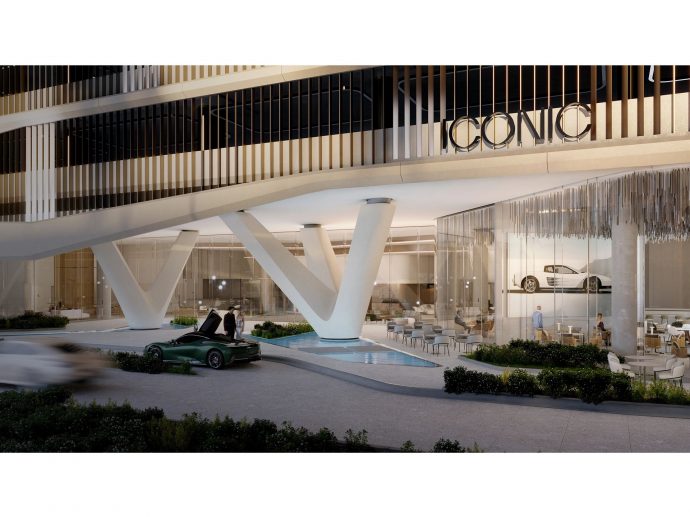
The current generation of towers reflects that lesson. ICONIC Residences by MERED, designed inside and out by Pininfarina and rising 66 storeys in Dubai Internet City, places its sky amenities on the 39th and 40th floors and furnishes residences through the Italian maker Reflex Angelo. The intent is visible in the plan rather than the brochure: the best outlook belongs to the shared spaces, and residents reach it without owning the penthouse.
Is Waterfront Living Practical for Families and Professionals?
Waterfront districts in Dubai have matured past the stage where they served only couples and investors. Schools, clinics, supermarkets, and nurseries now sit within the larger waterside communities, which has changed the resident profile considerably over the past decade.
Professionals weigh the commute carefully, and this is where location within the waterfront matters more than the waterfront itself. Districts positioned along the main arterial corridors keep the business districts within a manageable drive, while more isolated waterside enclaves trade convenience for seclusion. Residents who report the highest satisfaction tend to be those who chose a waterfront address that did not require them to sacrifice proximity to work.
The honest caveats are few but worth stating. Salt air is harder on cars, outdoor furniture, and exposed metal. Popular promenades attract visitors at weekends. Service charges are higher than inland equivalents. Residents who have moved inland and back again generally describe these as acceptable trade-offs rather than surprises.
Why So Few Residents Move Back Inland
The pattern that emerges across Dubai waterfront communities is a low rate of return to inland living. People who move to the water tend to move within it, trading up in size or shifting between marinas, rather than leaving the water entirely. That behaviour says more about the experience than any amenity list can.
For anyone weighing luxury waterfront apartments in Dubai, the practical advice from residents is consistent. Visit at the hours that matter, early morning and after sunset, rather than midday. Walk the promenade before viewing the apartment. Check which direction the living space faces and how deep the balcony runs. The view is what gets bought, but the life around it is what gets lived.