Categories more
- Adventures (62)
- Arts / Collectables (14)
- Automotive (77)
- Aviation (65)
- Bath, Body, & Health (123)
- Children (6)
- Cigars / Spirits (71)
- Cuisine (66)
- Design/Architecture (22)
- Electronics (63)
- Entertainment (36)
- Event Planning (115)
- Fashion (45)
- Finance (10)
- Gifts / Misc (6)
- Home Decor (118)
- Jewelry (41)
- Pets (3)
- Philanthropy (1)
- Real Estate (16)
- Services (44)
- Sports / Golf (14)
- Vacation / Travel (85)
- Watches / Pens (33)
- Wines / Vines (34)
- Yachting / Boating (67)


When to Call for Emergency HVAC Repairs

Published
08/18/2026The summer heat in Salt Lake City can be intense, and few things are more frustrating than your AC fan running outside but no cold air coming inside. When your central air conditioner struggles to cool your home, it's not just uncomfortable—it can impact your family's well-being. We understand the urgency of a malfunctioning AC system, especially during the peak of August 2026. This common issue often signals a deeper problem that needs attention. We'll explore the main reasons why your AC might be running without cooling your home effectively.
To learn more about optimizing your home comfort, explore Our Comprehensive HVAC Guide, or if you need immediate assistance, Contact Us Today for a Consultation.
While some issues might be simple fixes, others can point to critical system failures that require immediate attention. Knowing when to act can save you from prolonged discomfort and potentially more expensive repairs down the line. In this guide, we will walk you through common diagnostics, from airflow restrictions and refrigerant levels to critical signs like system tonnage mismatches and compressor failures. We’ll help you understand when a quick check is enough and when it’s time to call for professional help, especially when facing potential emergency repairs in the intense Salt Lake City climate.
When your AC unit’s outdoor fan is diligently spinning, but the air inside your Salt Lake City home feels anything but cool, it's a clear indicator that something is amiss. We often encounter homeowners who are perplexed by this situation, wondering why their system seems to be working but failing to deliver its primary function. Diagnosing the root cause involves understanding a few key components and their operational characteristics.
One of the first things we consider is the temperature of the insulated copper suction line at the outdoor unit. This line should feel distinctly cold to the touch, indicating that refrigerant is properly absorbing heat from your indoor air. If it's merely cool, or worse, warm, it suggests an issue with the refrigerant cycle or heat exchange. Another crucial diagnostic is measuring the temperature difference, or "delta T," between the return air entering your AC system and the supply air exiting the vents. For proper cooling, this temperature drop should ideally be between 15°F and 22°F. A significantly smaller drop points to inefficient cooling, while a drop exceeding 22°F can signal restricted airflow.
Let's delve into some of the most common culprits behind an AC that's running but not cooling.
Airflow Restrictions and Evaporator Coil Contamination
Airflow is paramount for your AC system's efficiency. Without adequate air movement, the system cannot effectively transfer heat, leading to poor cooling and potential damage. One of the simplest yet most overlooked issues is a dirty air filter. A clogged filter restricts the volume of air reaching the evaporator coil, forcing your system to work harder and reducing its cooling capacity. We recommend checking and replacing your air filter every one to three months, especially during peak cooling seasons in Salt Lake City.
Beyond the filter, ductwork can also be a significant source of airflow problems. Undersized ducts, especially in older homes or after system upgrades, can create excessive static pressure, impeding air circulation. Flexible return ducts, common in many homes, can also collapse or become kinked over time, severely limiting the amount of air drawn into the system. When airflow is compromised, the evaporator coil, located inside your home, can become excessively cold. This leads to a buildup of frost and ice, further blocking airflow and preventing heat absorption.
A dirty evaporator coil itself is another major contributor to poor cooling. Over time, dust, dirt, and mold can accumulate on the coil's fins, creating an insulating layer that prevents the coil from absorbing heat from the indoor air. Even if your outdoor fan is running, a contaminated evaporator coil means the heat exchange process is severely hampered, resulting in warm or only slightly cool air blowing from your vents. Regular professional cleaning of the evaporator coil is essential for maintaining optimal system performance and indoor air quality.
Low Refrigerant Levels and Evaporator Freezing
Refrigerant is the lifeblood of your AC system, responsible for absorbing heat from your home and releasing it outside. When the refrigerant level is low, the system cannot effectively complete this heat transfer cycle. A common symptom of low refrigerant is the evaporator coil becoming excessively cold, often leading to it freezing over. This isn't because the AC is working too well; rather, it’s due to a lack of sufficient heat absorption to warm the refrigerant as it passes through the coil. When the coil freezes, it acts as an insulator, preventing any further heat transfer and severely reducing your system's ability to cool.
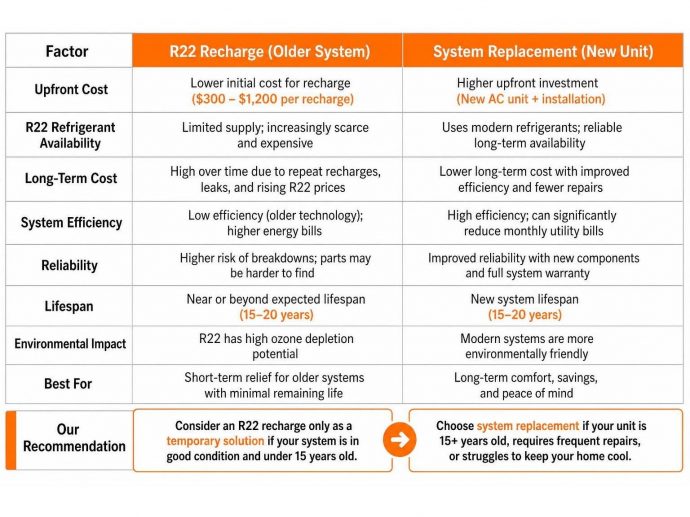
How can you tell if your AC has a refrigerant leak or is simply low on charge? Beyond the visible ice on lines or the evaporator coil, a common indicator is that only the bottom half of the evaporator coil might feel cool, as there isn't enough refrigerant to cool the entire surface. You might also notice a hissing or bubbling sound, which can indicate a leak. For older units, particularly those manufactured before 2010, the refrigerant used was likely R22. This refrigerant has been phased out due to environmental concerns, making it increasingly rare and expensive to recharge. If your 22-year-old unit, for example, is low on R22, a simple recharge might offer a temporary fix, but it doesn't address the underlying leak. We often advise homeowners in Salt Lake City that repeatedly recharging an R22 system is rarely a cost-effective long-term solution, as the leak will likely worsen, and the refrigerant itself is costly and difficult to obtain in August 2026. A professional technician can take pressure readings to accurately diagnose a low charge or leak.
Critical Signs You Need Emergency HVAC Repairs
While some AC issues can be addressed with routine maintenance or minor adjustments, others signal a more severe problem that requires immediate professional attention. Ignoring these critical signs can lead to further damage, more expensive repairs, or even a complete system breakdown, leaving you without cooling during Salt Lake City's hottest days. Understanding these warning signs can help you decide when it's time to call in the experts.
Identifying When Airflow and Coil Freezing Require Emergency HVAC Repairs
We've discussed how airflow restrictions and low refrigerant can lead to evaporator coil freezing. However, when this icing becomes severe or persistent, it moves from a diagnostic symptom to an emergency. If you observe thick layers of ice on your outdoor refrigerant lines, the indoor evaporator coil, or even your drain pan, it's a critical situation. This ice buildup severely obstructs airflow, preventing your system from cooling your home and putting immense strain on the compressor, which is the heart of your AC unit. Continued operation with a severely iced coil can lead to compressor failure, a very costly repair.
Insufficient airflow, often stemming from undersized ductwork or collapsed flexible return ducts, is a primary cause of AC icing and reduced cooling. For proper operation, the supply air temperature needs to be 15–22°F below the return air temperature. If your system consistently fails to achieve this, or if you notice significantly reduced airflow from your supply vents, it could be a sign of a major blockage or ductwork issue. For instance, a 2-ton AC system typically requires around 800 cubic feet per minute (CFM) of airflow, while a 3.5-ton system needs about 1400 CFM. If your ductwork cannot support these capacities, your system will struggle, potentially leading to icing and poor performance. When these issues are severe and persistent, or if your system completely stops cooling, it's time to consider getting professional help for potential emergency repairs to restore your comfort and prevent further damage.
Why Compressor Failure Demands Emergency HVAC Repairs
The compressor is arguably the most vital component of your AC system. It's responsible for circulating refrigerant and pressurizing it, making the heat exchange process possible. If your outdoor unit fan is running but the compressor isn't engaging, it’s a strong indication of a serious problem. You might hear the fan running but not the distinct hum or vibration of the compressor, or you might notice that the air coming from the vents is simply room temperature, not even slightly cool.
Several issues can lead to compressor failure or prevent it from starting. A common culprit is a faulty start capacitor. This component provides the initial electrical boost needed to get the compressor motor running. If the capacitor fails, the compressor won't start, even if it's otherwise healthy. Another issue can be a malfunctioning contactor switch, which acts as a relay, sending power to the compressor and outdoor fan. Over time, the contacts can pit or burn, preventing proper electrical connection.
An electrical overload, often caused by persistent issues like dirty coils, restricted airflow, or low refrigerant, can also lead to compressor failure. When the compressor works too hard, it draws excessive current, which can damage its internal windings. While a faulty capacitor or contactor might be a relatively straightforward fix, an actual compressor failure often necessitates a complete replacement of the outdoor unit or even the entire system, depending on its age and condition. Given the Salt Lake City heat, a non-functional compressor during summer is a definite emergency, as it renders your AC system completely ineffective.
Evaluating Repair Costs Versus System Replacement
Deciding whether to repair a malfunctioning AC system or replace it entirely is a common dilemma for homeowners, especially when facing significant issues like those we’ve discussed. This decision becomes even more complex when dealing with older units, particularly those still running on R22 refrigerant. Our goal is to help you make an informed choice that balances immediate comfort with long-term financial wisdom and energy efficiency.
Aging Equipment; Replacement Cost; System Efficiency
The age of your AC unit is a primary factor in the repair-versus-replace equation. Most central AC systems have an average lifespan of 15 to 20 years. If your unit is approaching or has exceeded this age, especially if it's a 22-year-old system, we often lean towards recommending replacement over costly repairs. For example, a service call for an R22 refrigerant issue on an older unit could range significantly, with no guarantee of a permanent fix for the underlying leak. Given the expense and scarcity of R22 refrigerant in August 2026, repeatedly recharging an old unit becomes economically unsound.
Modern AC systems are significantly more energy-efficient than units from two decades ago. Replacing an old, inefficient system with a new, high-efficiency model can lead to substantial savings on your monthly utility bills, often offsetting a portion of the replacement cost over time. We encourage homeowners to consider the total cost of ownership, which includes not only repair expenses but also ongoing energy consumption. A new AC replacement unit installation typically represents a significant investment, but it comes with a fresh warranty, improved reliability, and enhanced cooling performance for your Salt Lake City home.
Tonnage Mismatch and Ductwork Limitations
One of the more insidious problems we encounter, often leading to persistent cooling issues and premature system failure, is a tonnage mismatch between the indoor evaporator coil and the outdoor condenser. We've seen instances where a homeowner replaced a dead 2-ton outdoor unit with a more powerful 3.5-ton condenser, but the technician left the old 2-ton evaporator coil in the attic. This mismatch causes severe problems: the larger condenser overpowers the smaller coil, leading to freezing lines, reduced airflow, and inadequate cooling, despite the outdoor unit running continuously.
The evaporator coil and condenser must be appropriately matched in tonnage for the system to operate efficiently and effectively. Replacing a mismatched evaporator coil to correct such an issue can be a substantial project, but it’s crucial for proper system function. Furthermore, when upgrading to a higher tonnage condenser, it's imperative to verify that your existing ductwork can handle the increased airflow. As mentioned earlier, a 3.5-ton system requires approximately 1400 CFM of airflow. If your ductwork was designed for a smaller 2-ton unit (requiring around 800 CFM), it will be unable to accommodate the higher volume, leading to restricted airflow, increased static pressure, and potentially, system icing and poor cooling. We always emphasize the importance of a comprehensive system evaluation, including ductwork assessment, when considering any AC component replacement or upgrade.
Frequently Asked Questions
We understand that a malfunctioning AC system can be confusing and frustrating. Here are some of the most common questions we receive from homeowners in Salt Lake City when their AC fan is running outside but no cold air is coming inside.
Why is my outdoor AC fan running while warm air blows inside?
This is a classic symptom of a central AC system that's failing to complete the heat exchange process. The outdoor fan's job is to dissipate heat absorbed from your home. If it's running but the air inside is warm, it often points to a problem with the refrigerant cycle or the indoor evaporator coil. Common causes include low refrigerant levels (due to a leak), a dirty or frozen evaporator coil, a malfunctioning compressor, or issues with the indoor fan (blower) not circulating air effectively across the coil. The system is trying to work, but a critical component is preventing it from producing cold air.
What causes iced AC lines during Salt Lake City summer heat?
Iced AC lines, whether on the outdoor unit's suction line or the indoor evaporator coil, are a clear sign of trouble. Paradoxically, this usually happens when the system isn't working efficiently, not when it's over-cooling. The primary culprits are low refrigerant charge (which causes the coil to get too cold without enough heat to absorb) and severely restricted airflow. When airflow is blocked—by a dirty air filter, a clogged evaporator coil, or collapsed ductwork—the coil gets excessively cold because warm air isn't passing over it quickly enough. This cold causes condensation to freeze, leading to ice buildup. Operating your AC in cooling mode when outdoor temperatures are below 72°F can also cause icing, as the system isn't designed to handle such low heat loads.
Is recharging an older R22 AC unit cost-effective in 2026?
In August 2026, recharging an older R22 AC unit is generally not considered cost-effective for most homeowners. R22 refrigerant has been phased out due to environmental regulations, making it increasingly scarce and expensive. If your unit is low on R22, it means there's a leak, and a recharge is only a temporary solution. The leak will persist and likely worsen, requiring further costly recharges. For units that are 15-20 years old or more, the cost of repeatedly adding expensive R22, coupled with the unit's declining efficiency and the potential for other components to fail, often makes replacement with a new, energy-efficient system a more financially sound decision in the long run. A new system will use modern, environmentally friendly refrigerants and come with a fresh warranty, providing better peace of mind and lower operating costs.
Conclusion
When your AC fan is running outside but no cold air is coming inside your Salt Lake City home, it's more than just an inconvenience—it's a signal that your system needs attention. From simple fixes like replacing a dirty air filter to complex issues like refrigerant leaks, mismatched components, or compressor failure, understanding the potential causes is the first step toward restoring your home's comfort. We’ve explored how critical issues like severe icing due to airflow restrictions or a non-engaging compressor demand immediate professional intervention to prevent further damage and ensure your family's well-being during the intense summer heat.
The decision to repair or replace often hinges on the age of your system, the severity of the problem, and the long-term cost implications. For older units, especially those using phased-out R22 refrigerant, replacement often proves to be the most economical and energy-efficient choice in the long run. We always advocate for preventative maintenance, including regular professional inspections and cleanings, to catch potential issues early and extend the life of your AC system. When in doubt, or when facing any of the critical signs discussed, don't hesitate to reach out to a qualified HVAC professional. Their expertise can accurately diagnose the problem, provide effective solutions, and ensure your cooling efficiency and system longevity, keeping your Salt Lake City home comfortable for years to come.
Comments
